
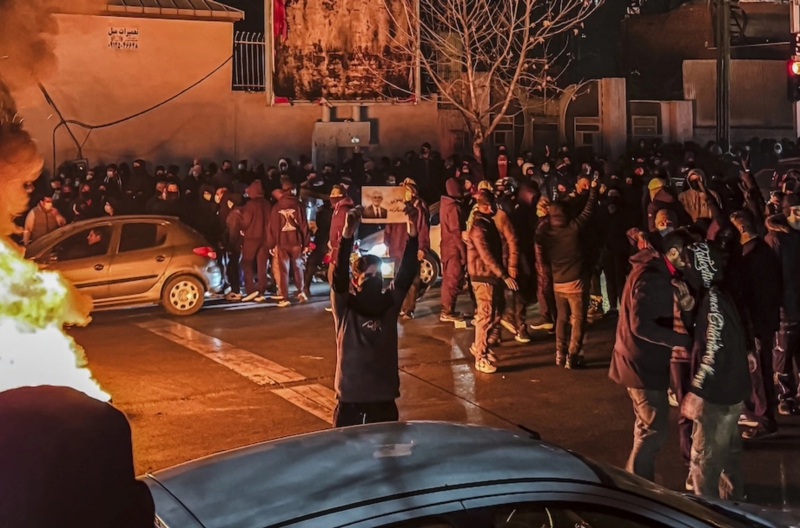
Protesters in Tehran, Jan. 9, 2026. Photo: MAHSA / Middle East Images / AFP / Getty Images
The end of the ayatollahs' rule or a temporary crisis?
Starting from late December, Iran has been engulfed in yet another wave of mass protests. The previous one, in 2022-2023, lasted about six months, but it in turn had been preceded by protests every year from 2017 onwards — and before that, there was the “Green Movement” of 2010-11, which itself followed the protests of June-July 2009. Just business as usual, then? Not necessarily. Many observers in Europe and North America have pointed to the scale of the current wave (reportedly the largest since 2009) and concluded that this is likely to be the beginning of the end for the Islamic Republic. Are they right?
This wave of protests indeed differs from previous iterations in several respects.
First, it started with disaffected bazaar traders, traditionally close to the clergy, staging their largest ever demonstrations over concerns about the rapidly worsening rial-dollar exchange rate. But their protests were rapidly overshadowed as other disgruntled demographic groups joined in.
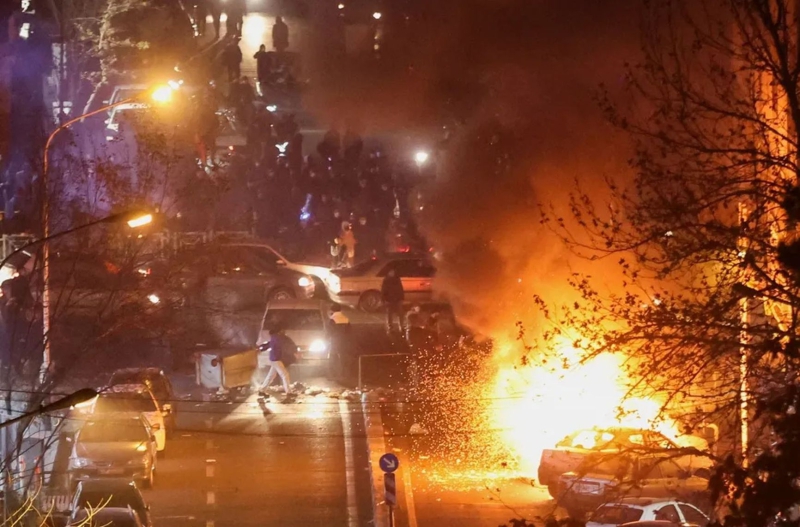
Second, after Donald Trump’s Jan. 2 statement, in which he threatened to retaliate if protesters were killed, some of the demonstrators turned to violence themselves, attacking government installations such as police stations, Basij offices, and hospitals. This is something that did not occur in previous protests. Were the rioters trying to provoke a violent reprisal with the aim of getting the Americans involved directly? If so, this would suggest that although on the whole the protest movement remains fragmented, there is an organised component to it.
Third, for the first time, the protests occurred in a context of an impending external threat against the Islamic Republic, with Israeli Prime Minister Benjamin Netanyahu openly advocating the resumption of the war against Iran and with Trump repeatedly evoking the possibility of new strikes. Thus, for the first time since 1981-83 — when Saddam Hussein and some Iranian opposition groups were cooperating — external and internal threats to the Islamic Republic came to be synchronised. Clearly, both the external enemies and the internal opposition sense that the Islamic Republic is weak and vulnerable. The reintroduction of European sanctions in October has impacted the economy, compounding the psychological effects of the fall of Assad in Syria in December 2024, of the beating taken by Hezbollah in Lebanon in September 2024, and of the initially dismal performance of the Iranian armed forces in the June 2025 war.
External interference and the regime's response
With the civilian victims of the riots now numbering in the hundreds — or even thousands — Trump is reportedly considering options for a military intervention, even if, for now, he seems to have only decided to slap additional sanctions on Iran. If he decided to intervene, in all likelihood Trump would not commit ground troops, instead opting for an air campaign against military and political targets, presumably with the intent of demoralising the Iranian armed forces and paving the way for the collapse of the regime. A campaign against civilian infrastructure, while potentially very effective in undermining the regime, would be at odds with the claimed intent of punishing the regime for its violent repression.
If he decided to intervene, in all likelihood Trump would not commit ground troops, instead opting for an air campaign.
In practice, the approximately 50,000 members of the police, Basij, and Revolutionary Guards who are directly engaged in the repression would be hard to target. Decapitation attacks will be much more difficult to implement after the regime has taken precautions to make its top officials much harder to track than they proved to be in June 2025. Killing the Supreme Leader would also be hard, as he mostly lives in various bunkers deep underground. Striking major military installations will have a psychological impact on the regime, but it is not clear whether this will weaken its resolve or strengthen it. If the Iranians retaliate against U.S. bases in the region, and/or against Israel, and/or block the Strait of Hormuz, the Americans will be dragged deeper in and will have to further escalate. Within the regime, there is hope that Trump, preferring not to risk getting entangled in the type of major war that his electoral base might not tolerate, will refrain from actually intervening.
The Iranians have indeed threatened retaliation, and sources within the Revolutionary Guards confirm that at the top of the regime there is a belief that an American attack might stem the tide of the demonstrations, not least by mobilising patriotic feelings. Hence, the Islamic Republic does not intend to bow to Trump’s threats.
Israel would likely join any American attack, as Netanyahu would want to be in a position to use a successful operation against Iran in advance of the parliamentary elections scheduled for October of this year. Israel’s help would not be needed in terms of striking power, but Israel can share its high-quality intelligence about Iran and offer the services of its agents and collaborators inside the country.
What are the prospects for the protests?
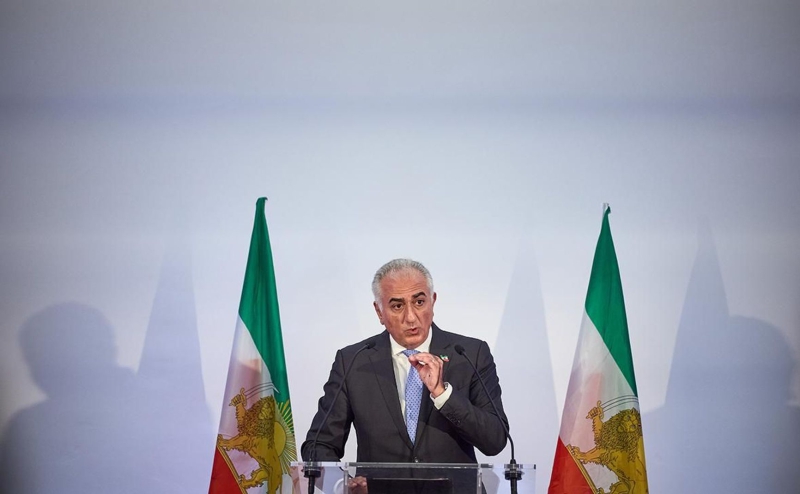
So far, the regime does not appear to be as shaken by the demonstrations as it was in 2022-23 cycle, when the morale of the security forces was seriously affected. All sources within the government appear confident that the stability of the regime is not threatened by the protests and that the security forces are not at risk of cracking. The relatively organised component of the protests, estimated by an officer of the Revolutionary Guards at 20% of the movement, is largely composed of the followers of Reza Pahlavi. This, together with the fact that a substantial portion of the protesters turned into rioters, contributed to making it easier for the security forces to resort to violence — in contrast to 2022-23, when many had doubts.
That said, much depends on how long the protesters can keep coming out. If they were to last more than a few weeks, the energy and morale of the security agencies would likely be sapped. The special forces of the Revolutionary Guards have deployed teams with the task of identifying and targeting the movement’s core activists, and according to a source in the Revolutionary Guards, a few thousand have been detained already. The regime hopes that day after day the growing number of detentions will weaken the ability of the hard-core protesters to sustain the effort, but it is hard to say whether they are right.
Iranian politicians have so far mostly kept quiet, probably realising that talking of reform at this point would be, in a word, pointless. But even if the protests were to eventually fizzle out, the critical state of the Iranian economy is guaranteed to invite more trouble in the future. The 2025-26 protests might well go down in history as yet another episode in a long chain of mass demonstrations, but even if they prove not to strike the fatal blow to the regime, the legitimacy of the authorities continues to erode. The end of the protests would also force even more of the regime’s supporters to question the future of the system, meaning that the most critical time for the Islamic Republic might well be when the protests end.
The Revolutionary Guards say that they have seized many opposition safe houses where weapons and ammunition were stored, and they imply that Israel had a hand in procuring weapons in an effort to escalate the protests into an open revolt. There is no way for now of verifying this, but it is not implausible given that the Israelis are certainly opponents of the Islamic Republic and have a considerable capacity to operate inside Iran. Still, it is difficult to see how the protesters can overcome the regime as long as the armed forces remain cohesive.
It is difficult to see how the protesters can overcome the regime as long as the armed forces remain cohesive.
The Baluchi and Kurdish minorities have joined the protests, and among the Kurdish protesters in particular are numerous armed fighters, but neither minority want a Pahlavi to come back to power. The Revolutionary Guards and the Basij are unlikely to completely wither away even if the Islamic Republic were to collapse.
Perhaps the greatest danger for the supporters of the Islamic Republic would be the disintegration of the army, which has never been as loyal to the regime as the Revolutionary Guards are. After the crisis of 2022-23, however, the regime has taken precautionary measures to counter risks emanating from the army’s ranks. It is not by accident that the army has not been mobilised against the protesters.
Perhaps only an extensive air campaign, smashing up Iranian military and civilian infrastructure alike, could create the conditions for the implosion of the regime. But even that would likely result in chaos, rather than in a takeover by Pahlavi’s supporters.