
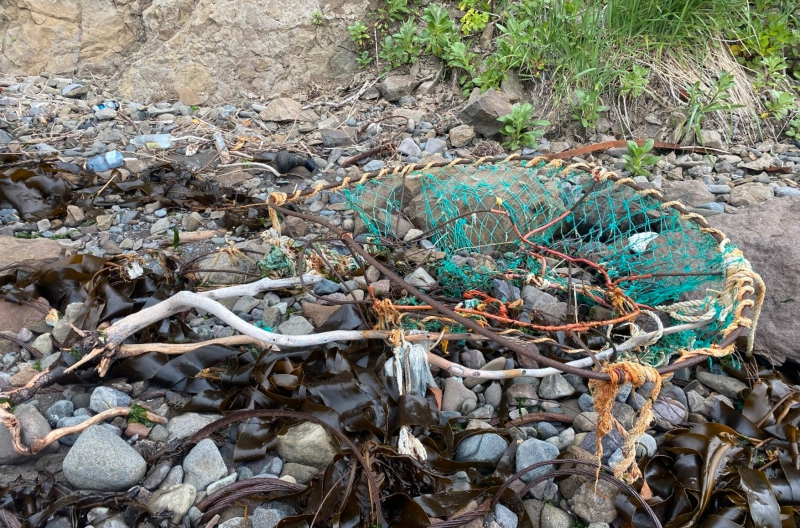
Kamchatka is a land of legendary salmon abundance, yet it faces a range of environmental and economic problems. Locals often cannot afford to eat the local catch, while fishing itself has turned into a semi-legal, highly corrupt business. The industry is dominated by large plants affiliated with high-ranking officials — in particular, Senator Boris Nevzorov. By bribing fisheries inspectors, these enterprises block spawning routes, leaving many of Kamchatka’s rivers short on stocks. A correspondent for The Insider traveled 900 kilometers across the peninsula and found that the local population, largely stripped of the right to fish legally, is poaching on a massive scale.
In Petropavlovsk-Kamchatsky, Fisherman’s Day is celebrated with elaborate fanfare every year on the second Sunday of July. That day, at the entrance to the central square, there are the usual metal detectors and drunk people, and near the waterfront stand numerous tents with souvenirs: T-shirts professing love for the region, Kamchatka nesting dolls, shawls, honey. The food stalls mostly sell burgers and hot dogs. A cutout photo board stands in the photo zone — stick your head through it, and you are a fisherman with a rod and an enviable catch.
But real fish, not the painted kind, is much harder to find. It is sold at four stalls set off to the side. There is very little Kamchatka fish, just a few items at high prices. The rest is brought in from the mainland: Astrakhan fish, Baltic fish, canned mackerel and herring. In a fishing region, at a fishing festival, there is virtually no local fish.
Nor is there any in the only fish store in another large settlement on the peninsula — Ust-Kamchatsk. The shop stands on the outskirts, where several fish-processing plants are located. The saleswoman says that only fish from Petropavlovsk are on sale. Asked why there is no local fish, she silently shrugs.
In local stores, it is generally difficult to find Kamchatka fish at all. They are available on the black market, but at prices so high that local residents cannot afford it. Most of the fish caught in the region goes to the mainland and to other countries. As is the case with many of the region’s problems, from environmental pollution to economic stagnation, the locals blame Moscow.
“This year and last year the fishing was poor. The Ust-Kamchatsk fish plants blocked everything off with seine nets — all the fish goes to them. And they send all the products to Moscow…” complains a fisherman from the village of Milkovo, casting for char.
Yet there was a time when there was enough fish here for everyone, because natural features provided Kamchatka with an abundant food base. “There are active volcanoes here, and ash is a natural fertilizer. As a result, the bioproductivity of the coastline is extremely high,” explains a local historian and writer, a former fisheries inspector who is leading a tour of the fish museum near the town of Yelizovo, the peninsula’s second-largest city after Petropavlovsk-Kamchatsky.
On an interactive map of Kamchatka from the mid-1950s, numerous lights glow. “These are settlements and fish plants — there were schools, hospitals, houses of culture. In short, these were living communities. In this part, in two districts, Bolsheretsky and Sobolevsky, 100,000 people lived. So what happened next?” the guide asks rhetorically before continuing the story of the “driftnet catastrophe.” In the 1950s, Japanese vessels set out large numbers of driftnets off Kamchatka’s western coast — “nets of death.”
Char is a white fish that is very fatty.
A fishing method that uses underwater nets which drift freely after being set. This practice is banned in Russia on the marine migration routes used by anadromous fish heading to their spawning grounds.
Nevzorov continues to hold this post. He is under personal international sanctions imposed by all EU countries, the United Kingdom, the United States, Canada, Switzerland, Australia, Ukraine, and New Zealand over his support for Russia’s aggression against Ukraine.
Fixed seines are stationary net traps used in coastal fishing, installed along the path of migrating fish.
Fish glazing is the application of a thin ice coating to frozen fish to protect them from drying out while preserving the taste, texture, and nutritional properties during storage and transportation. The process involves immersing the fish in cold water (1–2°C) or spraying them with water, after which the fish is quickly frozen so that the ice forms a protective shell that should not separate from the surface.
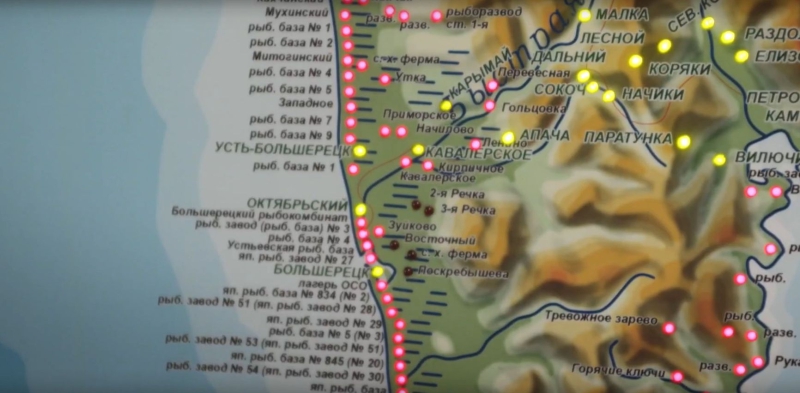
In 1945, the Japanese were barred from fishing in Soviet territorial waters extending 12 miles from the coast. But they continued to harvest fish in nearby seas, taking advantage of the absence of competition from the USSR, which lacked an ocean-going fishing fleet in the Far East. Japan ramped up its catch particularly sharply in 1952, when the United States and Canada significantly restricted its right to fish off of American shores.
In 1955, in addition to salmon fishing in the ocean, the Japanese sent two flotillas into the Sea of Okhotsk, to the western coast of Kamchatka. Each Japanese drifter set 300–350 nets every day. In total, more than 100,000 nets were deployed along the current, against the movement of salmon born in Kamchatka’s rivers and heading back to spawn. A salmon war nearly broke out, with Soviet naval forces preparing to launch an operation against the Japanese. But Nikita Khrushchev intervened, and a day before the planned attack a convention was signed conceding Japan the right to harvest Far Eastern salmon along their migration routes.
Char is a white fish that is very fatty.
A fishing method that uses underwater nets which drift freely after being set. This practice is banned in Russia on the marine migration routes used by anadromous fish heading to their spawning grounds.
Nevzorov continues to hold this post. He is under personal international sanctions imposed by all EU countries, the United Kingdom, the United States, Canada, Switzerland, Australia, Ukraine, and New Zealand over his support for Russia’s aggression against Ukraine.
Fixed seines are stationary net traps used in coastal fishing, installed along the path of migrating fish.
Fish glazing is the application of a thin ice coating to frozen fish to protect them from drying out while preserving the taste, texture, and nutritional properties during storage and transportation. The process involves immersing the fish in cold water (1–2°C) or spraying them with water, after which the fish is quickly frozen so that the ice forms a protective shell that should not separate from the surface.
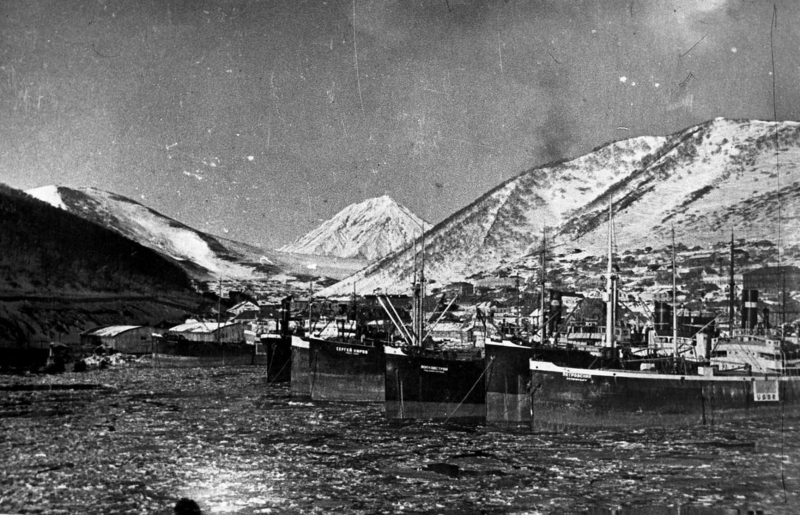
The catch levels at the time significantly exceeded allowable limits, moving Kamchatka closer to catastrophe. As early as 1958, Soviet enterprises in western Kamchatka were catching a tiny fraction of the salmon they had been bringing in as recently as the early 1950s — the fish had simply disappeared.
In 1978, when the USSR finally banned the Japanese from fishing in its exclusive economic zone, a new disaster followed. Suddenly, the guide says, there was too much fish: “All of it was rotting. Because of the lack of oxygen, the eggs could not develop. The roe died, spoiled.” The guide flips a lever on the map, and instead of a sea of lights only a pitiful few dozen remain: “This is what fish means in the life of our peninsula.”
In recent years, overall catches have been growing, and Russia has become the world leader in harvesting Pacific salmon. At the same time, their catch in 2024 turned out to be lower than at any time in the past two decades: 235.5 thousand tons of salmon (of which 131 thousand tons came from Kamchatka). But in 2025 the catch already amounted to around 350 thousand tons (of which 259 thousand tons were from Kamchatka). As the statistics show, more than half of the fish comes from Kamchatka, yet the peninsula’s residents get virtually nothing from it.
The settlement of Ust-Kamchatsk was once a thriving port with a population of more than 10,000. Ships arrived here from Petropavlovsk and also from abroad. It even had its own airport. Now the settlement is dying out. The agglomeration made up of Ust-Kamchatsk proper, the settlement of Pogodny (a strip of land on a spit reachable by ferry and home to the processing plants), and the remote Krutoberegovo, where almost no one lives, numbers about 3,000 residents. Several decades ago, a tsunami struck the central part of Ust-Kamchatsk, leaving it half-abandoned.
Char is a white fish that is very fatty.
A fishing method that uses underwater nets which drift freely after being set. This practice is banned in Russia on the marine migration routes used by anadromous fish heading to their spawning grounds.
Nevzorov continues to hold this post. He is under personal international sanctions imposed by all EU countries, the United Kingdom, the United States, Canada, Switzerland, Australia, Ukraine, and New Zealand over his support for Russia’s aggression against Ukraine.
Fixed seines are stationary net traps used in coastal fishing, installed along the path of migrating fish.
Fish glazing is the application of a thin ice coating to frozen fish to protect them from drying out while preserving the taste, texture, and nutritional properties during storage and transportation. The process involves immersing the fish in cold water (1–2°C) or spraying them with water, after which the fish is quickly frozen so that the ice forms a protective shell that should not separate from the surface.
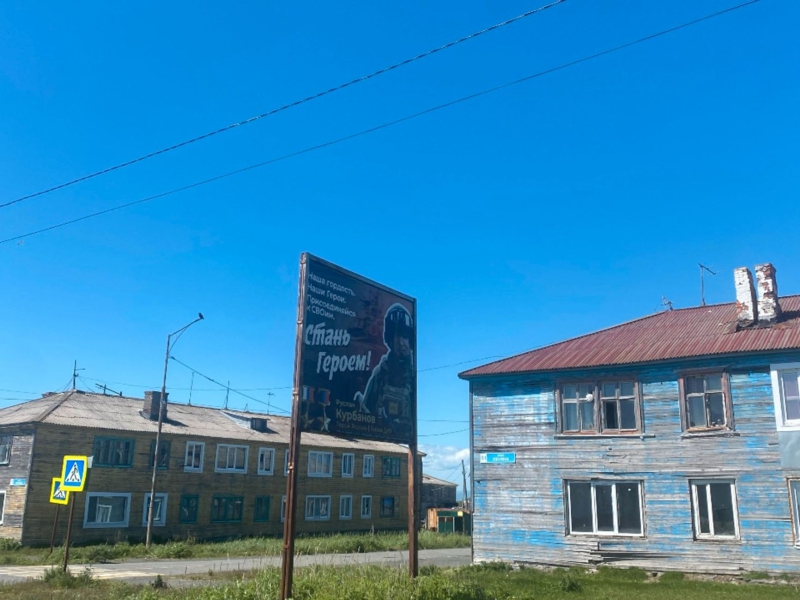
On the spit, at the point where the Kamchatka River flows into the ocean, stand six fishing plants. They take most of the red fish heading to spawn in Kamchatka and its smaller rivers. These are precisely the plants that fishermen complain about.
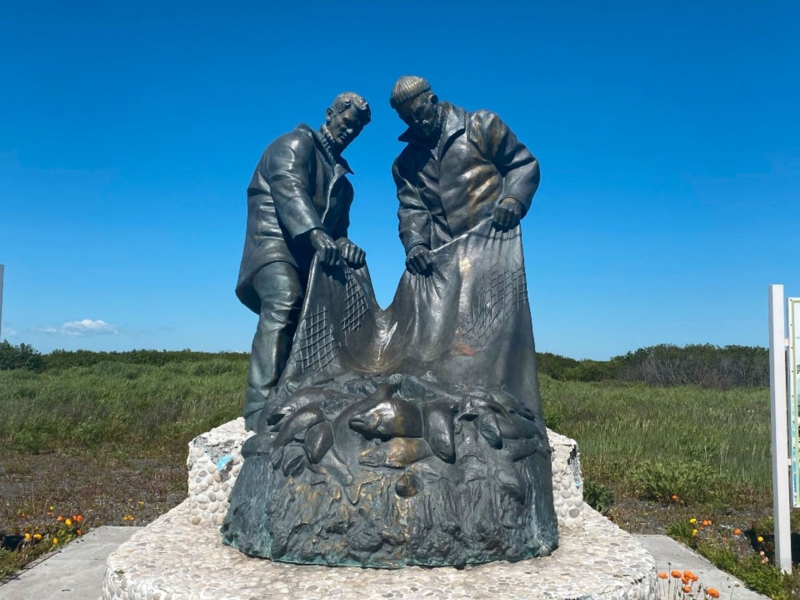
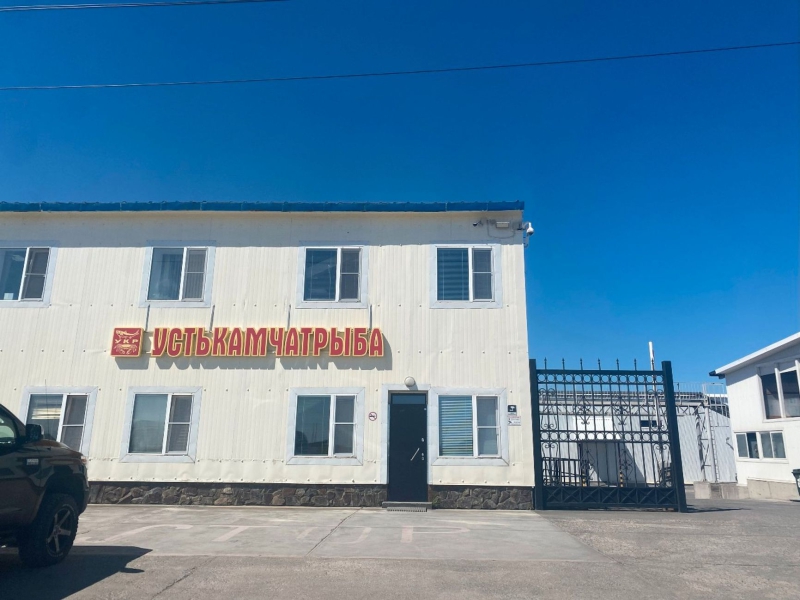
On the outskirts of Pogodny stands the Fishermen’s Glory monument — two fishermen with their catch. It was unveiled in 2015 at the request of the Ust-Kamchatsk Association of Fishing Industry Enterprises. The monument was ceremonially opened by an “honored guest,” Boris Nevzorov, deputy chairman of the Federation Council Committee on Agrarian and Food Policy and Environmental Management. Memorial plaques from local plants stand next to the monument. The largest of them, Ustkamchatryba, mentions Nevzorov on its plaque as its founder.
Char is a white fish that is very fatty.
A fishing method that uses underwater nets which drift freely after being set. This practice is banned in Russia on the marine migration routes used by anadromous fish heading to their spawning grounds.
Nevzorov continues to hold this post. He is under personal international sanctions imposed by all EU countries, the United Kingdom, the United States, Canada, Switzerland, Australia, Ukraine, and New Zealand over his support for Russia’s aggression against Ukraine.
Fixed seines are stationary net traps used in coastal fishing, installed along the path of migrating fish.
Fish glazing is the application of a thin ice coating to frozen fish to protect them from drying out while preserving the taste, texture, and nutritional properties during storage and transportation. The process involves immersing the fish in cold water (1–2°C) or spraying them with water, after which the fish is quickly frozen so that the ice forms a protective shell that should not separate from the surface.
In 1991, Nevzorov became the general director of the plant and later made it his own property. Then, after becoming a local lawmaker and later a senator from Kamchatka Krai, he re-registered the enterprise in the names of female relatives.
The Ustkamchatryba plant has eight fishing sites for the industrial harvesting of Pacific salmon along with a coastal processing base, making it a closed technological cycle: the fish is caught, processed, and shipped as finished products across Russia and abroad — to Japan, Korea, and China. The roe workshop processes an average of 10 tons of roe per day out of and has the capacity to churn out 16 tons. It employs 200–250 people on a permanent basis and up to 500 during the fishing season.
Members of Nevzorov’s family were listed as owners of the smaller Vostok-Ryba plant until 2024. A third plant, Nichira LLC, was also linked to him.
The other three plants are formally not connected to the senator but are closely intertwined with one another. Since 2022, Delta-Fish LTD has owned the nearby Sobol LLC. The sixth plant, Energia JSC, harvests salmon using two fixed seiners — in Kamchatka Bay and on the Kamchatka River.
Char is a white fish that is very fatty.
A fishing method that uses underwater nets which drift freely after being set. This practice is banned in Russia on the marine migration routes used by anadromous fish heading to their spawning grounds.
Nevzorov continues to hold this post. He is under personal international sanctions imposed by all EU countries, the United Kingdom, the United States, Canada, Switzerland, Australia, Ukraine, and New Zealand over his support for Russia’s aggression against Ukraine.
Fixed seines are stationary net traps used in coastal fishing, installed along the path of migrating fish.
Fish glazing is the application of a thin ice coating to frozen fish to protect them from drying out while preserving the taste, texture, and nutritional properties during storage and transportation. The process involves immersing the fish in cold water (1–2°C) or spraying them with water, after which the fish is quickly frozen so that the ice forms a protective shell that should not separate from the surface.

Before the war, Nevzorov and his family ranked among the ten wealthiest parliamentarians in Russia. Notably, in first place was another senator from Kamchatka — Valery Ponomaryov, who owns Oceanrybflot.
“The entire coastline belongs to Nevzorov,” says one of the plant workers. “He has his own bathhouse, an ATV, a gun. He’s a Putin-aligned lawmaker. I was still a kid when I heard about him. All the plants are brothers and sisters. They have different names, but they’re all friends. They even run a ferry of their own. You go up to the sailors, it says ‘Sobol,’ but in reality it’s Delta-Fish. They all work with UKR [Ustkamchatryba].”
Another worker adds: “The plants belong to Nevzorov. They’re controlled, like the whole country. Even if you have a billion, they won’t let you open a plant here. You need permission from above.”
Under the law, plants are required to observe pass-through days so that fish can move up the rivers to spawn. But local residents say this often does not happen: instead, the plants catch more fish than is needed to maintain ecological balance.
Moreover, despite a formal ban on driftnet fishing, the plants are still using nets, residents say. “The seines are set up in Ust-Kamchatsk. Under the rules, the plants are required to remove them, and the fish should move upstream along the Kamchatka to the spawning grounds. But on pass-through days they close the gates, the fish run into them, can’t get into the river, turn away and end up in the nets. The fishery inspectors have been bought off; the plant management gives bribes. That’s why the Kamchatka River is empty. It's capitalism, guys!” comments a former fisheries inspector.
Char is a white fish that is very fatty.
A fishing method that uses underwater nets which drift freely after being set. This practice is banned in Russia on the marine migration routes used by anadromous fish heading to their spawning grounds.
Nevzorov continues to hold this post. He is under personal international sanctions imposed by all EU countries, the United Kingdom, the United States, Canada, Switzerland, Australia, Ukraine, and New Zealand over his support for Russia’s aggression against Ukraine.
Fixed seines are stationary net traps used in coastal fishing, installed along the path of migrating fish.
Fish glazing is the application of a thin ice coating to frozen fish to protect them from drying out while preserving the taste, texture, and nutritional properties during storage and transportation. The process involves immersing the fish in cold water (1–2°C) or spraying them with water, after which the fish is quickly frozen so that the ice forms a protective shell that should not separate from the surface.
“The fisheries inspectors have been bought off, the plant management gives bribes. That’s why the Kamchatka River is empty. It's capitalism, guys!”
An employee of an environmental center in Yelizovo, who asked not to be named, clarifies: “Not all fish plants prevent spawning. We have an arrangement with one plant that when the fish is heading to spawn, they do not catch them. We ourselves count how much fish has entered the spawning grounds, so that there is neither too much — otherwise it is difficult for them to spawn — nor too little, so that the food chain does not break. At that point, plants, say, on the Ozernaya River are not operating. As soon as we determine that enough fish has entered to spawn, we give them permission to harvest. Practically all plants have counting frames installed, which makes it possible to count the fish.”
However, fish-plant workers speaking with The Insider openly admit that this does not help, and that the amount of fish in Kamchatka’s rivers is shrinking year after year.
During the entire time spent in Ust-Kamchatsk, the correspondent did not meet a single local resident employed at the fish plants. Instead, there are workers from Belarus, Krasnodar Krai, Tatarstan, and Altai. All of them come here for high pay.
They are usually entitled to unemployment insurance compensation of 90,000 rubles ($1,150) if there is no fish at all, but they are typically called in to work several times a month. In total, they earn about 300,000 rubles per season. One fish-processing worker confirms that last year there was hardly any fish. Still, over the course of 2.5 months in 2024, he earned 360,000 rubles($4,600).
For this money, workers put up with poor living conditions. “There are containers near the plant. That’s where we live,” says a fish processor from Krasnodar Krai. “It’s fine there. The bedding gets changed. You can sleep. There are fans and heaters, though there were no kettles. In some containers more people live, in others fewer.”
The working conditions leave just as much to be desired. “The shifts are bullshit. They call you at eight in the evening and say the fish will arrive at ten. In reality, we only start working at four o’clock in the morning. We work at the final stage. I stand by the freezer. The fish is rolled out. I have to lift it, smash the f**k out of it on the table, and send it along the conveyor with ice water so it goes through glazing,” another worker explains, pointing to his partner. “And he stands at the scales and packs it into boxes.” Another worker adds: “And I’ve got the hardest job. The fish moves along the conveyor, and you judge it by eye. Sometimes it’s this big” (he shows with his hands) “and sometimes it’s smaller.”
But not everything caught by the plants goes into processing. “A vessel comes in from the sea and brings fish. Everything gets caught in the net — flounder, chinook, sockeye, pink salmon. At the plant they sort it. Say 50 tons comes in. Of that, 10 tons is all kinds of trash, like flounder. And the plant only needs red fish. But the same plant steals it — literally gives it away to various FSB guys, people with rank,” one of the workers says.
Char is a white fish that is very fatty.
A fishing method that uses underwater nets which drift freely after being set. This practice is banned in Russia on the marine migration routes used by anadromous fish heading to their spawning grounds.
Nevzorov continues to hold this post. He is under personal international sanctions imposed by all EU countries, the United Kingdom, the United States, Canada, Switzerland, Australia, Ukraine, and New Zealand over his support for Russia’s aggression against Ukraine.
Fixed seines are stationary net traps used in coastal fishing, installed along the path of migrating fish.
Fish glazing is the application of a thin ice coating to frozen fish to protect them from drying out while preserving the taste, texture, and nutritional properties during storage and transportation. The process involves immersing the fish in cold water (1–2°C) or spraying them with water, after which the fish is quickly frozen so that the ice forms a protective shell that should not separate from the surface.
“The plant only needs red fish. But the plant itself steals it — literally gives it away to various FSB officers, people with rank…”
His colleague complains: “They brought the fish to the plant, and half of it was f***ing stolen — given to one person, given to another…” According to him, chinook, which is larger, tastier, and more nutritious than Atlantic salmon, is often handed over to management. Another worker explains how much chinook costs: “If you catch a chinook, one fish brings in 20,000 rubles ($250). And if it’s with roe — 50,000-60,000 rubles ($640-$760). That’s huge money.”
However, since only a small part of the catch makes it into open retail, fish in Kamchatka costs almost as much as on the mainland. A fish processor from Belarus is surprised by store prices for roe: “6,000 rubles ($76) per kilo. Last year I was in Vladivostok and was shocked — a kilo of sockeye at the market cost 3,000 rubles, here it’s 6,000 rubles.”
Char is a white fish that is very fatty.
A fishing method that uses underwater nets which drift freely after being set. This practice is banned in Russia on the marine migration routes used by anadromous fish heading to their spawning grounds.
Nevzorov continues to hold this post. He is under personal international sanctions imposed by all EU countries, the United Kingdom, the United States, Canada, Switzerland, Australia, Ukraine, and New Zealand over his support for Russia’s aggression against Ukraine.
Fixed seines are stationary net traps used in coastal fishing, installed along the path of migrating fish.
Fish glazing is the application of a thin ice coating to frozen fish to protect them from drying out while preserving the taste, texture, and nutritional properties during storage and transportation. The process involves immersing the fish in cold water (1–2°C) or spraying them with water, after which the fish is quickly frozen so that the ice forms a protective shell that should not separate from the surface.
According to the workers, the plants also violate rules meant to sustain fish stocks. Some release fry, but others only harvest. One fish processor complains: “Here they just catch, they don’t raise anything. If we went back fifteen years, they would bring us not 50 tons, but 300 tons. In ten years there won’t be any fish here at all, neither in the ocean nor in the river. They won’t restore anything. They live for today.”
The environmental center employee, however, disagrees: “There is enough fish. Both last year and this year. Our environment is changing very markedly, deteriorating very sharply, but fish adapt even to poor ecology. So we do not expect fish to disappear.”
The settlement of Esso is marketed to tourists as “Kamchatka’s Switzerland.” It is a small highland village with mountain rivers and several museums dedicated to local peoples. Notices offering fish for sale are posted around the settlement: 350 rubles ($4.50) per kilogram of sockeye. After negotiations on WhatsApp, you are given an address. The fish can be picked up at a hotel on the outskirts of Esso. The administrator makes a call, and a large fish in a black bag is brought out from the corridor. Payment is made by bank transfer. Nowhere else in Kamchatka can you find red fish this cheap.
This is explained by the fact that such fish is sold mainly by those who caught it themselves in local rivers — a right held by representatives of Indigenous small-numbered peoples. One of them, a local driver, transports cargo around Kamchatka. He says that he and his Koryak wife have seven children. This means they are entitled to catch 800 kilograms of red fish a year. The fisherman says they usually catch even more, and the inspectors who check them do not weigh it precisely. The fisherman’s entire house is packed with freezers full of fish. Some of it they eat as a family, and the rest they sell on the local black market.
“In Kamchatka it has become popular for men to marry women from Indigenous peoples who already have children. The men may also have children from a previous marriage. Then they are all considered representatives of small-numbered peoples and together are entitled to a large amount of fish. They can then sell that fish. Many people I know do this: they get married but don’t live together. They harvest fish ald sell it — everything is legal, everyone is happy,” says an employee of an environmental center in Yelizovo.
Char is a white fish that is very fatty.
A fishing method that uses underwater nets which drift freely after being set. This practice is banned in Russia on the marine migration routes used by anadromous fish heading to their spawning grounds.
Nevzorov continues to hold this post. He is under personal international sanctions imposed by all EU countries, the United Kingdom, the United States, Canada, Switzerland, Australia, Ukraine, and New Zealand over his support for Russia’s aggression against Ukraine.
Fixed seines are stationary net traps used in coastal fishing, installed along the path of migrating fish.
Fish glazing is the application of a thin ice coating to frozen fish to protect them from drying out while preserving the taste, texture, and nutritional properties during storage and transportation. The process involves immersing the fish in cold water (1–2°C) or spraying them with water, after which the fish is quickly frozen so that the ice forms a protective shell that should not separate from the surface.
“Many people I know do this: they get married but don’t live together. They catch fish and sell it — everything is legal, everyone is happy”
A resident of Klyuchi says that things used to be different: “Plants gave away what they didn’t process — heads and tails in any quantity. Back then we salted it in sacks, and there was still some left for the dogs. It would be very good if people were given fish like that again now.”
For everyone else, strict limits apply to fishing — not only on quantity, but also on gear. Those who violate these rules are considered poachers. There are very many of them, despite the fines. A fisherman from Esso complains: “Plants are allowed to fish with seines, but we aren’t! We’re only allowed to use a small net. If it’s longer than 30 meters, they’ll confiscate everything — the fish, the net, and you’ll get a fine on top. But you can get out of it if you have money and connections.”
Char is a white fish that is very fatty.
A fishing method that uses underwater nets which drift freely after being set. This practice is banned in Russia on the marine migration routes used by anadromous fish heading to their spawning grounds.
Nevzorov continues to hold this post. He is under personal international sanctions imposed by all EU countries, the United Kingdom, the United States, Canada, Switzerland, Australia, Ukraine, and New Zealand over his support for Russia’s aggression against Ukraine.
Fixed seines are stationary net traps used in coastal fishing, installed along the path of migrating fish.
Fish glazing is the application of a thin ice coating to frozen fish to protect them from drying out while preserving the taste, texture, and nutritional properties during storage and transportation. The process involves immersing the fish in cold water (1–2°C) or spraying them with water, after which the fish is quickly frozen so that the ice forms a protective shell that should not separate from the surface.
“Plants are allowed to fish with seines, but we aren’t! We’re only allowed to use a small net. If it’s longer than 30 meters, they’ll confiscate it”
Those caught with undocumented fish face huge fines. A local resident says that traffic police conduct strict inspections between settlements. At the entrances to Yelizovo and Sokoch, all vehicles are stopped and checked. Boats and helicopters also patrol the rivers. Sometimes, when he is traveling with his family, he hides fish under a child’s seat: they definitely won’t search there.
However, law enforcement fights real poachers with mixed success. “In southern Kamchatka there was a large amount of fish, and poaching was flourishing there, even though it was a protected area,” says an environmental center employee. According to her, in 2007 inspectors were afraid to enter those territories because poachers behaved aggressively. They not only caught fish on a massive scale, but also hunted bears. Later, an operations group assembled from across Russia began working there and over five years managed to clear the area of poachers. This made it possible for fish to return to spawning grounds and for bears to “catch their breath.”
Today, despite the large number of raids and fines, there are still many poachers in southern Kamchatka, largely because it is easier to get there. “If last winter four poachers were recorded in the Valley of Geysers [located in the central part of the peninsula], then in the south there were about a thousand,” an environmental center employee claims.
“Poaching is everywhere. But what kind of poacher goes after fish? They’re interested in roe! Just look at the prices!” the guide explains. “And as for fish meat, only chinook matters — it costs thousands per kilo! The rest of the fish is thrown away.”
Char is a white fish that is very fatty.
A fishing method that uses underwater nets which drift freely after being set. This practice is banned in Russia on the marine migration routes used by anadromous fish heading to their spawning grounds.
Nevzorov continues to hold this post. He is under personal international sanctions imposed by all EU countries, the United Kingdom, the United States, Canada, Switzerland, Australia, Ukraine, and New Zealand over his support for Russia’s aggression against Ukraine.
Fixed seines are stationary net traps used in coastal fishing, installed along the path of migrating fish.
Fish glazing is the application of a thin ice coating to frozen fish to protect them from drying out while preserving the taste, texture, and nutritional properties during storage and transportation. The process involves immersing the fish in cold water (1–2°C) or spraying them with water, after which the fish is quickly frozen so that the ice forms a protective shell that should not separate from the surface.
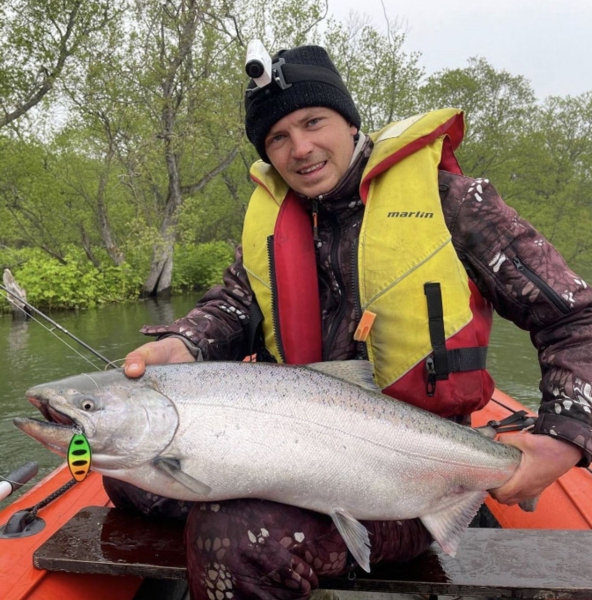
He regrets that public oversight of poachers has failed to stop the illegal trade. “There were cases when we paid people for this work, and they used it against us. They covered for poachers,” says our guide. “Later, an association of fishing industry enterprises was created on the Bolshaya River. They are now engaged in anti-poaching activity, but they too are interested in securing more fish for themselves.”
Public inspectors operate on only one river, while on the remaining stretches, state fisheries inspectors are in charge. But for the past thirty years, according to the guide, their composition “has been determined by the principle of who can extract the most benefit. That’s how everything works in our country — not just fisheries protection, the entire state structure. It’s all about how to get more into your own pocket.”
The environmental center employee sums up the situation: “Poaching will always exist. It can’t be eradicated completely. If you eliminate poaching, people will suffer, because many earn their living this way, people live off it. You just need to regulate things so as not to harm nature and not prevent people from making a living from fishing.”
Char is a white fish that is very fatty.
A fishing method that uses underwater nets which drift freely after being set. This practice is banned in Russia on the marine migration routes used by anadromous fish heading to their spawning grounds.
Nevzorov continues to hold this post. He is under personal international sanctions imposed by all EU countries, the United Kingdom, the United States, Canada, Switzerland, Australia, Ukraine, and New Zealand over his support for Russia’s aggression against Ukraine.
Fixed seines are stationary net traps used in coastal fishing, installed along the path of migrating fish.
Fish glazing is the application of a thin ice coating to frozen fish to protect them from drying out while preserving the taste, texture, and nutritional properties during storage and transportation. The process involves immersing the fish in cold water (1–2°C) or spraying them with water, after which the fish is quickly frozen so that the ice forms a protective shell that should not separate from the surface.