
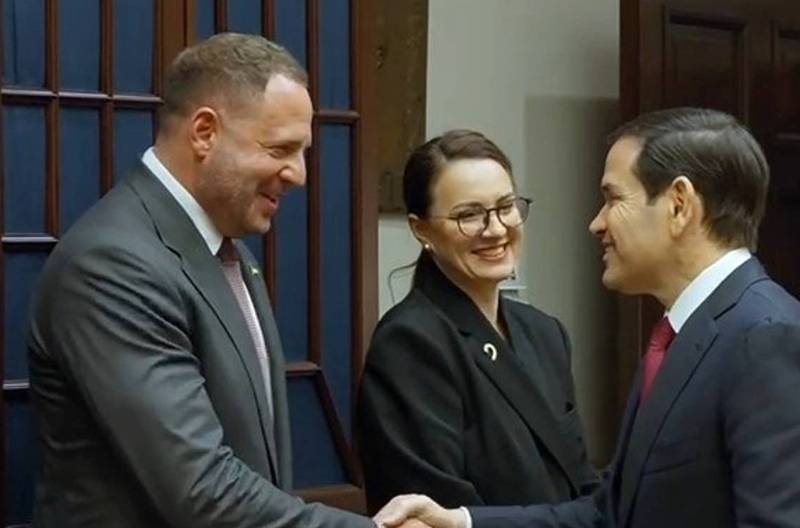
Andriy Yermak and Marco Rubio
What was the calculation?
One of the first questions raised by analysts after the initial, by-now infamous 28-point “peace deal” surfaced was: why now? The original plan contained nothing revolutionary (apart from a truly novel proposal to make the United States a beneficiary of potential investments made using the frozen Russian assets held in Europe). Almost all of its points had effectively been under discussion since spring 2025 at the latest, and they still offered no answers to the most critical issues: the actual content of security guarantees for Ukraine and the international legal status of Russian-occupied territories. One plausible explanation is that Moscow, which largely authored the 28 points, may have concluded that the presidents of Ukraine and the United States had been significantly weakened by domestic troubles (the Epstein scandal and Operation Midas, respectively) and in need of a public success, making them more likely to accept the document uncritically.
In Trump’s case, it might have worked. He has long made clear that the White House would not insist on substantive terms so long as Moscow and Kyiv merely signed something. But in assessing Zelensky’s situation and motivations, Kremlin analysts miscalculated — as they often do.
The corruption scandal in Ukraine is likely to lead to a decline in Zelensky’s approval rating. But that decline is probably not critical, even with his chief of staff, Andriy Yermak, having stepped down after his home and office were searched by law enforcement last week.
Under martial law, the head of state is virtually irreplaceable. In theory, he could be forced to resign, but no one can be elected to take his place. Under the Constitution, the speaker of Ukraine’s parliament, the Verkhovna Rada, would become acting president — and oversee the military. However, the personal popularity of the current speaker, Ruslan Stefanchuk, is insufficient for a leader during wartime. In the eyes of most Ukrainians, such a replacement would clearly weaken the country.
The only situation in which Zelensky could lose office would be if he placed himself in direct opposition to society, such as by trying to shield corrupt officials or by signing an agreement with Russia on terms unacceptable to a critical mass of his constituents. A weakened Zelensky therefore has not become more accommodating, as some might have assumed — rather, the domestic political turmoil has made the authorities in Kyiv even less willing to sign a controversial deal.
Domestic political turmoil has made the authorities in Kyiv even less willing to sign a controversial deal
It is also important to remember that under Ukrainian law any international agreement — and a peace accord certainly qualifies as such — must be ratified by the Verkhovna Rada. And if the document affects constitutional principles such as territorial integrity, ratification would require a qualified majority of 300 votes.
According to Stefanchuk, roughly 340 to 350 lawmakers are currently taking part in parliamentary procedures, which means that attaining the requisite level of support would require a broad national consensus.
A referendum on the acceptability of peace terms may appear to many as a compelling response to current and possibly future ultimatums from Trump. But a referendum cannot be held during wartime for more or less the same reasons elections cannot be held: it is impossible to guarantee the physical safety of voters, to ensure access for service members and displaced people, or to allow for free campaigning in the media.
Kyiv raises the stakes
Strictly speaking, the emergence of the “Trump plan” could have been a far less significant event in global politics. In 2025, Ukraine has already faced the American president’s unpredictable pressure campaigns — demands that Kyiv accept Russian terms and threats to cut off the provision of U.S. military assistance. A firm deadline for signing the 28-point plan — Thanksgiving Day, Nov. 27 — also should not have caused panic: the White House has set many such ultimatums for reluctant foreign counterparts, only for Trump to later pretend the stated date represented nothing serious.
Even so, Zelensky chose to elevate the moment. His emotional address to the nation on Nov. 21 — “Ukraine may find itself facing a very tough choice: either the loss of our dignity or the risk of losing a key partner” — unsettled not only Ukrainians but also European leaders and members of the U.S. political establishment. Consultations began, along with negotiations and efforts to draft alternative versions of the plan.
On one level, the Ukrainian president again showed Washington the limits of his flexibility. But on another, he shifted domestic public and media attention away from an anti-corruption scandal unfavorable to him while temporarily shielding National Security and Defense Council Secretary Rustem Umerov and presidential chief of staff Andriy Yermak, who had been sent to negotiations in Geneva. As it turned out, that protection was short-lived: after searches of his office and home in Kyiv, Yermak was forced to resign.
Ukraine has also responded to each U.S. proposal to end the war by deliberately bringing Europe back to the table. Washington has found itself in no position to openly object, as Trump himself has repeatedly called the conflict a European problem.
Now, having once again secured the backing of his allies on the continent, Zelensky is prepared to fly to Washington. But it is entirely possible he will be received only after the announced visit of a U.S. delegation to Moscow. And when he does arrive in America, the conversation is likely to be difficult.
Putin comes out ahead
It must be acknowledged with regret that the past week of tension in Kyiv and Western capitals has benefited Russia. Once again, a decision on tightening U.S. sanctions has been postponed, and approval for the supply of Tomahawk missiles to Ukraine appears as far away as ever. The proposed Putin-Trump Budapest summit has not returned to the agenda, while the upcoming arrival of a U.S. delegation in Russia can be seen as a diplomatic victory for the Kremlin. The world is back to debating the Kremlin’s nearly unchanged set of demands, while Vladimir Putin presents himself as unflappable: until Ukrainian forces withdraw from the Donetsk Region and Kyiv accepts the rest of Russia’s terms, he says, the war will continue.
The upcoming arrival of a U.S. delegation in Russia — not just Steve Witkoff — can be seen as a diplomatic victory for the Kremlin
Most likely, European governments will help Ukraine defend its “red lines” in negotiations with the United States: no troop withdrawal without a fight, no de jure recognition of annexation, and no constitutional changes dictated by the Russian aggressor state. In time, Trump may again conclude that Moscow — not Kyiv — is the side sabotaging a peace deal. He may yet even impose secondary sanctions, thereby outdoing European efforts to weaken the Russian war machine.
Putin, meanwhile, is clearly prepared to keep fighting. Economic problems visible to outside experts have not yet seriously threatened his regime’s domestic stability, and the Russian military continues its slow advances while replenishing heavy personnel losses without resorting to full mobilization. Illusions should be set aside: a cease-fire — let alone a full peace — is unlikely in the foreseeable future.