
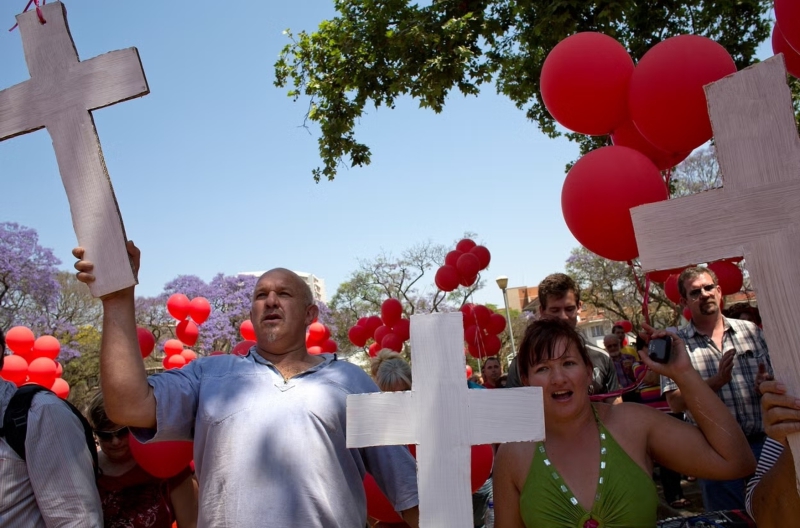
The 2026 G20 summit is set to take place in Miami this December, and Trump has already officially stated that South Africa will not be invited, citing “the genocide of the white population.” Trump has long criticized South Africa for the “oppression of Afrikaners” and, under the same pretext, in early 2025 halted all economic assistance to Pretoria. Yet within South Africa itself, white farmers do not feel discriminated against and do not consider the word “genocide” to appropriately describe what is happening, while even local right-wing groups are disavowing U.S. aid. The only political figure in the country who openly sings songs calling to “kill the Boer” is marginal populist Julius Malema — who is backed by the Kremlin and constantly praises Putin.
The idea that the post-apartheid Republic of South Africa faces a “genocide of whites” is one of the false narratives that Donald Trump has been repeating ever since his first term in the White House. Back in 2018, Trump wrote that he had instructed then–Secretary of State Mike Pompeo to “closely study land expropriation and the large-scale killing of farmers in South Africa.”
Many figures on the American right sided with Trump. Former Fox News personality Tucker Carlson repeatedly raised the topic of South Africa on his programs: he has claimed, for example, that the country’s president, Cyril Ramaphosa, is “taking land away from his own citizens because their skin is the wrong color,” and has called the republic’s government “genocidal-racist” (meaning, of course, a genocide against whites).
Similar arguments are echoed by South Africa–born Elon Musk, who on Jan. 7 reposted a tweet claiming that “White solidarity is the only way to survive.” Even the Grok chatbot on Musk’s social network talks about a “white genocide” in South Africa in responses to random user queries.
With Trump’s return to the White House in 2025, the topic of “genocide” in South Africa has predictably resurfaced. In January, the republic adopted a law on the redistribution of agricultural land, most of which has belonged to whites since the apartheid era. Less than a month later, Trump demanded that all financial assistance to Pretoria be halted and promised to facilitate the resettlement of white South Africans to the United States.
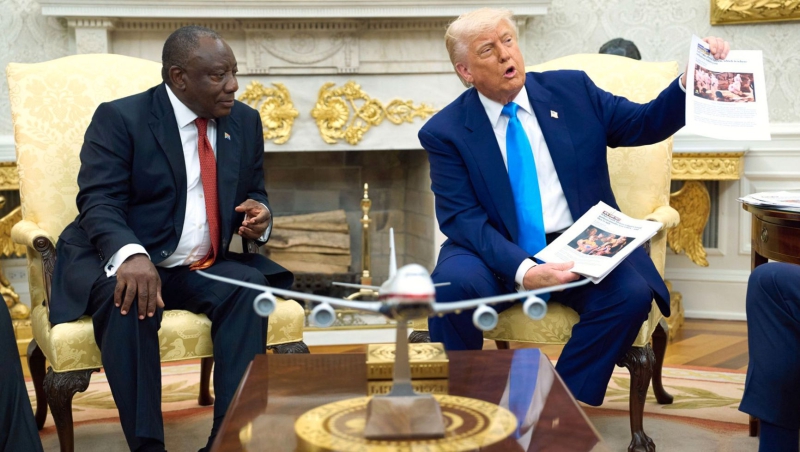
Most of the materials Trump presented at his meeting with Ramaphosa do not withstand the test of fact-checking. A video with crosses shows not a burial site but a memorial to those killed during a protest. Some of the images even turned out to be footage from the war in the Democratic Republic of Congo.
Nevertheless, South Africa’s president still had to explain why one of the clips featured the song Dubul’ ibhunu, which translates from Xhosa and Zulu as “kill the Boer,” a reference to one of the white settler groups known as Afrikaners, most of whom were descendants of Dutch colonizers. Their language, Afrikaans, is related to Dutch, and in it the word boer means “farmer.” Although Afrikaners do not call themselves that, most of the settlers’ ancestors were indeed engaged in farming (which is why Trump’s insinuations about calls to “kill white farmers” in this song do contain at least one small element of truth).
In one of the videos Trump used as evidence of a “white genocide” in South Africa, the song “Kill the Boer” was playing
The song is a relic of South Africa’s colonial past — in particular the period of apartheid that reigned in the Republic of South Africa from the moment it gained independence in 1948 until 1994. Under this system, power belonged mainly to the white minority, notably the Afrikaners. They also owned most of the land, capital, and other economic assets. Black residents of the republic were deprived of many political and social rights. They often lived in reservations outside cities and were seen as nothing more than a labor force.
As early as 1973, the UN recognized segregation in South Africa as a crime against humanity and helped impose sweeping sanctions on the country. South Africans themselves opposed apartheid despite political terror by the authorities. The song “Kill the Boer” emerged in this context — as an anthem of resistance.
The UN recognized apartheid in South Africa as a crime against humanity in 1973
Although Dubul’ ibhunu is still performed at some political rallies in South Africa, it can hardly be described as being widely popular in this day and age. South African courts have ruled that the song constitutes “hate speech” and temporarily banned it, only for those decisions to later be suspended and eventually overturned. All of these legal battles, however, were linked to one specific politician: the radical populist Julius Malema — coincidentally or not a major admirer of Putin and a favorite of Russian state propaganda — who was prosecuted in South Africa for inciting hatred over the song. It was footage of his speeches that Trump showed to Ramaphosa. The South African president, in turn, explained that the country is a democracy with freedom of speech, and that even if an insignificant minority exercises its right to engage in provocative political behavior, this does not mean their actions are supported by the national authorities.
According to a report by the South African government, in 2017, 72 percent of privately owned land belonged to local whites, who number about 4.5 million people — 7.2 percent of the total population. These ownership disparities are a direct consequence of apartheid. Although more than 30 years have passed since the racist policy’s abolition, South African society has still not resolved the problem of inequality. The latest attempt to address it was the Expropriation Act signed by Cyril Ramaphosa in February, which Trump used as evidence of a “white genocide” in South Africa.
As of 2017, 72 percent of private land in South Africa belonged to whites, who make up 7.2 percent of the country’s total population
The Act was adopted after five years of research, debate, and revisions. It allows for land to be seized without compensation in cases where doing so is “fair, objective, and within the public interest” — for example, when property is not being used or, conversely, when its use poses a threat to the life and health of the population.
On Feb. 7, the Trump administration issued a memorandum “On the egregious actions of the Republic of South Africa.” In addition to proposing resettlement for white South African citizens, the document declared an end to all U.S. financial assistance to the country. The memorandum’s first point concerns precisely the Expropriation Act:
“This Act follows countless government policies designed to dismantle equal opportunity in employment, education, and business, and hateful rhetoric and government actions fueling disproportionate violence against racially disfavored landowners.”
There is no consensus in South African society regarding the reform. Some consider the Act unconstitutional, while others see it as a necessary step toward overcoming historical inequality. At the same time, nearly a year after the Act came into force, not a single case of expropriation without compensation has been recorded. This is acknowledged even by right-wing Afrikaner groups.
The largest nationalist organization of white South Africans — the Solidarity Movement — issued a statement: “We did not accuse the government of large-scale race-based land grabs, or distribute false information in this regard. We did not and will not ask for sanctions against South Africa, or that funds for vulnerable people be cut off by the U.S. government.”
A number of laws in the Republic of South Africa, like the land reform, are aimed at addressing the legacy of apartheid. For example, quotas for nonwhite employees have been established by law, and an act has been adopted requiring that at least 30 percent of local subsidiaries of foreign companies be owned by members of historically disadvantaged groups (although discussions are underway about easing this requirement).
According to Elon Musk, the latter law prevents his Starlink satellite internet network from entering the country. In March, he complained to his multimillion audience on X: “Starlink is not allowed to operate in South Africa simply because I am not black.” At the same time, South Africa’s communications licensing authority says that Musk’s company has never submitted an application to open a local subsidiary in the republic.
Elon Musk claimed that his Starlink cannot be rolled out in South Africa because he is “not black,” but the company has not even applied to operate in the country
In short, the laws referred to in the Trump administration’s memorandum do in fact exist; however, they are not aimed at “discriminating against the white minority.” Meanwhile, the “disproportionate” violence against “white farmers” cited by the White House is not observed at all. According to a report released in 2025 by South Africa’s Institute for Security Studies, levels of violence against different population groups are far more strongly influenced by geography and living standards.
Last year, 27,621 people were killed in South Africa — 45 murders per 100,000 residents (in the 1990s the figure reached as high as 67 per 100,000). In other words, South Africa is, in general, one of the most dangerous countries in the world. At the same time, most murders result from personal conflicts, and crime rates vary by region. The highest number of violent incidents occurs in cities, with a substantial share concentrated in poor neighborhoods populated predominantly by nonwhite residents.
There are many reasons for this level of violence: the legacy of apartheid and the struggle against it, large volumes of illegal weapons circulating in the country, corruption, organized crime, and chronic underfunding of law enforcement agencies responsible for crime prevention. True, crime in South Africa does threaten “white farmers” — just as it threatens all other population groups.
The statistics published by the South African government do not provide separate data on attacks committed in rural areas. However, the issue of violence in isolated regions has been discussed since the 1990s, when the authorities identified combating this type of crime as a state priority. In 2001, a special committee was established, and a report published in 2003 concluded that nearly 90 percent of murders in rural areas were committed in the course of attempted robberies.
South Africa’s Institute for Security Studies says that in 2025 this motive remains the primary driver of such crimes. “Cases with potential racial or political motives — such as slogans written at crime scenes or statements reportedly made by attackers — are exceedingly rare,” the report states. “Between January and March 2025, six people were murdered on farms or small holdings — two farmers and four employees or residents. Only one victim, a resident, was white. Over the same period, 5,727 people were murdered across South Africa — about 64 per day.”
Four-meter-high electrified fences, hired security, and regular patrols are a routine part of life for white farmers in South Africa, but they are the result not of a genocide against whites but extreme inequality rooted in the apartheid era and a persistent high overall level of crime. It is for this reason that some Afrikaners affected by Trump’s resettlement proposal welcomed the memorandum.
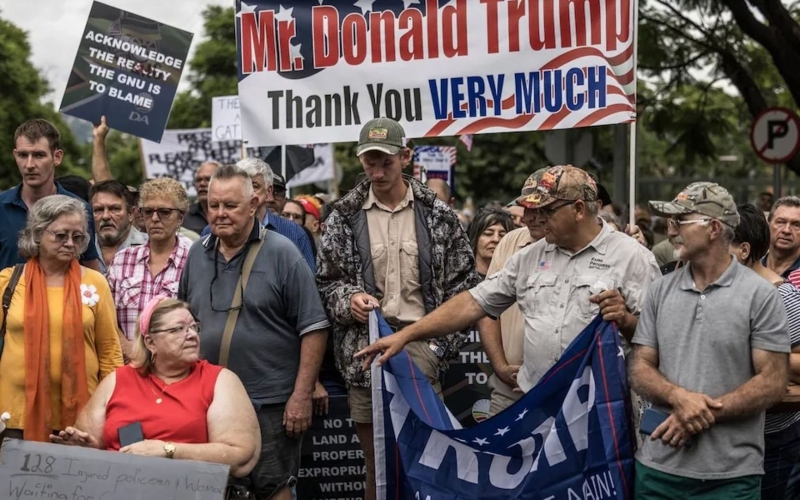
Even so, most white farmers themselves do not see their race as the main reason for the attacks: “I don't buy that narrative that in this area the attacks are against whites only. If they thought that the black guy had 20,000 rand ($1,200) sitting in his safe, they'd attack him just as quickly as they'd attack the white guy with 20,000 in the safe,” one farmer of Afrikaner origin tells reporters. In his view, people who characterize attacks on South African farms as a “white genocide” do not understand the meaning of the word: “What happened in Rwanda is genocide. What is happening to white farmers is very bad, but I don't think you can call it genocide.”