
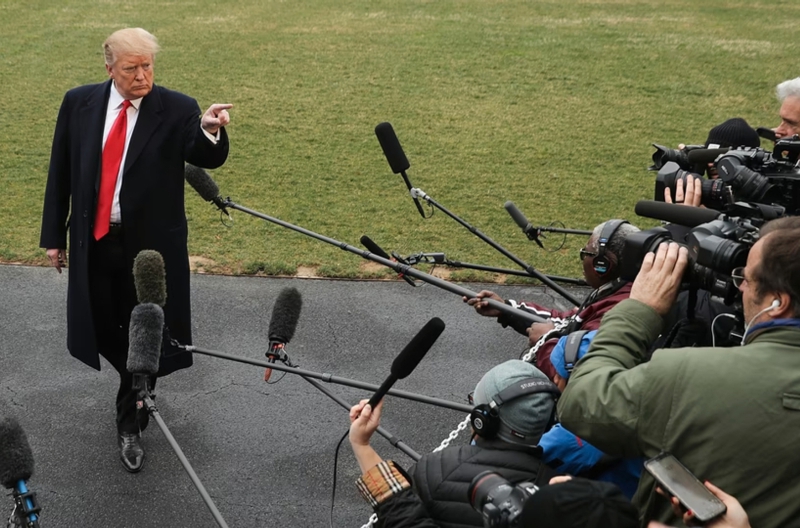
On Jan. 14, the FBI conducted a search at the home of Washington Post reporter Hannah Natanson, who had been covering the most sensitive initiatives of Donald Trump’s second administration. The formal pretext was a probe into a leak of classified U.S. government information. Although criminal cases involving reporters are not uncommon, observers note that a search is an extremely unusual and aggressive step for the authorities to take, but it still did not come as a major surprise. Since returning to the White House in January 2025, Trump has launched an offensive against the independent press — using legal, economic, and administrative tools. For now at least, solidarity within the journalistic community remains insufficient to meaningfully push back against pressure from the White House.
On the very first day of his new term, Donald Trump signed an executive order nominally aimed at “Restoring Freedom of Speech And Ending Federal Censorship.” Beyond the grand language about the First Amendment, the document contained only one practical measure: it directed the attorney general to launch an investigation into alleged censorship during Joe Biden’s presidency.
Subsequent events showed that Trump intended to “restore” freedom of speech only for his supporters. From the first months of his tenure, he began an unprecedented assault on the American media.
The White House is actively using the judicial system to go after the press, forcing media outlets to devote real time and resources in order to fight off the president’s largely frivolous claims. In July, Trump filed a $10 billion lawsuit against The Wall Street Journal over a story about his ties to Jeffrey Epstein. The U.S. president said at the time: “I hope Rupert [Murdoch] and his 'friends' are looking forward to the many hours of depositions and testimonies they will have to provide in this case.” Then in September, Trump initiated litigation against The New York Times, this time putting the compensation for “defamation” at $15 billion. The court dismissed the suit, but by October the president had filed a new version.
Trump filed a $10 billion lawsuit against The Wall Street Journal over a story about his ties to Jeffrey Epstein. He wished his opponents “hours of questioning”
The most high-profile scandal played out on the international stage — in December, Trump demanded $10 billion from the BBC, which he accused of falsifying footage of his speech to supporters hours before they stormed the Capitol on Jan. 6, 2021. The BBC apologized to Trump, and in November the company’s chief executive Tim Davie and head of news Deborah Turness resigned.
Many U.S. media outlets are owned by major corporations — ABC News by Walt Disney Co., CBS News by Paramount Global, NBC News by Comcast Corp., etc.— giving the federal government the opportunity to potentially influence newsrooms’ editorial decisions by applying pressure to businesses that are unrelated to media operations. On Oct. 31, 2024, Trump filed a $10 billion lawsuit against CBS over the editing of Kamala Harris’s appearance on “60 Minutes” (the program’s producers shortened Harris’s answer to a question about U.S.-Israel relations). Then, in July 2025, Paramount agreed to pay Trump $16 million as part of a pretrial settlement.
What distinguished this case from other lawsuits? Paramount was awaiting FCC approval for an $8 billion merger with Skydance Media. Immediately after the settlement, the commission allowed the deal to proceed.
Federal Communications Commission (FCC) chairman, Brendan Carr, announcing approval of the merger, stated outright that he welcomed Skydance’s decision to implement “significant changes” at CBS. In particular, the company announced the appointment of an official responsible for reviewing complaints about “bias” and promised to roll back its diversity, equity, and inclusion (DEI) policies.
A similar tactic was used in September 2025, when U.S. authorities attempted to force the cancellation of Jimmy Kimmel’s comedy show over his comments about the killing of conservative podcaster Charlie Kirk. Carr urged the companies that carry ABC broadcasts to pressure Disney into taking the program off the air.
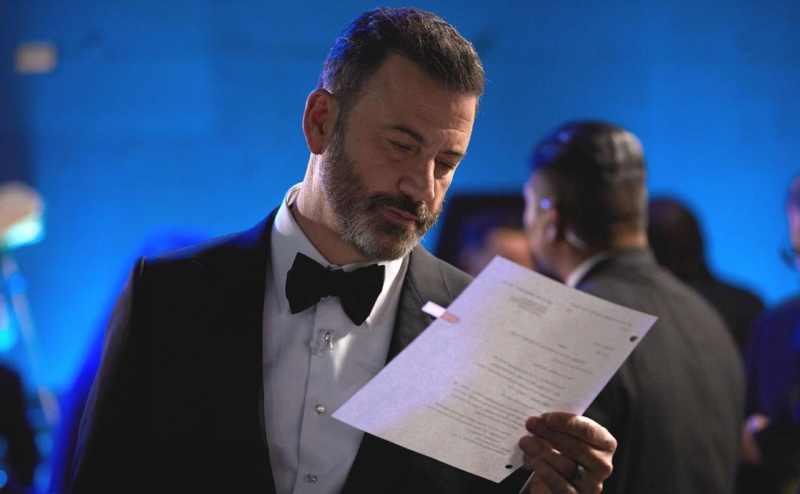
As a result, the two largest station groups — Nexstar and Sinclair — agreed to stop airing the show, substituting other content during ABC’s broadcast. After Carr hinted that Disney could lose its broadcast license if it did not take action, ABC suspended the show (only for public outrage to force a reversal).
In late 2025, Trump tried to block Netflix from acquiring Warner Bros. Discovery, which in addition to its film operations also owns CNN. The president pushed for an alternative deal that would see the news channel come under the ownership of Paramount Skydance, whose chief executive David Ellison has already promised to revise editorial policy to Trump’s liking. Warner Bros., however, is leaning toward Netflix’s offer (one that could result in CNN being spun off into a separate company).
Back in November 2024, Trump’s campaign headquarters revoked the credentials of reporters from Politico, Axios, and Puck over their coverage. The president continued to use similar tactics after taking office, and Axios was eventually “tamed” when the outlet’s correspondent Barak Ravid began regularly publishing “leaks” from White House sources.
In February, the White House barred the AP from presidential events for its refusal to refer to the Gulf of Mexico as the American Gulf. In April, a court sided with the outlet and blocked restrictions on its journalists’ work, but some of the bans remained in place while the appeals process played out. After the AP incident, the administration announced that it would now decide on its own whom to admit to presidential press conferences. Previously, that authority belonged to the White House Correspondents’ Association (WHCA).
The White House announced that it would decide on its own which reporters would be admitted to presidential events
The Pentagon, which Trump now insists on calling the “department of war,” introduced a requirement in September for journalists not to disclose “sensitive information” without government approval. Now-former National Security Advisor Mike Waltz, however, found himself at the center of a scandal in the spring after adding a reporter and several relatives to a Signal group chat in which U.S. military plans were being discussed.
More than 30 media outlets, including CNN, ABC, Reuters and The Guardian, refused to operate under the new conditions. They were replaced by outlets openly supportive of the Republican Party. In December, The New York Times, filed a lawsuit, arguing that the new rules violated the First Amendment.
At the end of October 2025, the Trump administration also restricted reporters’ access to officials working in the West Wing of the White House, claiming that journalists had been secretly recording audio and video and barging into offices. Around the same time, the president declared that he might close the White House to the press altogether.
Right after his inauguration, Trump said he would “happily” get rid of the blandly fact-based, publicly funded outlets NPR and PBS because he claims them that they are biased against his policies. In May, he issued an order ending their budgetary support.
Trump issued an order ending federal funding for public broadcasters because he claims that they are biased against his policies
NPR chief executive Katherine Maher said the order was an attempt to force the network to reshape its journalistic standards to align with the government’s line. At the end of May, NPR and PBS filed suit, arguing that their First Amendment right to free speech had been violated. The cases are still pending, but in the summer Congress approved a $1.1 billion cut to public broadcasting.
Trump routinely insults reporters — most often female ones — making disparaging remarks about their appearance and professional abilities and accusing them of working for media that spread “fake news.” In May, NBC correspondent Peter Alexander asked the president a question about a plane donated by Qatar, and Trump responded by telling him to “get out.” Later, Trump called Alexander “a terrible reporter” and “not smart enough” before attacking the entire NBC network. In September, reporter Ebony McMorris asked the president to comment on the deployment of the National Guard to Memphis. Trump replied: “Quiet! You’re really obnoxious!”
In response to a reporter’s question about the deployment of the National Guard to Memphis, Trump replied: “Quiet! You’re really obnoxious!”
In October, CNN reporter Kristen Holmes asked Trump about his role in shaping the agreement between Israel and Hamas. The president insulted her before ignoring the question: “This is CNN speaking, by the way. So, you know, this is one of the worst reporters you’ll ever see. I don’t even want to take her question. It’s a waste of time.”
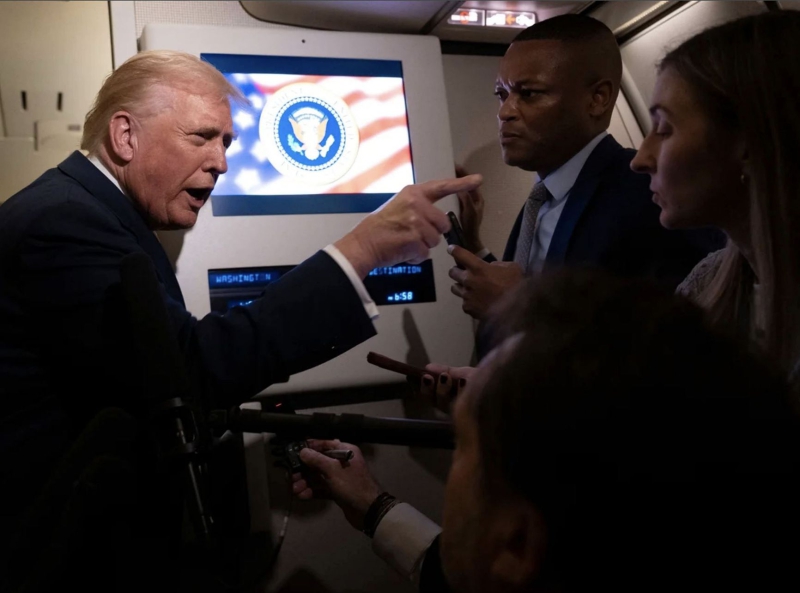
Perhaps the most notorious confrontation between Donald Trump and reporters occurred aboard AirforceOne on Nov. 14, when Bloomberg journalist Katya Lucy asked him about the Epstein archive. Trump declined to answer, pointed his finger at Lucy, and said: “Quiet, piggy!”
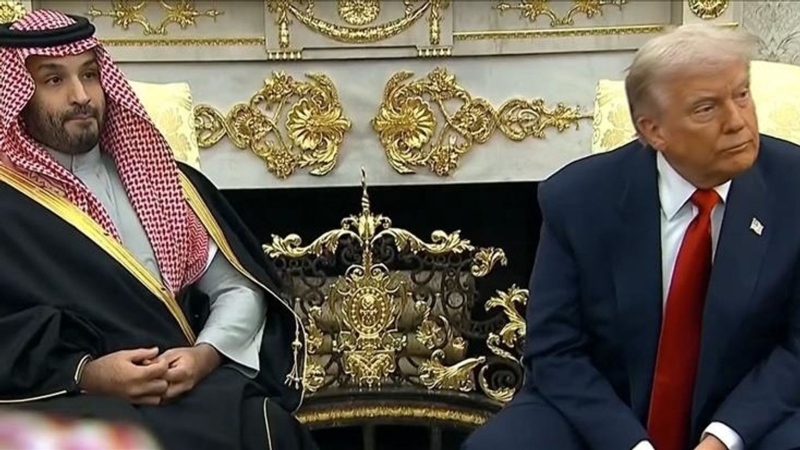
Then, on Nov. 18 during Trump’s meeting with Mohammed bin Salman, ABC News reporter Mary Bruce asked the Saudi crown prince about the death of a Washington Post columnist Jamal Khashoggi at the Saudi consulate in Istanbul in 2018. U.S. intelligence had said at the time that the killing was carried out on the prince’s orders, yet Trump first asked ABC’s Bruce not to “embarrass our guest by asking a question like that” and later called her “a terrible person and a terrible reporter,” adding that ABC should lose its license for spreading “fake news.”
That same month, The New York Times published a story about the multiple age-related health issues affecting the president. Trump called one of its authors, Katie Rogers, “a third-rate reporter who is ugly, both inside and out,” and described the Times as “a cheap rag” and “an enemy of the people.”
In addition to making regular insults, the president has repeatedly threatened reporters with fines and bans on their work. In August, he wrote on his Truth Social account that the licenses of ABC and NBC should be revoked for their “97 percent negative” coverage of him (even though neither Trump nor the Federal Communications Commission has such authority). He also proposed charging TV networks a broadcasting fee amounting to “millions of dollars a year.”
Trump also repeatedly demanded the dismissal of specific television personalities. On Nov. 15, for example, he wrote that NBC late-night host Seth Meyers “has no talent” and should be “fired immediately.” He also openly celebrated the departure of CBS’s Stephen Colbert, called for ABC’s Jimmy Kimmel to be removed from his job, and constantly attacked Jimmy Fallon’s show on NBC.
Analyzing Trump’s confrontation with the press, media-law attorney Amy Kristin Sanders recalled Barack Obama’s attempts to limit the White House access of Fox News reporters he suspected of bias. The 44th U.S. president failed because most major networks stood up for their colleagues — this despite the fact that most of the people working in their newsrooms had voted for him.
The situation has changed markedly. Trump repeatedly went to battle against the press during his first term, and by the time of his return to the Oval Office last year he had already managed to develop a fairly effective system of media control using a complex combination of the courts, regulators, and licensing decisions. As a result, when Trump barred AP reporters from the White House, only a handful of organizations stepped in to support them.
Media expert Chris Terry says the lack of solidarity extends to the legal battlefield as well: “If major news organizations like CBS and ABC choose to settle lawsuits they could win, that will only strengthen a system designed to intimidate other media.”
Trump’s efforts to “restore free speech” appear to be having their intended effect: they have cowed respectable mainstream news networks into covering Trump in a manner that is less harsh than the facts dictate it should be. Editorial decisions in the United States are increasingly shaped by corporate interests, by newsrooms’ willingness to enter into conflict with the White House, and by their capacity to withstand a long and costly defense in court. During Trump’s second term, attacks on the media have become a constant backdrop that journalists are forced to contend with, and we may never know how many very real scandals we are failing to uncover as a result.