
Photo: AFP
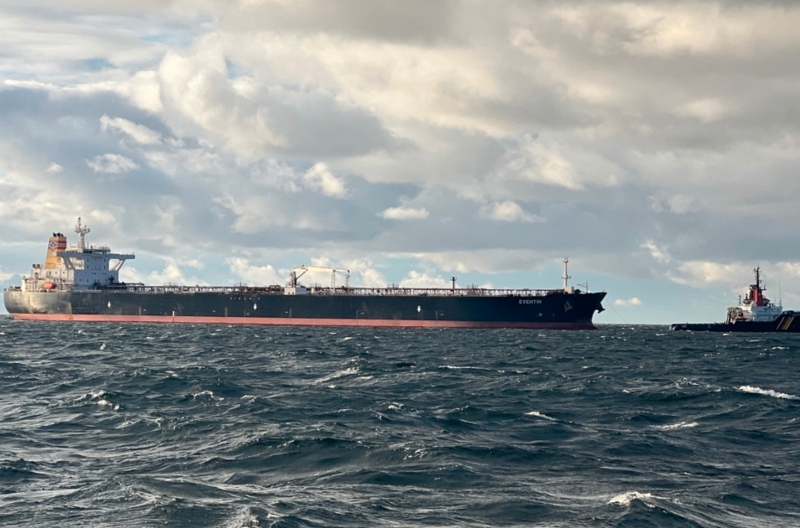
Spain has dispatched a salvage tugboat to escort the tanker Chariot Tide, which is linked to Russia’s “shadow fleet” and recently lost control in the western Mediterranean. Despite the vessel being under EU and UK sanctions, Spanish authorities helped it continue its voyage to the Moroccan port of Tangier, Reuters and Lloyd’s List report.
The tanker Chariot Tide (IMO: 9323376), flying the flag of Mozambique, was traveling from the Russian port of Ust-Luga to Morocco's Tangier. Problems began on Jan. 21 as it approached the Strait of Gibraltar: the vessel’s speed dropped sharply, and its navigational status was changed to “not under command,” meaning that due to technical issues the ship was unable to maneuver or avoid other vessels.
Spain’s maritime safety agency SASEMAR said the tanker suffered engine failure that left it drifting without propulsion in international waters, roughly 33 nautical miles south of Adra, in Almería province, within Spain’s search-and-rescue zone. A Spanish tugboat, Clara Campoamor, was then dispatched to move the vessel away from busy shipping lanes and begin escorting it to the port of Tangier. Spanish authorities did not explain why the tanker was not detained. At the same time, Morocco (the tanker’s destination) may serve as a hub through which Russian diesel fuel enters Spain in circumvention of sanctions.
According to Bloomberg, Chariot Tide was carrying approximately 300,000 barrels of diesel fuel loaded at a Russian port. This is the second Russia-linked tanker to experience steering problems in the Mediterranean in the course of a week, once again heightening concerns among coastal countries about the risk of accidents and fuel spills involving “shadow fleet” vessels.
Chariot Tide has been under EU sanctions since December 2024 for assisting Russia in exporting oil and petroleum products while “engaging in irregular and high-risk shipping operations” — a formulation cited in the EU decision with reference to a resolution of the International Maritime Organization’s General Assembly. “Shadow fleet” tankers often operate under opaque ownership structures and possess questionable insurance coverage.
Until November 2024, the tanker operated under the name MARABELLA SUN — the name under which it is listed in EU and UK sanctions registries. According to the UK Office of Financial Sanctions Implementation, the tanker was involved in transporting Russian-origin oil and petroleum products from Russia to third countries, thereby supporting the Russian government and benefiting from the export of Russian fossil fuel. Vessel-specific sanctions have been imposed on the ship, including a ban on entry into UK ports and the possibility of its detention.
Chariot Tide drew the attention of European authorities this past December when the ship’s captain reported technical problems before dropping anchor off the German coast in the North Sea near an underwater data transmission cable. Amid investigations into damage to cables in the Baltic Sea, German authorities dispatched Bundeswehr and police vessels to the tanker and carried out an onboard inspection. However, they ultimately allowed it to continue on its voyage.
The episode became part of a broader shift in how EU countries are treating “shadow fleet” vessels. In January 2026, Germany denied entry to the Baltic Sea to another Russia-linked tanker, Tavian, which was suspected of using falsified registration data. Prior to that, any cases that might have involved barring “shadow fleet” tankers from the region had not been recorded publicly.
Chariot Tide’s route is also notable in the context of Morocco’s role as a logistics hub for petroleum products. Despite the absence of operating refineries in Morocco, Spain sharply increased diesel imports from the country in 2024–2025. Experts and journalists suggest that some of this fuel may be of Russian origin and may be entering the EU in circumvention of sanctions.