
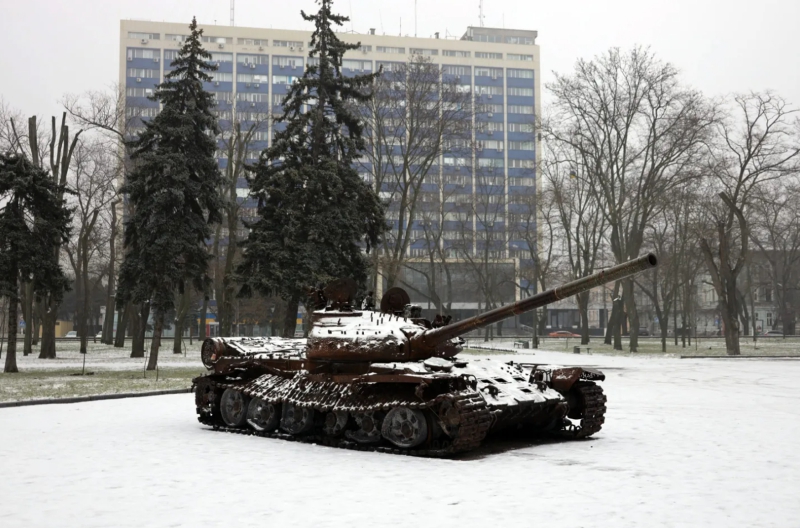
February 24 marked four years since the start of Russia’s full-scale invasion of Ukraine. The war has already surpassed the Second World War in duration and shows no signs of ending soon, remaining the largest and bloodiest conflict in Europe since 1945. The Insider sums up four years of Russia’s war in numbers: people lost, equipment destroyed, resources spent, and the battlefield results “achieved” as a consequence.
According to estimates by DeepState, over the past year Russian forces have taken slightly more than 4,000 square kilometers of territory in the Ukrainian theater of operations, with almost 500 more retaken inside Russia’s Kursk Region, where in August of 2024 Ukrainian forces carried out what remains the last major maneuver offensive operation of the war. As a result of the fighting in 2025, the total area of Ukraine that is under Russian control increased from 18.6% to 19.3%. At their current rate of advance, Moscow’s forces would require several more years just to seize the entirety of the Donetsk and Luhansk regions.
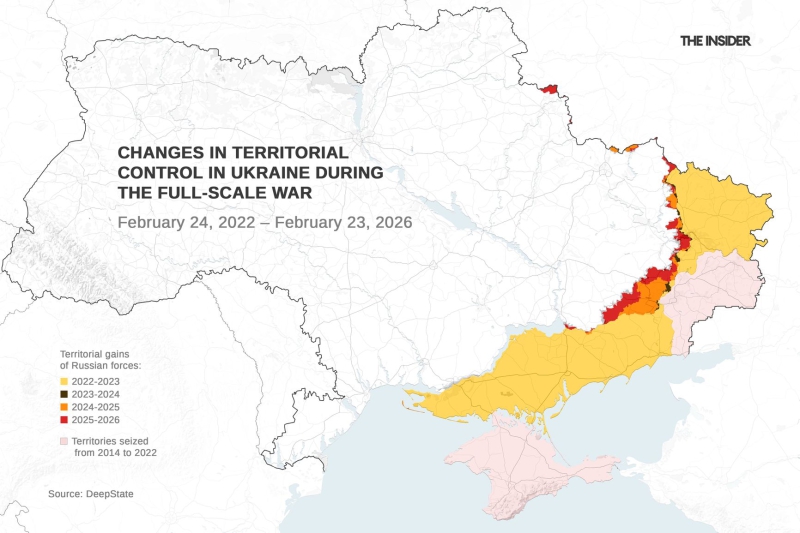
Since the fall of 2023, when Russia launched an offensive that continues along nearly the entire front line, the gains achieved in any direction have not progressed beyond the tactical level, let alone reached an operational–tactical breakthrough. Ukrainian forces are slowly retreating, aiming to maximize losses for the attacking side, while the Russian Armed Forces are advancing just as slowly — often “on credit,” as happened with the declared “liberation” of Kupiansk and Kupiansk-Uzlovy.
According to calculations by the Washington-based CSIS think tank, the pace of Russia’s territorial gains in its largest ongoing offensive operations — the battles for Chasiv Yar, Kupiansk, and the Pokrovsk–Myrnohrad urban area — ranges from 15 to 70 meters per day, even slower than the allies progress in the World War I Battle of the Somme.
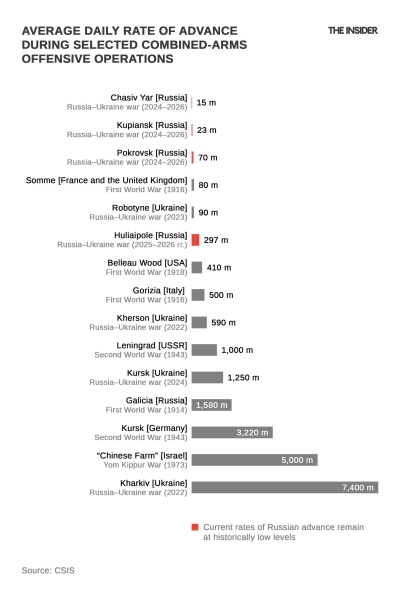
None of the Russian offensive operations mentioned above has resulted in a breakthrough of Ukrainian defenses or an opening into operational depth. Since 2023, the war has been predominantly positional and has become a contest of attrition. A return to maneuver warfare is prevented both by resource constraints and by fundamentally new technological conditions.
A return to maneuver warfare under new technological conditions has proved impossible
An advance measured in mere dozens of meters per day is explained by the complete saturation of the line of contact with drones that conduct surveillance and strike targets up to 10–15 km beyond the front. The expansion of so-called kill zones means that classic mechanized offensive operations have become effectively impossible. This form of “demechanization” also increases the size of “gray zones,” where small assault teams supplied by unmanned ground systems and aerial drones move on foot, following the so-called infiltration tactic.
Infiltration, rather than massing manpower and equipment, is the product of a tactical evolution in the way combat operations in Ukraine are conducted. In 2022, Russian forces were still attempting maneuver warfare using mechanized formations and tank breakthroughs, with artillery and aviation employed as direct fire support assets.
In 2023, as drones were increasingly used as strike weapons (FPV drones and bomb-carrying copters such as the “Baba Yaga”), a gradual shift toward “meat assaults” began. A textbook example is the battle for Bakhmut, where Wagner Group losses alone reached 20,000 killed.
In 2024, small mobile groups conducting high-speed “banzai attacks” on motorcycles, quad bikes, buggies, and other ersatz armored vehicles became the primary assault unit of the Russian Armed Forces. These were used in an effort to “burst through” kill zones as quickly as possible.
By 2025, kill zones and the gray areas bordering them had taken over the entire front. The use of not only mechanized armor but of almost any equipment dropped sharply. Assault teams shrank to pairs and trios attempting to infiltrate the thinning defensive lines between enemy positions.
In 2025, Russian forces appear to have sustained their heaviest losses of the entire war. According to estimates by BBC News Russian and Mediazona, which maintain a name-by-name list of the dead based on open-source reports, the number of Russian soldiers killed will most likely exceed 90,000. So far, the list comprising the whole of the conflict contains 200,186 names, 57% of whom had no connection to the military at the start of the war (these include volunteer soldiers, mobilized men, and recruited prisoners).
In 2025, Russian forces suffered the highest losses of the entire war
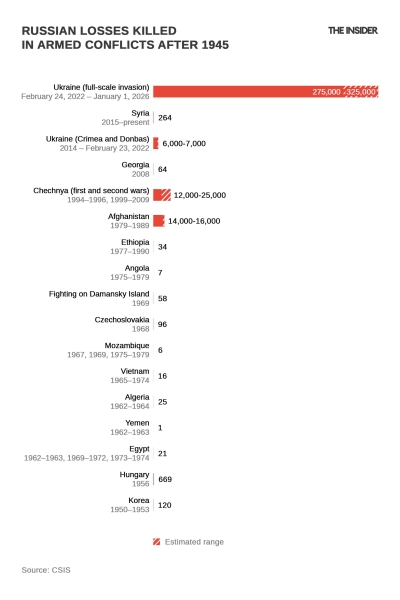
According to CSIS, the number of people killed in the war on the Russian side ranges from 275,000 to 325,000, roughly five times greater than all combat deaths sustained by the USSR and Russia in every armed conflict since 1945, including the operations in Afghanistan and Chechnya.
Total losses in the war — including those killed, wounded, and missing — are estimated at 1.2 million people. No major power has faced losses on such a scale in any war since the mid-twentieth century. And according to the BBC Russian Service and Mediazona, the number of people killed may actually be as high as 468,000.
Total Ukrainian losses are estimated at 500,000 to 600,000 people, including 100,000 to 140,000 killed.
Every square kilometer of Ukrainian territory taken costs the Russian Armed Forces 100 people killed and wounded. Still, until late last year, the influx of new contract recruits made it possible not only to replace losses, but also to form new units and formations. By all indications, however, that balance has shifted.
Western assessments hold that since at least November 2025, monthly Russian Armed Forces losses have reached 40,000 people, with recruitment at 30,000 to 35,000.
At the beginning of 2026, experts recorded the lowest Russian Armed Forces equipment losses of the entire war — only five units over the course of an entire week. Overall, the trend toward reduced equipment losses was evident throughout 2025. Compared with 2024, the total number fell from 5,781 units to 3,222 — a result of the “demechanization” described above. Visually confirmed tank losses dropped from 1,061 to 524, and losses of armored personnel carriers and infantry fighting vehicles fell from 2,934 to 1,329.
According to CIT calculations, more than 2,300 civilians were killed or wounded in Russia in 2025. This is the highest figure since the start of the war, and the rise in civilian casualties is directly linked to the growing intensity and expanding geography of Ukrainian long-range drone and missile strikes against targets in Russia’s rear.
In December 2025, Russian Defense Minister Andrei Belousov disclosed the cost of the “special military operation” for the first time — 11.1 trillion rubles, or 5.1% of GDP. Western estimates reach 10% of GDP, or more than 22 trillion rubles. Up to half of the Russian government’s budget goes to the armed forces, the defense industry, security, and debt servicing.
The Russian economy has fully shifted to a “two-sector model”: defense and related industries are growing and enjoy privileged access to capital and labor, while all others stagnate. Without Western investment or access to international debt markets, the government must raise taxes and borrow domestically in order to cover the rising costs of the conflict.
The image created by Kremlin propaganda of the Russian army as a steamroller relentlessly advancing toward the destruction of its enemy is not even remotely close to reality. In 2025, Ukraine endured both a near-total halt in U.S. military assistance and an unprecedented campaign of Russian strikes on energy infrastructure. Nevertheless, Russia’s several attempts at large-scale offensive operations proved incapable of breaking the stalemate on the front.
At the same time, Russia’s human and material costs from the ongoing “war of attrition” continue to rise: territorial gains are measured in meters, volunteer recruitment no longer covers losses, and the economy is overstretched by wartime spending.