
With November’s mid-term elections fast approaching, Donald Trump has decided to use the Republican primaries as a weapon to fight fellow partisans whom he considers to be insufficiently loyal to him personally. Several members of the House and Senate have already lost to challengers endorsed by the president. However, Trump’s war against the opposition within his own party might not just hamper his legislative agenda and appointments, but also cost the Republican Party its majorities on Capitol Hill.
Доступно на русскомContents
Over the past decade, Donald Trump has achieved something no Republican politician before him managed to do: return to the White House after a failed reelection bid. In the process, Trump established near-total control over the Republican Party, becoming its undisputed leader.
When former Democrat Donald Trump announced in 2015 that he would run for president as a Republican, many politicians treated it as a publicity stunt — or even as a joke. However, as he pushed aside the frontrunners, winning one primary after another, the laughs gave way to anxiety, panic, and even an attempted revolt at the Republican National Convention. When the party officially nominated Trump as its presidential candidate, some Republicans openly declared that they could not support him and would rather sit out the election or vote for Democratic candidate Hillary Clinton.
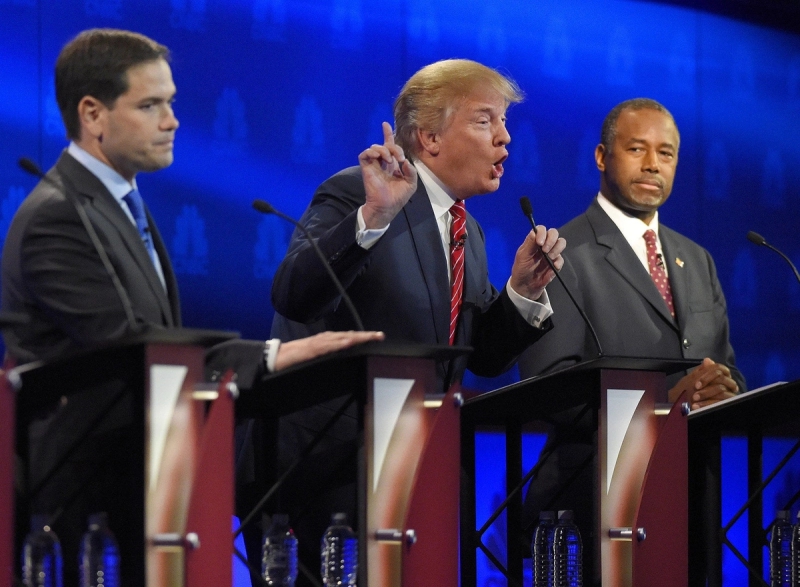
Trump at a Republican primary debate in 2015. To his left is current Secretary of State Marco Rubio
After Trump’s victory, his opponents and critics faced a difficult choice. Some, like former Florida Governor Jeb Bush and Senator Mitt Romney, chose to end their political careers after finding no place for themselves in the transformed party, but only a few — like Liz Cheney — tried to openly oppose the new president. In 2022, she lost her primary race to Trump-backed Harriet Hageman.
Mike Pence, who served as Trump’s vice president during his first term, also became an outcast within the party after refusing to block the certification of the 2020 presidential election results. As a result, his own attempt to challenge Trump in the 2024 Republican primaries failed miserably.
Most Republicans chose to reconcile themselves with Trump and accept him as their party’s leader despite two impeachments and a string of criminal cases. Among the Republicans who came over to Trump’s side after criticizing him back in 2016 are current Secretary of State Marco Rubio, Vice President J.D. Vance, and South Carolina Senator Lindsey Graham.
Having brought the Republican Party under his control, Trump transformed it from an ideological project rooted in Reagan-era conservatism into a right-wing populist force. The key factor in today’s Republican Party is no longer ideology, but personal loyalty to the leader. This means demonstrating the ability to quickly adapt to the president’s position, which on major political issues can shift with remarkable speed. Yet even within the MAGA that Trump created as a counterweight to the traditional Republican establishment, not everyone accepted — or even understood — the new rules of the game.
Some MAGA Republicans, having believed Trump’s campaign promises, quickly became disillusioned. After America experienced its highest levels of inflation since the 1970s during Joe Biden’s presidency, the sweeping tariffs imposed by Trump and the consequences of his foreign policy only accelerated price growth, and his promises to focus on solving domestic problems while abandoning the practice of “regime change wars” abroad were broken with an operation to abduct Venezuelan President Nicolás Maduro and the decision to carry out extensive strikes on Iran. The latter led to the closure of the Strait of Hormuz and a spike in fuel prices in the United States that only put further upward pressure on inflation.
And of course, there is also the matter of the Epstein files. The publication of the files from the criminal case involving the late financier and convicted sex offender had become something of an obsession for conservatives, yet their release was initially blocked by the Trump administration. Publication was only secured through a joint effort by Democrats and MAGA Republicans, a coalition that House Speaker Mike Johnson ultimately proved unable to stop.
One of the first Republicans to draw attention to this shift was conspiracy theorist turned Georgia Congresswoman Marjorie Taylor Greene, one of Trump’s most loyal supporters until their very public parting of ways. MTG, who had always called for the release of the Epstein files, accused Trump of breaking his promises and criticized his administration for failing to respond to rising healthcare costs. In response, Trump declared her a traitor and promised to support a challenger against her in the upcoming primaries. Greene did not wait for the election and resigned from the House of Representatives in January 2026. As a result of her conflict with the president, she began receiving death threats — and according to Greene, Trump told her in private messages that she deserved them.
For voting in favor of releasing the Epstein files, Trump branded Greene a traitor and promised to back her opponent in the primaries
In addition to Greene, one of the leading Republican critics of Trump’s policies in Congress has been Indiana conservative Thomas Massie, another politician fond of conspiracy theories and long seen as friendly to Moscow. Massie co-authored the bill calling for the publication of the Epstein files, which Trump initially opposed only to switch sides after realizing its passage was inevitable. Massie was one of just two Republicans who voted against Trump’s One Big Beautiful Bill, as he was unwilling to support an increase in the national debt resulting from tax cuts. The congressman has also criticized Trump’s foreign policy — from regime change efforts in Venezuela to the war with Iran — accusing Trump of indulging Israeli Prime Minister Benjamin Netanyahu.
The president himself made no effort to hide his irritation with Massie’s disloyalty, calling him “the worst congressman in history,” “an idiot,” and “a sleazebag,” while urging Republicans to throw him out of the party.
To put an end to Massie’s political career, Trump backed his primary challenger: retired Navy special operations captain Ed Gallrein, who barely campaigned, skipped every debate, and spoke to the press only occasionally. Nevertheless, he managed to defeat Massie by nearly 10%, as Trump’s supporters, together with pro-Israel groups, provided Gallrein with unprecedented financial backing. The race became the most expensive congressional primary in history, and of the $34 million spent on campaigning, nearly $20 million went toward ads attacking Massie.
The cases of Greene and Massie demonstrated that Republican politicians unhappy with Trump’s policies and willing to criticize him publicly are left with only two options: leave the Republican Party or prepare for a brutal primary battle against a well-resourced Trump-backed challenger.
A similar story unfolded in the Senate. Republican Thom Tillis of North Carolina refused to support the One Big Beautiful Bill due to the fact that the legislation’s cuts to Medicaid funding could leave more than 600,000 residents of his state without health insurance. Trump responded by calling Tillis “a talker and complainer” and threatened to back a primary challenger against him. Realistically assessing his chances, Tillis ultimately decided not to seek reelection.
Trump called Senator Thom Tillis “a talker and complainer” and pressured him into abandoning his reelection bid
Democrats are now hoping to flip the seat in November by nominating former North Carolina Governor Roy Cooper. Republicans, meanwhile, will field former Republican National Committee chairman Michael Whatley, who was appointed to the position at Trump’s urging. Polls, however, show Cooper leading Whatley comfortably, meaning Republicans could ultimately lose the seat as a result of Trump’s political maneuvering.
Trump has also sought revenge against Louisiana Senator Bill Cassidy. In recent years, Cassidy had established himself as a fairly loyal Republican and Trump ally, consistently supporting the president’s positions in Senate votes. Cassidy, a former physician who supports the science behind vaccines, even conceded to vote to confirm Robert F. Kennedy Jr. as Secretary of Health and Human Services. Even so, Trump accused the senator of disloyalty and brought up Cassidy’s vote in favor of removing Trump from office during his second impeachment trial in February 2021 — after Joe Biden had already been sworn in as president. The North Carolina senator was one of seven Republicans to break ranks at the time; today, only three of them still hold their seats.
In the primary race Trump ultimately backed Congresswoman Julia Letlow, who advanced to the runoff against Louisiana State Treasurer John Fleming while Cassidy finished third with just 25% of the vote. In his concession speech, Cassidy avoided mentioning Trump directly, though he could not resist making an oblique reference to the 2020 election. “When you participate in democracy, sometimes it doesn’t turn out the way you want it to, Cassidy said, “but you don’t pout, you don’t whine, you don’t claim the election was stolen.”
Trump also dealt a blow to the career of Republican Senator John Cornyn, who has represented Texas in the Senate since 2002. Cornyn was seeking a sixth term and advanced to a primary runoff against state Attorney General Ken Paxton. A few days before the vote, Trump publicly endorsed Paxton, saying Cornyn had not been sufficiently loyal to him despite the senator having voted in favor of every major Trump-backed bill. Cornyn lost by more than 25 percentage points.
Paxton’s victory was welcomed not only by Trump, but also by Democrats, who now hope Texas could elect a Democratic senator for the first time since 1988. Their candidate is state legislator and seminary graduate James Talarico, who has actively campaigned in Republican districts, espousing a progressive interpretation of Christianity focused not on the issues of abortion or same-sex marriage, but on helping one’s neighbor, ensuring access to healthcare, and combatting inequality and corporate power.

James Talarico has benefited from Trump’s intervention: thanks to the president’s political maneuvering, he now has a chance to become the first Democratic senator from Texas since 1988
Democrats believe Talarico has an even stronger chance of winning thanks to Paxton’s scandal-ridden reputation (his wife recently filed for divorce over his infidelity). Paxton has also faced a series of investigations into fraud and abuse of office, which previously led to a failed impeachment effort by fellow Texas Republicans. Under these circumstances, even if Republicans manage to hold on to the Senate seat, the party will be forced to deploy enormous financial resources that could otherwise have been spent in other states.
By alienating Republican senators and branding them “RINOs,” Trump risks losing the support he needs to push through his legislative agenda. Senators who lost their primaries will remain in office until the new Congress convenes in January 2027 and may begin acting far more independently now that they are no longer bound by loyalty to Trump. Republicans currently hold 53 out of 100 Senate seats, which means losing the support of even four senators would be enough to block legislation or prevent confirmation of presidential nominees for executive branch posts and federal judgeships.
The first signs of this shift are already visible. Senator Tillis publicly criticized Homeland Security Secretary Kristi Noem during congressional hearings — a few days later, she was fired by Trump. Tillis also blocked the confirmation of Kevin Warsh, Trump’s nominee for Federal Reserve chair, because of a Justice Department investigation into his predecessor Jerome Powell. Trump had accused Powell of refusing to cut interest rates and of wasteful spending. In the end, the Justice Department was forced to back down and closed the investigation.
Senator Cassidy, meanwhile, supported resolutions aimed at prohibiting the use of military force against Iran, despite having consistently voted against such measures before his primary defeat. Yet in the coming months, the confirmation of nominees for labor secretary, as well as the heads of the Centers for Disease Control and Prevention and the Food and Drug Administration, both of which were left vacant after recent resignations, will depend in part on Cassidy’s support.
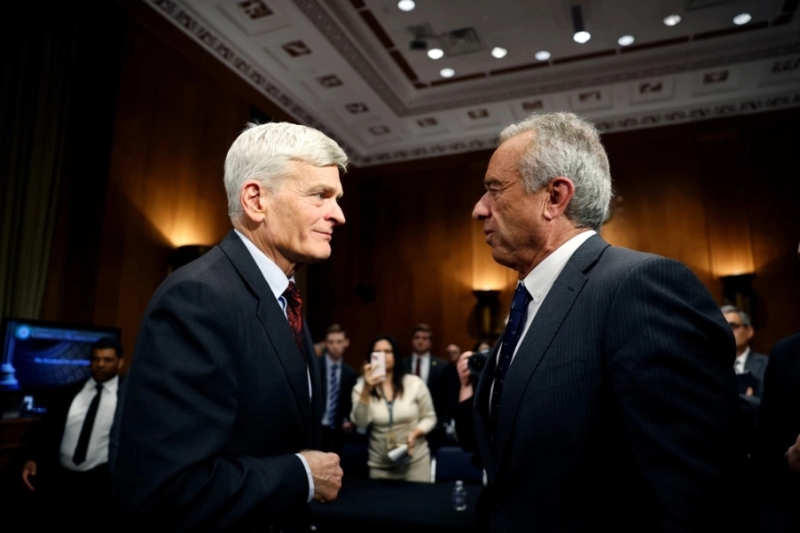
Senator Bill Cassidy with U.S. Health Secretary Robert F. Kennedy Jr.
Over the past few weeks, Tillis, Cassidy, and several other senators have also blocked a vote on approving the budget for federal immigration agencies. They opposed the inclusion in the bill of a $1 billion allocation for the construction of a ballroom on the site of the demolished East Wing of the White House.
Finally, senators criticized the Justice Department’s decision to create a $1.776 billion compensation fund for people allegedly persecuted for political reasons during Biden’s presidency, a group prominently including participants in the January 6 Capitol riot who were later pardoned by Trump.
Trump’s fight against opposition within the Republican Party is not limited to Washington. The president has been actively pressuring state governments to redraw congressional district boundaries. Normally, redistricting takes place at the beginning of each decade following the census. However, the White House has been pushing Republicans to engage in gerrymandering ahead of the 2026 House elections.
Many Republican-controlled states complied and carried out unscheduled redistricting, catching Democrats off guard and leaving them unable to respond with similar measures of their own. Republicans were also aided by the Supreme Court, which allowed the elimination of majority-minority districts, which were created after the passage of the 1965 Voting Rights Act — such districts had mostly been represented by Democratic lawmakers. As a result, Republicans could gain an extra 9 to 10 House seats simply because the lines in certain states have been redrawn.
Not all “red” states, however, yielded to pressure from the White House. In Indiana, the proposed redistricting effort failed because of resistance from Republican state senators. Twenty-one of them — a majority of the 40-member Republican caucus — crossed party lines and voted against the plan, despite Trump warning beforehand that he would back primary challengers against disloyal lawmakers. He also published a list of nine Republican senators who, in his words, “needed help making the right decision.” Three of them said they began receiving threats and false reports of bombs targeting their homes. Police SWAT teams were also repeatedly dispatched to their addresses under false pretenses.
Only 19 of the 40 Republican members of the Indiana State Senate supported Trump’s redistricting plan
Trump ultimately followed through on his threat and endorsed challengers against the dissenting lawmakers. As a result, only two of the “dissidents” managed to survive the May primaries, while six lost to Trump-backed candidates. Organizations linked to the president spent around $13.5 million on the campaigns — tens of times more than is normally spent on races at that level.
Republicans in South Carolina also resisted the president’s demands. Governor Henry McMaster initially said he would not even convene lawmakers for a special session to redraw district boundaries. Under pressure from Washington he reversed his position, but the gerrymandering efforts were nevertheless blocked in the state Senate, where twelve Republicans joined Democrats in voting against the proposal. They are now likely to face highly competitive primaries in 2028.
The president is making no secret of the fact that he is drawing up a list of Republican politicians he may target for insufficient loyalty when primary season begins again two years from now. The list reportedly includes both House members and senators.
One possible target is Colorado Congresswoman Lauren Boebert. Like Marjorie Taylor Greene, she had been a staunch Trump ally but split with him over the White House’s reluctance to publish the Epstein files. She also publicly backed Thomas Massie’s candidacy, after which Trump urged fellow Republicans to run against her.
Another congressman in Trump’s crosshairs is moderate Brian Fitzpatrick, who was elected from a swing district in Pennsylvania. Together with Massie, he voted against the One Big Beautiful Bill and opposed allocating federal funds for the construction of the White House ballroom. Trump has already begun threatening him as well.
Storm clouds are also gathering over some Republican senators who will come up for reelection in 2028. Kentucky Republican Rand Paul voted against the One Big Beautiful Bill because of its impact on the national debt, prompting Trump to call him a “sick psycho.” Paul also co-authored a number of resolutions seeking to bar Trump from using military force against Venezuela and Iran without congressional approval.
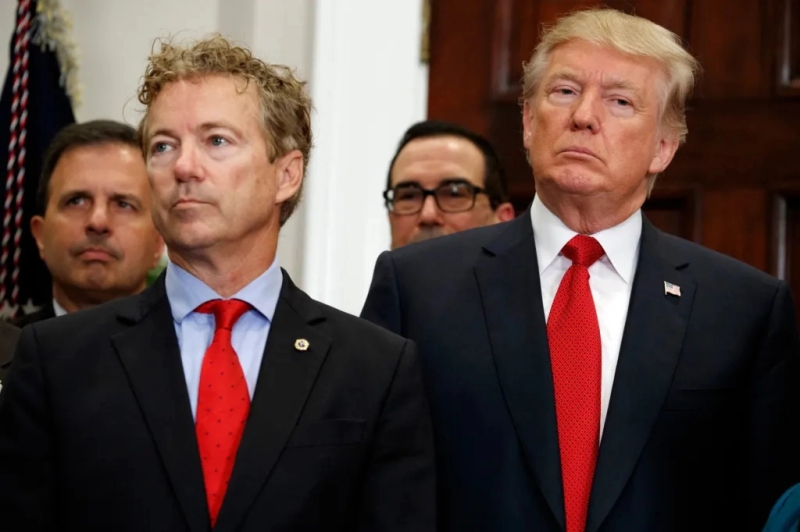
Trump would likely prefer to erase his Republican critic, Senator Rand Paul, from this photo
Those same resolutions were supported by moderate Alaska Senator Lisa Murkowski, drawing Trump’s anger as well. Trump already tried to unseat her in 2022 by endorsing a more conservative challenger and demanding that the Alaska Republican Party censure her. Murkowski nevertheless managed to win reelection.
Several establishment Republicans will also face reelection in 2028, including Indiana’s Todd Young, Louisiana’s John Kennedy, North Dakota’s John Hoeven, and Senate Republican leader John Thune of South Dakota. It is entirely possible that Trump will attempt to purge some of them as well for failing to advance his agenda with sufficient zeal.
For Trump, maintaining personal control over the Republican Party appears to matter more than securing a congressional majority. He sees the legislative branch as too slow and unwieldy, which is why he has sought to implement his key initiatives primarily through the executive branch, where he has already carried out sweeping purges and consolidated control.