
In April 2026, Volodymyr Zelensky reported the first instance of Ukrainian drones and ground robotic systems (GRS) capturing a position and taking enemy fighters prisoner without infantry involvement. In the first three months of 2026 alone, Ukrainian ground drones completed 22,000 missions at the front. Some compare their proliferation to the revolution of military affairs seen in the early 20th century, which was marked by new technologies such as machine guns, tanks, and aircraft. GRSs perform numerous tasks on the front line: logistics and evacuation missions, mining and demining, reconnaissance and combat operations, electronic warfare support, and FPV drone deployment.
Доступно на русскомContents
Modern ground robotic systems trace their origins to experiments conducted more than a century ago, when the first simple remote-control systems emerged. In 1903, Spanish engineer Leonardo Torres Quevedo created a device called El Telekino, which received commands via radio waves and converted them into mechanical actions.
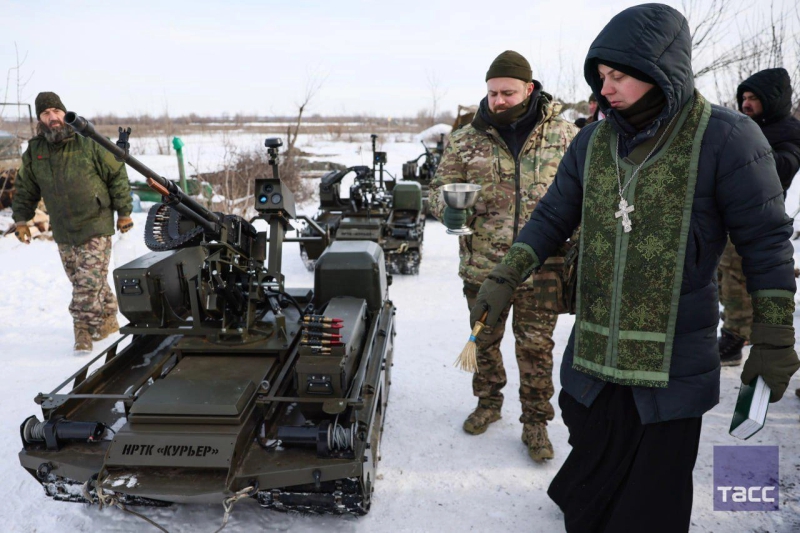
The forerunners of modern combat systems were radio-controlled teleoperated tanks like the Soviet TT-26, developed in the 1930s. In the 1980s, following the Chornobyl nuclear disaster, specialized remotely operated vehicles began to appear for use in hazardous zones. In the mid 2010s, Russian robotic systems Uran-9 and Uran-6 were tested during military operations in Syria. The obtained operational experience informed the development of more advanced models, such as the NRTK Kuryer (NRTK is the Russian abbreviation for GRS).
A key driver behind the rapid development of ground robots during the Russia-Ukraine war has been the near-impenetrable “kill zone” stretching dozens of kilometers on both sides of the frontline, the result of extensive aerial drone use by both sides. The first GRS operator companies in the Defense Forces of Ukraine (DFU) appeared as early as the first half of 2024, while the Russian armed forces began catching up considerably later. Critical logistics challenges were among the main reasons for the sharp rise in the prominence of GRS in 2025, but an additional driver was the personnel shortage caused by failures of mobilization policies and widespread desertion.
In order to further prioritize the preservation of soldiers’ lives, tech-savvy Ukrainian commanders began delegating as many frontline tasks as possible to robots. Notably, given the one-time compensation of 15 million hryvnias (around $340,000) paid for each fallen AFU fighter, a soldier’s life costs the state far more than a robot. If the soldier survives, the same amount could buy and deploy around 35 robots on a combat mission.
A soldier’s life costs the state far more than a robot
Russia’s circumstances are similar. The one-time payment upon the death of a serviceman in the so-called “special military operation” amounts to 13.9 million rubles plus a regional component of 1 to 3 million rubles (totaling between $206,000 and $234,000) — equivalent to the cost of 15–17 NRTK Kuryer chassis.
Ukrainian authorities have been consistently incentivizing the use of technological solutions. In September 2025, Minister of Digital Transformation Mykhailo Fedorov (now the Minister of Defense) announced that e-points under the Army of Drones Bonus program would be awarded not only for striking enemy targets but also for logistics operations carried out with the use of GRS.
To earn e-points, units need to document the completion of a mission and submit confirmation to the system, just as they do when striking enemy targets with drones. Troops can use the accumulated points to order new GRS systems tailored to their unit’s needs. At the time, 10 types of robotic systems were available for points on the Brave1 Market platform; now there are around 90.
Ukraine’s Ministry of Defense Procurement Agency has signed contracts with GRS manufacturers to enable the swift supply of systems on order for military units under the Army of Drones Bonus program.
The DFU owes much of the scaling of ground drone use to Robert ‘Madyar’ Brovdi, the commander of the Unmanned Systems Forces. As early as the summer of 2025, he identified the “deployment of ground robotic systems as the primary logistics tool for delivering munitions, drones, and peripherals to operators at positions.” Moreover, the expansion of Unmanned Systems Forces units to the regiment and brigade level brought the GRS subunits within them to a qualitatively new level.
In early April 2026, Ukraine’s Ministry of Defense declared its intention to reduce the risks to personnel by transferring frontline logistics tasks to ground robotic systems where possible. While only 67 DFU units were using GRS for missions in November 2025, by March 2026 that number had grown to 167.
In April, GRS completed more than 10,000 missions at the front, compared to just 2,900 in November 2025. In April, Defense Minister Fedorov set a goal of outsourcing 100% of frontline logistics to robotic systems, and the DFU plans to replace up to 30% of its personnel in the most challenging sections of the front with robots by the end of 2026.
On April 15, Ukraine’s Ministry of Defense announced the introduction of drone assault units that integrate aerial and ground drones with infantry. According to official assessments, this approach has proven effective in the South Donetsk sector, where these new units have liberated significant territory since February.
Ukraine is deploying drone assault units that combine ground and aerial drones
The ministry also revealed plans to contract 25,000 GRS in the first half of 2026 — twice as many as in all of 2025. Additionally, a GRS competence center under the Ministry of Defense will be established, intended as the sole platform for interaction between manufacturers and the military and a catalyst for the deployment of robotic systems at the front. This year, manufacturers will receive contracts for 2027, enabling them to plan production and ensure the necessary supply volumes.
The industry’s rapid progress is also evidenced by a special competition for GRS manufacturers held in Kyiv in February 2026. During the trials, robotic platforms had to navigate obstacles, orient themselves in terrain, and locate and film special markers placed in trees.
Defense Minister Fedorov noted in April that the GRS segment had become one of the most dynamic areas of defense tech in Ukraine. At the start of the full-scale war, the country had to build this industry from scratch; now it has since grown into a fully-fledged market with more than 280 companies.
Ukraine’s GRS segment has grown into a fully-fledged market with more than 280 companies
The DFU is seeing an ever larger number of successful GRS deployments for missions involving logistics, evacuation, assault, mining, and demining, and GRS are also used as mobile EW platforms and for launching FPV drones. Major Volodymyr Rovensky, an officer in the Ground Systems Development Section of the Unmanned Systems Command at Army Command, reported that 47% of all GRS missions involve logistics and evacuation, around 25% involve engineering tasks, and the remainder involve combat operations and special objectives.
GRS are critically important for logistics tasks such as delivering water, ammunition, and mines to the line of contact. These vehicles were first used on a large scale during the Battle of Pokrovsk, where intense drone surveillance made unit rotations exceptionally risky. As a result, soldiers often remained at their positions for weeks, sometimes even months.
According to the Unmanned Systems Directorate of the 7th Corps of the AFU’s Air Assault Forces, GRS accounted for around 90% of all logistics in certain areas of the Pokrovsk sector. The Termit robot, resembling a small turretless tank and capable of carrying around 200 kilograms of cargo, delivered water, fuel, and ammunition to troops.
GRS themselves, however, remain highly vulnerable to UAVs and mines. Other challenges include their limited range, insufficient terrain mobility, and significant thermal emissions — at low temperatures, a robot appears as a bright red target on surveillance devices. Near Pokrovsk, a single logistics platform survived for an average of just two sorties. Yet this is precisely the point of robotic logistics: machines taking the hit instead of people.
Telegram
GRS are increasingly being used to evacuate wounded soldiers, civilians, and even other unmanned vehicles. One of the most notable operations was carried out in November 2025 by the 1st Separate Medical Battalion using an original GRS called MAUL, developed within the unit and equipped with an armored capsule. In this case, 33 days had passed from the moment of injury. Over that time, six unsuccessful evacuation attempts had been made in which Ukrainian forces had lost six robotic platforms. The seriously wounded soldier was being evacuated from a settlement under Russian control. During the successful attempt, the GRS hit an anti-personnel mine but continued moving on a damaged wheel. The platform also came under UAV attack, but the armored capsule protected the soldier inside. In all, the GRS covered a distance of 64 kilometers, 37 of them after sustaining damage from the mine explosion.
Telegram
During such missions, operators maintain constant communication with the wounded soldier. Servicemen of the 92nd Separate Assault Brigade of the AFU recall a case in which a soldier who was being evacuated pulled out a grenade — for unknown reasons — and held it in his hands for part of the journey. Communications operators talked to the wounded man, trying to calm him down. The soldier was ultimately delivered safely to a secure area, where medical personnel picked him up.
Telegram
In March 2026, a Sirko-S1 GRS serving with the 100th Separate Mechanized Brigade was returning from a logistics mission in Kostiantynivka in the Donetsk Region (geotagged). While en route, it discovered a group of soldiers, one of whom was wounded. Pulling up closer, the robot took the wounded soldier on board and delivered him to the evacuation point at maximum speed.
Footage is also available of a joint evacuation operation carried out by the Skelia 425th Separate Assault Regiment and the 1st Separate Medical Battalion in late May. A wounded soldier who was semi-encircled was evacuated using a GRS fitted with an armored capsule. During the mission, the robot ran over two anti-personnel mines but managed to continue moving and successfully reached its destination.
The Lava Unmanned Systems Regiment of the Khartia Corps evacuated three wounded soldiers in one go on a single ground robotic system. Although the mission took place in winter under constant shelling, the operators managed to evacuate a soldier in critical condition and two others with less severe injuries. While in transit, the wounded soldiers assisted the GRS operators by watching the sky to warn of approaching Russian drones and clearing mud and ice from the robot’s camera.
GRS are also used to rescue civilians from areas that are under constant bombardment. Soldiers of the 60th Mechanized and 3rd Separate Assault Brigades evacuated a 77-year-old woman from the combat zone using a robotic platform capable of carrying her belongings. The elderly woman had left her village on crutches, apparently intending to evacuate on her own, but fell by the roadside. She was spotted by a drone, and a robot was sent to assist her. To help the woman understand she was being rescued, the GRS had “Babusya, sidai!” (“Grandma, get in!” in Ukrainian) written on it. The evacuation to safety was successful.
GRS are used to rescue civilians from frontline areas
Paratroopers of the 25th Separate Sicheslav Airborne Brigade of the 7th Airborne Assault Forces Corps evacuated another elderly woman who did not want to end up under Russian occupation from the town of Dobropillia north of Pokrovsk. The mission was complicated by constant shelling and the threat of drone strikes, and in this case two soldiers also took part. Some of the evacuee’s belongings were loaded onto a GRS, but the woman herself had to walk several kilometers, taking cover from Russian drones along with the troops.
In the Lyman sector, soldiers of the 3rd Army Corps used a GRS to evacuate four civilians from the gray zone. The elderly residents of a frontline village required assistance, and one of the women was wounded. The evacuation took place in stages: the civilians were first transported by GRS, then by boat before finally being handed over to medical personnel.
Telegram
The Kholodnyi Yar 93rd Separate Mechanized Brigade adapted ground drones to evacuate damaged GRS and UAVs from the frontline, effectively turning them into robotic recovery vehicles. To evacuate damaged equipment, GRS are fitted with additional engineering equipment, such as a mechanized tow system for hauling other GRS and mechanized forks for recovering UAVs. The forks allow crews to pick up fallen drones, including heavy hexacopters of the Vampire type, known on the Russian side as Baba Yaga. The brigade notes that even drones damaged beyond repair can still be harvested for spare parts.
Telegram
Similar footage was published by other Ukrainian units. For example, a soldier from the HUR’s Khymera unit published a video of a GRS evacuating another disabled robotic system from the battlefield. Meanwhile, soldiers of the Combat Hawks Unmanned Systems Battalion of the 25th Sicheslav Brigade, 7th Airborne Assault Corps, demonstrated how they evacuate damaged UAVs in the Pokrovsk area.
Telegram
GRS are indispensable for mining and demining operations. “A single Termit drone managed to lay more than 1,500 anti-tank mines before the Russians destroyed it with a barrage of FPV drones,” said Maksym Vasylchenko, co-founder and CEO of Ukrainian GRS manufacturer Tencore.
For reconnaissance tasks, a robotic system can be deployed to forward positions for several days, continuously monitoring the situation and relaying information to DFU units. Using GRS for reconnaissance reduces risks to personnel, as a robot is significantly harder to detect and track than a human reconnaissance team. The Ukrainian tracked ground reconnaissance and relay system Plyushch can “sit in ambush” for four days and monitor the movements of enemy units.
The 93rd Separate Mechanized Brigade documented an episode involving the destruction of a Russian mechanized column near Kostiantynivka in which a ground robotic reconnaissance system played a key role. Russian forces attempted to advance under fog, counting on the reduced effectiveness of Ukrainian UAVs. However, a GRS scout detected the moving vehicles and relayed target coordinates to FPV drone operators, which successfully struck the Russian column.
A GRS combat deployment similar to the one described by Zelensky — though still involving active infantry participation — occurred in the summer of 2025 in the Kharkiv Region, becoming one of the first known cases of ground robots storming a position. The 3rd Separate Assault Brigade was tasked with establishing full control over a fortified Russian shelter. Infantry groups were positioned approximately five kilometers from the target, and the assault began with the deployment of two ground suicide robots and UAVs. One robot destroyed the entrance to the Russian position, after which the second began approaching the shelter. In response, Russian soldiers signaled their surrender by raising a cardboard sign. Drones escorted two Russian soldiers to the nearest Ukrainian position, where they were taken prisoner. Ukrainian infantry then took control of the fortification without firing a single shot.
Ukrainian media covered another notable case of GRS use in April. In the village of Ternuvate on the border of Zaporizhzhia and Dnipropetrovsk regions, a GRS equipped with a machine gun opened fire on a building sheltering Russian assault troops, forcing them to surrender. The soldiers came out with their hands raised and lay down on the ground in front of the robot.
A Droid TW 12.7 GRS by Ukrainian company DevDroid, operated by the NC13 assault GRS company of the 3rd Separate Assault Brigade, held a position on one section of the front for roughly six weeks. According to the unit commander, the machine-gun-equipped GRS was tasked with controlling an intersection in a village through which Russian forces regularly attempted to conduct attacks. Every morning for a month and a half, operators deployed the robotic system on combat duty and brought it back in the evening. During that time, the Droid TW 12.7 successfully completed several fire missions against the enemy, and Russian forces never managed to pass through that section.
Telegram
The first documented case of armored vehicle destruction by a ground drone in combat was described in December 2025 by Mykhailo Fedorov. Ukrainian forces received intelligence on the planned route of Russian assault troops and promptly deployed a Droid TW 12.7 GRS equipped with an M2 Browning machine gun, digital communications, Starlink, and LTE. The robot took up its position and waited for the Russian MT-LB. Opening fire on the frontal section, the drone disabled the vehicle’s control system, causing it to lose control, then shot up the troop compartment. Later, reconnaissance UAVs of the 5th Separate Assault Brigade recorded the results of the ambush: a disabled vehicle and the bodies of several killed Russian soldiers in a tree line.
In February 2026, the special operations company of the Lava Unmanned Systems Regiment of the Khartia Corps conducted a clearing operation against Russian infantry in Kupiansk using ground robotic systems. Both armed GRS and suicide robots loaded with hundreds of kilograms of explosives were used to strike Russian positions held by ten soldiers. Once the positions were fully cleared, Ukrainian units could occupy them.
Telegram
During fighting in the Kupiansk sector in late May, soldiers of the 115th Separate Mechanized Brigade cleared the village of Novoplatonivka in the Kharkiv Region. During the operation, a GRS provided support and fire cover for the assault group.
In addition, Ratel Robotics has unveiled the Ratel H system with a new module: a drone launch platform capable of transporting UAVs to dangerous areas and launching them without operators at the launch position. The use of fiber-optic control combined with a ground carrier reduces UAV vulnerability to electronic warfare tools and provides a more stable control link during combat operations. Russian pro-war channel Military Informant demonstrated the deployment of such a GRS at the line of contact.
EW modules mounted on GRSs create a “dome” to protect personnel and equipment from FPV drones and loitering munitions. In May, Serhii ‘Flash’ Beskrestnov reported that Russian forces are widely using robotic systems outfitted with EW systems and positioned in front of Russian troops with their antennas facing rearward in order to suppress Ukrainian drones that fly past them.
In the meantime, Russia is also advancing its drone innovations. The Russian Armed Forces’ use of a new generation of GRS first became known in 2023. For about a year, they underwent combat trials — carrying supplies, evacuating the wounded or killed, and sometimes serving as suicide drones. Most of the systems in use at the time were modified Chinese robots, but by 2024, the situation began to change. Russia’s military acquired its first domestically developed serial-production GRS, and the tracked NTRK Kuryer, an analog of Ukraine’s Termit, soon became one of the most widespread GRS in the Russian army.
Telegram
Propagandists report that thousands of such platforms have allegedly transferred to dozens of units. The system regularly appears in videos in various configurations: originally it existed in logistics and combat versions — the latter outfitted with a machine gun or an automatic 30mm AGS-17 grenade launcher. Subsequent modifications featured EW systems and capabilities for mining, demining, and smoke screen deployment.
Telegram
Other GRS have also appeared alongside it: the tracked Impuls-M, Omich, Bogomol, the wheeled Depesha, and the Chelnok heavy tug. State Watch has identified 32 Russian GRS models, with legal entities established for 29 of the manufacturers. Combat use in the war against Ukraine has been documented for at least 20 GRS types.
Sanctions restrictions barely affect the Russian companies supplying robotic systems to the front. Of the 20 identified manufacturers, 10 are under U.S. sanctions, nine under Ukrainian sanctions, and three under EU sanctions. Still, the manufacturers are able to source components from the rest of the world, primarily from China.
Russia’s armed forces have 32 GRS models in their arsenal, with combat use documented for at least 20
The main pitfall for Russia’s frontline GRS deployment is communications. Russian troops previously actively used Starlink terminals, which provide stable communications with an unlimited range. However, after unregistered terminals operating on the territory of Ukraine were blocked in February 2026, most Russian units had to revert to radio-channel control, which has limited range and stability due to terrain distortion and Ukrainian EW. To compensate, Russian forces attempt to set up signal repeaters to create a mesh network and send Mavic drones to escort vehicles.
Fiber-optic communications are also used, despite the risk of cable breakage. In some cases, operators are forced to stay with the robotic system to control it, which effectively negates the very premise of a robotic system — operator safety.
The relatively low scale of GRS use by Russian forces is confirmed by recorded losses. According to the Oryx and Válka.online portals, which count vehicle losses based on published photos and videos, at least 71 Russian GRSs had been knocked out by April 1. To compare, Ukraine lost 207 ground drones, indicating their far more extensive use. The use of horses and other pack animals by Russian forces also indirectly points to challenges when it comes to finding technical solutions for frontline logistics.
Blessing of the NTRK Kuryer robotic system of the Nevsky Volunteer Reconnaissance-Assault Brigade, Jan. 27, 2026
Russian pro-war observers acknowledge that Russia’s armed forces are lagging behind Ukraine in adopting new technologies. Alexei Chadayev, head of the Ushkuynik Research and Production Center, admitted to a decline in GRS use while the Ukrainian army expands its deployment of ground drones. Beyond the communications problems following Starlink’s disconnection, which resulted in robots regularly losing their signal in any low-lying terrain, the situation is made even worse by military bureaucracy and commanders’ fear of losing expensive but slow equipment that is vulnerable to enemy FPV drones. In the field, robots have yet to be treated as expendable, meaning that from an operational perspective it is easier for a commander to risk a soldier’s life than to risk a valuable piece of equipment.
To remedy the situation, Chadayev proposed launching mass production to reduce robot costs, deploying a digital communications network over the combat zone using aerostats, reinforcing platform protection to make hunting GRS economically unprofitable for the enemy, expanding robot functionality for EW and air defense tasks, and shifting from training individual operators to working up entire unmanned supply units at rear training grounds.
As of now Ukraine is comfortably in the lead when it comes to the scale and intensity of GRS application for military purposes. In response, the Russian side will likely focus on mass production and scaling of several basic GRS models. Victor Pavlov, founder of the GRS school of Ukraine’s Third Army Corps, said that according to Ukrainian intelligence, Russia selected several GRS models for serial production in 2025. However, he cautions that despite Ukraine’s superiority over Russia in the development and deployment of ground robots, Russia has a different advantage: a more centralized defense industry.
In Russia, once specific models are selected, production ramps up quickly. Enterprises are given clear targets, a doctrine of use is developed, and mass personnel training is organized. As a result, technologies that are adopted with a delay are subsequently used on a significantly larger scale. The growth of Russia’s Unmanned Systems Forces may also contribute to this development: according to Ukrainian intelligence, their strength stood at around 101,000 personnel in early April 2026, with plans to expand to 165,500 by year’s end.
Meanwhile, communications remain the key constraint on the large-scale deployment of ground robotic systems. As a CIT expert who wished to remain anonymous noted, on the front line, ground drones without a reliable control channel lose their effectiveness. In his view, Russia’s armed forces will not have an alternative to Starlink comparable in capability and communications stability in the foreseeable future.
He also notes that in terms of the number of GRS, the Russian army will likely achieve formal parity and find various workarounds for communications. However, the gap in real effectiveness will likely persist due to problems with control channels.
Military expert Kyrylo Mykhailov emphasizes that ground drones are particularly sensitive to any obstacles between the operator and the platform, and the use of aerial relays makes the control system vulnerable to Ukrainian interceptor drones. He also points out that as GRS become increasingly important for tasks involving excessive risk to personnel (in logistics, evacuation, mining, and the search for “waiting” drones), their dependence on batteries and communications channels will increase. At this stage, these technologies are not sufficiently developed to allow them to fully replace infantry.
The CIT expert agrees that the scale of ground robotic system use at the front will continue to grow, primarily in the area of logistics, but their capabilities in direct combat operations remain limited for now.