
Last month both Donald Trump (May 13-15) and Vladimir Putin (May 19-20) made highly publicized trips to China. Notably, Serbian President Aleksandar Vučić made a similar visit (May 24-28), returning home with a package of signed agreements and a golden Medal of Friendship. Belgrade’s rapprochement with Beijing and the rapid growth of Chinese investment in the Balkans further highlight the limits of Russia’s influence in Serbia, especially as cooperation with Moscow becomes increasingly toxic. A more neutral Beijing, which does not require Serbia to abandon European integration in order to achieve its aims in the region, is easily taking over Moscow’s former role as Serbia’s key partner in the East.
Доступно на русскомContents
On May 25, Serbian President Aleksandar Vučić appeared to tear up slightly as Chinese leader Xi Jinping presented him with a gold Medal of Friendship, Beijing’s highest award for foreign citizens, given for outstanding contributions to China’s modernization, the development of ties with other countries, and the strengthening of world peace. Vladimir Putin was its first recipient, and since his ceremony in 2018, only 14 others have enjoyed the honor. In Europe, the only other holder of the Chinese order is former French Prime Minister Jean-Pierre Raffarin.
Judging by the multitude of joint projects involving Chinese capital investment in Serbia, Vučić’s task is to help Beijing open a window into Europe. His warm reception by Xi suggests he is performing that role reasonably well. Serbia is among China’s main European partners in the Belt and Road Initiative, which Beijing is using to expand control over sea and land routes in Asia, Africa, and Europe. Meanwhile, observers in Beijing noted that Vučić appeared emphatically confident, demonstrating independence in his choice of foreign policy partners.
In recent years, China has crowded out Belgrade’s longtime economic partners, moving closer to Germany, which still leads the list. According to Serbian data, overall trade with China grew by a factor of 6.7 from 2012 to 2025, while Serbian exports to China increased by a factor of 333. In dollar terms, bilateral trade in 2025 reached $9.36 billion, while exports from Serbia amounted to only $2.1 billion.
Serbia’s trade volume with China rose by a factor of 6.7 from 2012 to 2025, while Serbian exports to China went up by a factor of 333
Cooperation now covers more and more areas, including military technology. In fact, Serbia is the only European country currently buying weapons from China. According to media reports, Serbia’s defense industry imported 240 million euros’ worth of goods from China in 2024 and 2025, and last year, troops from the two countries held their first joint exercises — in northern China’s Hebei province.
Vučić calls his country’s cooperation with China “ironclad” and characterizes his May visit to Beijing as “the most important” of his political career. China’s leadership called it “historic.” More than 30 agreements were announced, intended to help Serbia attract new multimillion-dollar investments.
Serbia’s foreign policy still rests on four pillars: the United States, Russia, China, and the European Union, with membership in the latter remaining a key strategic goal.
In recent years, Serbia has had to constantly balance between partners, protecting itself from the damaging effects of the war in Ukraine while advancing its own interests. Since the start of Russia’s full-scale invasion in February 2022, Serbia’s integration into the EU has slowed, mainly because of Vučić’s refusal to join Western sanctions efforts.
Indeed, the Kremlin’s confrontation with the West has created many problems for Belgrade. Serbia buys Russian gas but also needs financial support, investment, and security guarantees for Serbs still living in Kosovo. Resolving those issues depends mainly on Washington and the European Union, which are unhappy with Belgrade’s opaque ties to Moscow and its excessive energy dependence on Russia.
The Kremlin’s confrontation with the West has created many headaches for Belgrade
Under the circumstances, Serbia’s relationship with China has become a source of stability, with some even calling friendship with Beijing a “safe harbor.” Still, Belgrade’s Western partners are unhappy with China’s expansion in the Balkans, especially when it comes to questions of corruption, the use of forced labor, and environmental pollution. Brussels also points to a lack of transparency: all Chinese infrastructure projects in Serbia have been adopted without tenders, merely on the basis of direct state agreements.
Belgrade’s growing borrowing is also raising concerns. The main loans for infrastructure projects have come from the Export-Import Bank of China (China Exim Bank). Serbia’s debt to the bank is estimated at 2.8 billion euros, or 11% of its total external debt.
Vučić has developed his own way of dealing with the worlds’ economic powers, showing gratitude, offering flattery, and producing internet-friendly moments. In China, he has even been given a playful nickname — the number 577, which sounds similar to his surname in Chinese. He learned about the moniker while signing a basketball.
During a visit to China six years ago, Vučić delivered a short address in Chinese. The video drew hundreds of thousands of views and inspired jokes and memes, bringing Chinese-Serbian cooperation a shot of public goodwill.
Still, many in the Balkans continue to see China as an alien civilization, and Vučić’s domestic opponents say he made a serious mistake several years ago by signing a free trade agreement with the country. Their concern, they say, is not cooperation itself but the unequal terms behind it. The opposition has also asked pointedly what values Vučić shares with China’s Communist Party: one-party rule, censorship, the arrest of human rights activists, or the use of tanks against students?
The sarcastic remarks are an open reference to Vučić’s increasingly authoritarian style of rule, as for a second year in a row he has been unable to bring mass protests under control. One of the largest rallies coincided with his visit to China.
The protests have continued since Nov. 1, 2024, when the collapse of a canopy at the railway station in Novi Sad killed 16 people — the disaster occurred after the building had been renovated by a consortium of Chinese companies. Vučić, nevertheless, has managed to hold on to power and continues to express his readiness to build a “Chinese-Serbia community with a shared future.”
The process did not begin with Vučić. In 2009 Serbia’s then-President Boris Tadić signed a strategic partnership agreement in Beijing. The first major investments followed Xi Jinping’s visit to Belgrade in 2016, when the Chinese bought Serbia’s largest steel plant, Železara Smederevo, for 46 million euros (it is now called HBIS Serbia). Before the Chinese entered the picture, U.S. investors had shown interest in the loss-making plant, which has its own port on the Danube, but the deal did not work out.
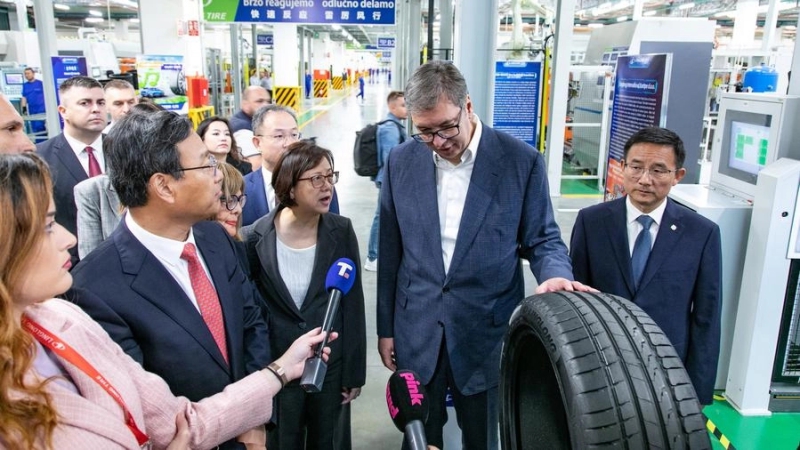
One of the key Chinese investment projects in Serbia is Linglong’s tire factory in Zrenjanin, a city in the country’s northern province of Vojvodina. The plant, worth $990 million and capable of producing 13 million tires a year, is the Chinese manufacturer’s first major facility in Europe. In total, Serbia has several dozen large production sites involving Chinese capital, employing about 40,000 people.
Chinese businesses are also actively investing in transport corridors and railways linking Belgrade with European capitals. Such projects include the Danube Corridor and the Belgrade-Budapest high-speed railway.
Vučić at a Chinese tire factory in Serbia
Chinese companies are also building metro infrastructure in Belgrade and rapidly constructing the EXPO 2027 exhibition complex ahead of the first such event to be held anywhere in the former Yugoslavia. The expo complex is being created as a multifunctional space and, in addition to exhibition halls, will include commercial, hotel, and residential facilities.
Also of note, while in China Vučić was shown advanced developments in artificial intelligence and humanoid robotics. The robots even danced for the guest of honor while their creators expressed hopes that Serbia could become one of Europe’s main centers for producing them.
Vučić’s enthusiasm for Chinese technologies and investment leads to an obvious question: given Belgrade’s deepening relationship with Beijing, what areas of cooperation remain for Moscow to fill?
Before February 2022, Vučić openly sympathized with the Kremlin and even stressed Putin’s superiority over other world leaders (especially when communicating with a Russian audience). As a result, Vučić consistently received discounts on Russian natural gas and regularly held military exercises with Moscow’s forces (even if he complained that he didn’t have enough money to buy Russian S-400 missile systems).
Such displays led Vučić to be seen as a Kremlin ally when it came to Moscow’s efforts to undermine EU influence in the Balkans. In reality, however, Vučić is focused on receiving whatever benefit he can via cooperation with all potential partners. He never intended to exchange ties with the European Union, which accounts for two-thirds of Serbia’s foreign trade, for a Eurasian future that clearly cannot offer comparable opportunities when it comes to investment, trade, and technological exchange.
Therefore, it should come as little surprise that since 2022 Serbia has not hosted any senior Russian officials, and Vučić himself no longer travels to Moscow. These days, contacts take place at a lower level, with Serbian Energy Minister Dubravka Đedović Handanović and International Economic Cooperation Minister Nenad Popović attending events like the St. Petersburg International Economic Forum earlier this month. Before them, Aleksandar Vulin, chairman of the supervisory board of the state company Srbijagas, visited Moscow. Popović and Vulin are the Russian authorities’ most frequent Serbian interlocutors, and in recompense for their efforts, both have found themselves included on U.S. sanctions lists since 2023.
Vučić no longer travels to Moscow, but contacts still take place at a lower level
Vulin previously headed Serbia’s Security Intelligence Agency, and before that he served as the country’s defense minister and interior minister. The United States has accused him of having ties to organized crime and drug trafficking, along with participation in corrupt deals that “facilitated Russia’s malign activities.”
Popović, who owns numerous companies in Serbia and Russia, was accused by the U.S. of “corruption and tax fraud.”
Belgrade’s refusal to impose sanctions on Russia has flattered the Kremlin’s ego in recent years, allowing Moscow to claim that it prevented the West from building a united anti-Russian front in Europe. Still, the Serbian exception has brought the Kremlin little practical benefit. Since 2022, trade between Russia and Serbia has fallen by nearly half, to $2.3 billion, and although Serbia still considers Russia a “reliable partner in gas supplies,” Belgrade receives only short-term, three-month contracts (even though Serbian authorities had hoped to sign a three-year agreement in 2025).
In effect, relations between the two countries have reached a low point, a status all the more evident now that the future of energy giant NIS, Russia’s main asset in the Balkans, has been thrown into doubt. After buying a controlling stake in the company in 2008 and 2009, Gazprom Neft turned the loss-making enterprise into a profitable corporation. However, U.S. sanctions, accompanied by demands that Russian capital be excluded from the company’s ownership structure, have led to talks aimed at selling Gazprom’s stake to the Hungarian company MOL.
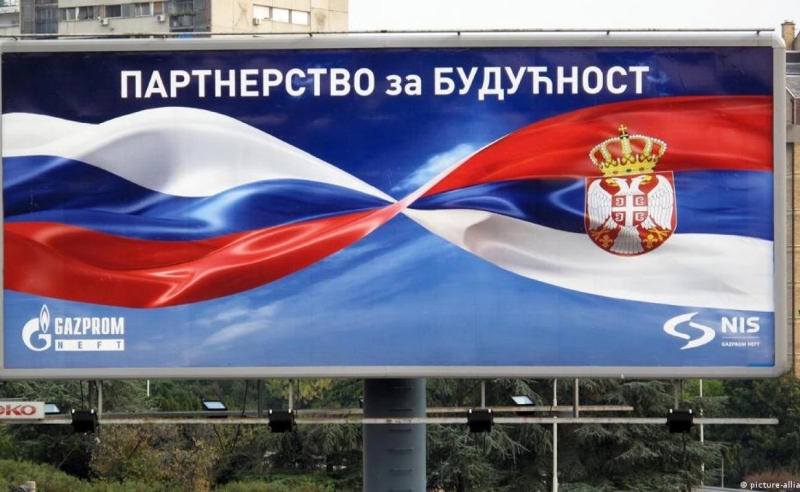
Serbia is heavily dependent on Russia for its energy needs
Although the rhetoric remains positive, real cooperation is clearly on the decline. During Russian Deputy Foreign Minister Alexander Grushko’s April visit to Belgrade, Serbia confirmed its readiness to expand cooperation with Moscow, though without offering any specifics. The Serbian Foreign Ministry’s statement on the event stood out mainly for what it lacked: the word “strategic,” which Belgrade now actively uses to describe its relations with China, Israel, and even the United States.
That last point should be especially painful for Moscow, especially given its past efforts to present itself as the main defender of Serbian interests on the international stage, eagerly exploiting NATO’s 1999 bombing of Belgrade and the subsequent separation of Kosovo from Serbia for propagandistic purposes. Now though, if the war in Ukraine drags on, Serbia will have to rethink its relationship with the Kremlin even more deeply in order to avoid jeopardizing ties with its actual financial donors and security guarantors in the Balkans.