
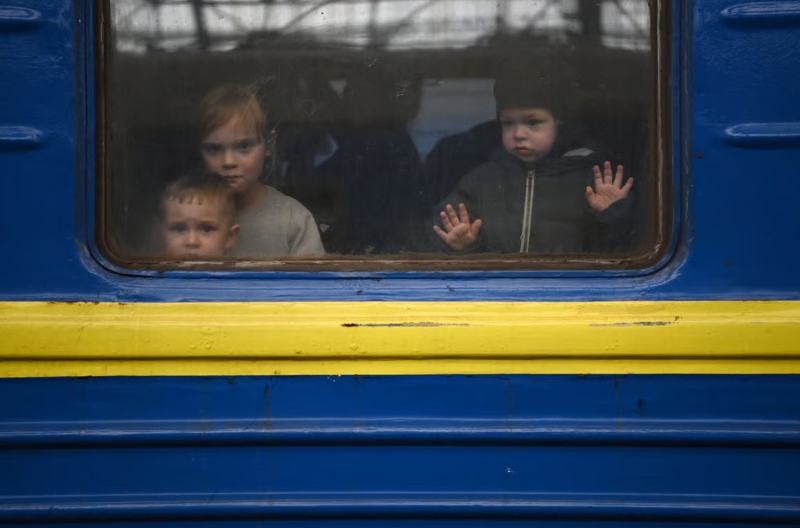
Photo: AFP
The UN General Assembly on Dec. 3 adopted a resolution demanding that Russia ensure the “immediate, safe and unconditional” return of children taken from Ukraine. The document does not outline concrete steps for rehabilitating the displaced, which is why it remains only “a starting point,” according to international law expert Vladimir Zhbankov.
Ninety-one countries backed the resolution, 12 voted against, and another 57 abstained.
The text calls on Moscow to provide for the “immediate, safe and unconditional” return to their home country of all children forcibly transferred or deported during Russia’s full-scale invasion of Ukraine, and to end “any further practice of forcible transfer.”
However, Zhbankov told The Insider that the process of returning deported children to Ukraine is requires lengthy rehabilitation and involves numerous ethical challenges that the resolution does not address, which is why he calls it “a starting point”:
“If you want to do this properly, you have to conduct rehabilitation. A person has gone through severe shock. They were pulled out of one life and pushed into another, and everything unfolded in unexpected ways. These are all traumatized people who require rehabilitation. If we are talking about taking back, say, 20,000 children, then we also need 100,000 people to work with them, four or five adults per child to handle rehabilitation,” he said.
Zhbankov also noted potential ethical problems that may arise in determining how and where the children will be returned. Some were taken from Ukraine at a very young age, even as infants; finding them may be physically difficult, and moving them again into a new environment could be even harder.
For both very young children and teenagers, a return depends on whether their parents are alive. In cases where the parents have been killed, he said, even more rehabilitation work is necessary:
“Simply pulling someone out of one environment and dropping them into another is extremely difficult. Each year in adolescence is like ten years… There are horrific places, like Russian orphanages, and yes, you probably need to take children out of there. But if a child is already in a family — even if not the best one — and the parents were killed, what do you do? People like simple solutions, but in our circumstances they can’t exist…
With the children it’s an even more complicated thing, because since 2023 there have been no major offensives by the Russian army, and it’s already 2025. The poor children have had their brains washed with terrible force — and if we take them to Ukraine, then the international community has to chip in big money for rehabilitation. A person may now be 15, he may already have been in the Yunarmiya [Russia’s ‘Young Army’ Movement], learned about [Russian imperial general Alexander] Suvorov’s heroic deeds, and then he’s thrown into a Ukrainian environment and told that everything he was told over the last three years was lies and horror — this way we will get a wave of child suicides…
They wrote perfectly well that everyone must be returned. I, in general, am in favor of returning everyone, but this is a starting point for now… The time when you could just take everyone and return them has already passed. In 2022-2023 you could still do that, but now it’s already the year 2025, the children are growing up and acquiring their own traumas from life in Russia,” Zhbankov said.