
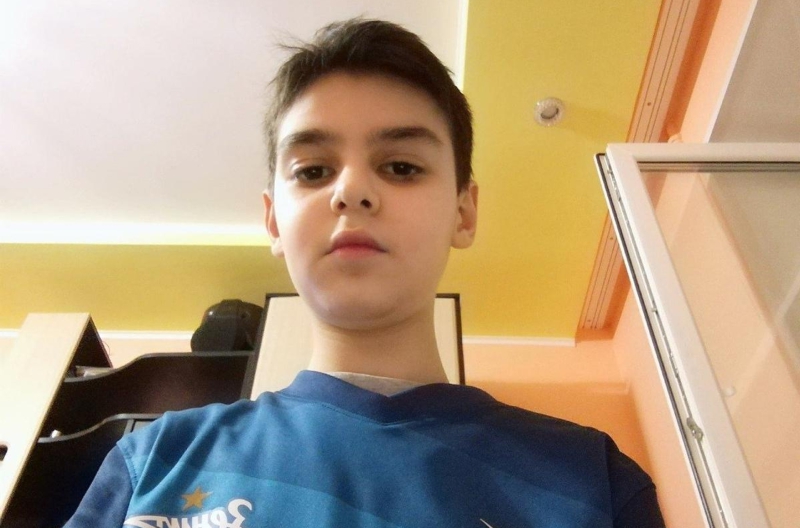
Russian authorities are preparing new criminal charges against 17-year-old political prisoner Arseny Turbin, who in 2024 was sentenced to five years in a penal colony in a case involving his alleged “participation in a terrorist organization.” This time, Turbin may be accused of “participation in mass riots,” according to a post by the political prisoner’s support group on Telegram.
According to the activists, the new criminal case is being prepared under Part 2 of Article 212 of Russia’s Criminal Code. It carries a sentence of three to eight years in prison:
“It is known that a wide circle of people are giving testimony against him. An attempt to build a case around AUE was stopped in December, but apparently the task was to increase his sentence, and now they will form a new case and a new term.”
It was not immediately clear what specific allegations the case against Arseny is based on or what stage the investigation had reached.
In June 2024, 15-year-old Arseny Turbin was sentenced to five years in a juvenile correctional colony, allegedly for participating in the activities of the Freedom of Russia Legion — a paramilitary unit that operates under the umbrella of the Armed Forces of Ukraine, which the Russian authorities consider a terrorist organization. According to investigators, Turbin corresponded with the unit’s representatives and, acting on their instructions, placed leaflets in mailboxes in the summer of 2023 (the fliers in question asked Russians, “Do you need this kind of president?”).
In June of that year, Turbin attempted to stage a solo picket. His mother initially tried to stop him, but on June 12, Russia Day, he went to the protest without his parents’ knowledge. On the morning of Aug. 29, FSB officers came to the Turbin family’s apartment. Arseny was questioned, and the next day he was invited for a “conversation,” which the family attended without a lawyer. After hours of questioning, a report was drawn up, which security officers rewrote several times because of errors. In the end, the document was signed without Arseny rereading it.
Later, the FSB claimed that Arseny had confessed to joining the Freedom of Russia Legion. However, a transcript later published by the independent exiled outlet Mediazona showed that the report included words the teenager did not say, and that during the conversation the FSB officers themselves assured him that corresponding with representatives of the legion “does not violate anything” and “is not a crime.”
The schoolboy then faced multiple instances of bullying and harassment while in pretrial detention. His mother said that Arseny lost 17 kilograms (37.5 pounds) during his time behind bars waiting for trial. Ahead of Turbin’s cassation appeal, “extremist” AUE symbols were planted on him while he was in the penal colony serving his sentence.
Arseny Turbin has been recognized as a political prisoner by the Nobel Peace Prize-winning human rights organization Memorial. Turbin has also been added to the Russian state’s official “list of terrorists and extremists,” becoming its youngest member.
AUE (АУЕ) is a Russian criminal-prison subculture and youth network linked to prison norms and gang culture, often described as an acronym for phrases like “Arestantsky uklad edin” (roughly, “the prisoners’ code is one/united”). Russian authorities designated the “AUE” an extremist movement in 2020, and the label is now often used in prosecutions involving alleged prison-subculture symbols or activity.