
Russia is pressing ahead with measures to throttle Telegram and, ultimately, to block the app entirely. The messenger is not only the country’s most popular social network and the largest source of uncensored information, it is also a critically important piece of infrastructure supporting the war effort. Telegram has become home to an entire ecosystem of “war correspondents” and rapid fundraising campaigns that finance a substantial share of the needs of Russian Armed Forces units fighting in Ukraine, and much of the activity of the so-called people’s military-industrial complex has been built around the messenger. Finally, Telegram is also used on the front line as a tool for command, control, and communications. For now, as The Insider has learned, Russian troops are managing to circumvent the restrictions with VPN services, but fundraising campaigns have already taken a significant hit.
Доступно на русскомContents
In January 2026, Telegram overtook WhatsApp to become the most popular messaging platform in Russia, with more than 90 million users. Then, at the beginning of February, Russian authorities began taking unprecedented measures to slow down the messenger’s service. In addition, Telegram founder Pavel Durov was accused by Russian officials of supporting terrorism, refusing to remove banned content, failing to combat fraud, and granting foreign intelligence services access to private correspondence.
Pressure on the messenger is being applied as part of a campaign to move users to Max, a service controlled by the VK holding company, which itself is connected to relatives of Vladimir Putin. On Feb. 21, the FSB posted a separate statement on its website warning that Telegram was unsafe for Russian military personnel:
“The Federal Security Service of the Russian Federation possesses reliable information indicating that the armed forces and intelligence services of Ukraine are able, in the shortest possible time, to obtain information posted in the Telegram messenger and use it for military purposes.
As a result of an analysis of Telegram’s operation, numerous reliable findings were obtained showing that its use by servicemen of the Armed Forces of the Russian Federation in the zone of the special military operation during the past three months has repeatedly led to threats to the lives of servicemen.”
To reinforce the effect, pro-Kremlin outlets began publishing stories featuring military personnel describing the risks Telegram allegedly created for combat operations. For example, a commander with the call sign Hector told the state news agency TASS the following:
“In the zone of the special military operation, we do not use the Telegram messenger to command units, because its servers are located abroad and the enemy can most likely gain access to message logs and telemetry, which could result in the deaths of our comrades. We use a domestic messenger operating through communication channels protected by certified security tools. We are talking about a military messenger that fully enables us to carry out assigned combat missions.”
TASS also published similar stories attributed to a mechanic nicknamed Barbos, a signalman with the call sign Krot, and a commander with the call sign Shum. In pro-war “Z” channels, such reports were published as part of a paid propaganda campaign. Notably, many of those same channels have also regularly posted criticism of Telegram restrictions, including video appeals to reverse the policy.
Telegram
Among these, the authors of the “Two Majors” channel highlighted Telegram’s irreplaceable role in the armed forces:
“Telegram remains in many ways almost the only means of communication in active military units, and it organizes the work of interagency mobile fire groups.”
In addition, the channel “Belarusian Silovik 🇧🇾” expressed doubts that communications could be transferred to Max:
“Everything is tied to Telegram right now and, unfortunately, as colleagues note, it is unlikely to function in Max for objective reasons.”
Even the highly loyal pro-war correspondent Alexander Sladkov voiced his criticism, albeit cautiously:
“Telegram. Everyone is sick of talking about it already. It is a painful issue for people. But what will replace Telegram in the special military operation zone? The West gave us a double knockdown with this disabled ‘Starlink.’ Now we are burying this means of command and communication as well. But if you take a rifle away from a fighter, give him another one, an even better one. Instead, it turns out they take away the rifle – and you are left without a weapon. And communications are more than a weapon; forgive the cliché, they are the foundation of troop command. How are we supposed to win, and with what means?”
Responding to dissatisfaction from pro-war circles, Kremlin spokesman Dmitry Peskov said that he “cannot imagine” front-line communications being provided through Telegram — a remark that was met with a separate wave of ironic laughter from pro-war channels.
Nevertheless, the Kremlin decided not to stop there. Later, Vladimir Putin himself held a staged conversation on camera with a female communications officer (formally on the occasion of International Women’s Day), during which he described “uncontrolled communications systems” as posing a danger to Russian military personnel.
Since mid-March 2026, there have been reports of problems accessing Telegram in occupied territories of Ukraine, despite earlier promises by Maksut Shadayev not to restrict its operation in the zone of the “special military operation.”
Also since mid-March, pro-war “Z” channels have been circulating information (1, 2) about an order requiring servicemen to delete Telegram from their phones, and military police have reportedly been tasked with carrying out checks. At the same time, in some units commanders have been forcing subordinates (1, 2) to register with Max.
Additionally, the Kremlin’s efforts to regain control over the domestic information space may ultimately extend even further. At the same time as Telegram was being throttled, Russian authorities were discussing measures to counter the VPN services Russians use to circumvent the blocks.
Contrary to the claims made by Kremlin press secretary Peskov, it is indeed difficult to imagine command and communications on the front line without Telegram. Coordination of actions, regular exchanges of intelligence data, and the dissemination of video and photo materials for geolocation all take place through chats and closed channels.
The entire kill chain for detecting, identifying, and organizing strikes on targets is built through Telegram: assault troops on the front line send photos or videos, personnel at a command post identify the target and determine its coordinates, and a drone or artillery fire is directed at the target. Following the strike, photos of the aftermath are also passed up the chain for reporting purposes.
Some Western experts describe Telegram’s role in the command system of the Russian Armed Forces as “military radio on steroids.” Standard communications systems do not handle coordination functions the way Telegram does. Before the war, there were plans to supply the armed forces with 40 brigade-level sets for the Unified Tactical-Level Command and Control System (ESU TZ), Sozvezdie-M2, at a cost of 300 billion rubles ($3.9 billion). But as far as is known, the system has still never functioned as a unified and effective army communications solution.
Telegram plays the role of “military radio on steroids” in the Russian Armed Forces command system
For the Russian military, the Telegram messenger combines (1, 2) the functions of traditional radio communications, wired telephone communications, and long-distance communications — all on a single platform. It also provides both horizontal and vertical interaction at the unit level and for individual personnel.
As far as can be determined from reports by active servicemen and pro-war correspondents, military analogues of Telegram do exist together with related military-purpose hardware and software systems, but phones equipped with the necessary software are issued only to senior officers.
Rank-and-file soldiers and sergeants are expected to buy smartphones themselves and submit them for “flashing,” with wait times often stretching out for a month or more. On top of that, the military messenger itself is unreliable, and when technical problems arise, users must again go through the entire process of sending the phone away for servicing.
In addition, much of the logistical activity of Russian Armed Forces units is organized through Telegram. Beyond its obvious military communications role, Telegram serves as a critically important platform linking military units with organizers of fundraising drives and, more broadly, with the civilian world itself.
Pro-war “Z” channels are already writing about the potential effect on grassroots aid campaigns. Deep distrust of official information from the Russian Ministry of Defense gave rise to the phenomenon of the “Z” community, which unites military personnel with social media influencers and volunteer networks. In essence, exclusive information from the front line – including videos with shocking footage – is traded for publicity and financial support. The entire ecosystem depends on Telegram.
Some pro-war “Z” figures have stated publicly that with the death of Telegram, Russia’s spring-summer offensive will die as well. It was precisely Russian troops’ communications problems that have allowed the Ukrainian Armed Forces to achieve certain successes on several sectors of the front, pro-war “Z” channels acknowledge. Other “war correspondents” insist that Telegram has been “blocked on credit,” meaning it still continues to function. Reports have also appeared that military personnel can now access Telegram only through paid VPN services, but that not every paid service is able to keep the messenger working.
In conversations with The Insider, several active members of the Russian Armed Forces said that, for now, all communications connected with combat operations remain on Telegram, while the Max messenger is used only for reporting to superiors. Another serviceman said he continues to correspond through Telegram but deletes chats after every exchange. Overall, it appears that Telegram communication in the combat zone continues to be stable, but only thanks to the availability of VPN services.
In short, restrictions on access to the Starlink satellite internet system (as The Insider previously detailed) and to the Telegram messenger have become a problem for the Russian Armed Forces, though likely not a critical or long-term one.
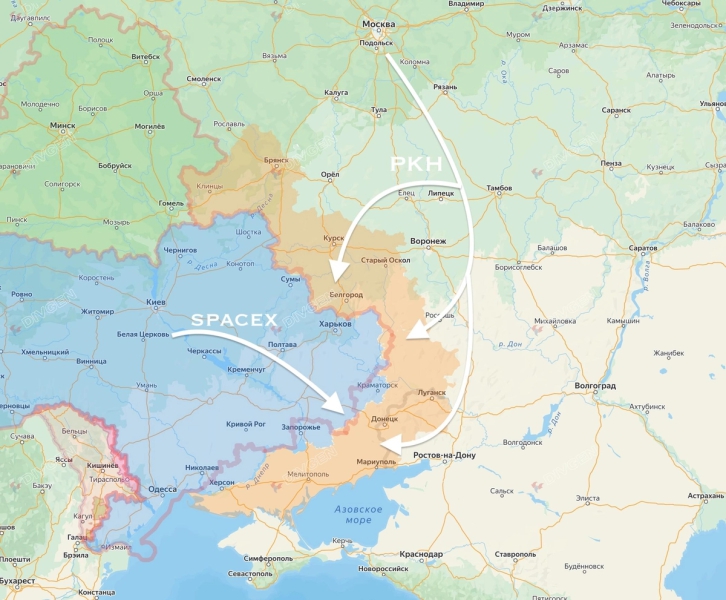
Perception in pro-war circles of simultaneous strikes against the Russian Armed Forces by SpaceX and Roskomnadzor
Still, given the Russian government’s efforts, the quality and speed of information exchange on the front will undoubtedly decline, and the informal communication channels built up between military units and the community of military volunteers over the past four years of full-scale war will be disrupted. One major pro-war “Z” channel describes the likely consequences as follows:
“The primary problem is the loss of coordination between units: established communication channels will collapse. Against the backdrop of the lack of internet access at positions, the transmission of intelligence information will slow down, and the absence of Telegram will worsen this situation because delays will be added at the command level… Broadly speaking, this will set us back a couple of years, roughly to the very beginning of the war. Although alternative methods are already being devised, recovery will take some time. The current war is highly dynamic, and the foundation of that dynamism is rapid response to changes in the situation, meaning any delays will negatively affect the conduct of combat operations.”
Particular difficulties are linked to organizing the work of mobile air-defense groups on the territory of Russia and in occupied areas of Ukraine, given that an interagency system of situational awareness for the airspace has yet to be created. But that is not the only problem.
As pro-war “Z” figures explain, information that was previously collected and exchanged using Telegram bots is no longer flowing through the necessary channels. In addition, Telegram hosts numerous groups belonging to the so-called people’s military-industrial complex — companies and engineering specialists working on UAVs, rear support, repairs, and “garage workshop” projects. Still, perhaps the most tangible practical result so far from the disruptions to Pavel Durov’s messenger is the recorded decline in post reach across pro-war “Z” channels, and, accordingly, a corresponding drop in volunteer fundraising (1, 2).