
On March 23, a rocket carrying a group of small spacecraft took off from the Plesetsk Cosmodrome in western Russia. Although there was no official announcement of the launch, space enthusiasts already knew that the first batch of Rassvet satellites — the “Russian Starlink,” under development since 2020 — was expected to go up. State space agency Roscosmos is formally not involved in the project, as the development of its analogous program, Sfera, has not gone according to plan. Rassvet has better chances of success, but scaling up the project under sanctions will be extremely difficult.
Contents
In February 2026, when Elon Musk cut off Russian troops’ access to Starlink terminals, the Defense Ministry in Moscow had no domestic equivalent to turn to as a potential substitute. Back in 2022, state space agency Roscosmos reported that it had begun deploying its multi-satellite Sfera system into orbit. However, after the first satellite, Skif-D, was launched on Oct. 22, 2022, not a single other launch from that ambitious project followed. Now Rassvet is pursuing its own version — but even if it succeeds, it will take several years before its results become visible on the battlefield in Ukraine.
The name “Sfera” (lit. “Sphere”) was first mentioned by Vladimir Putin in June 2018, the day after Roscosmos presented a project for a multi-satellite broadband internet constellation called “Efir” (“Ether”). Comments quickly appeared online suggesting that the president had simply confused the names and said “Sfera” instead of “Efir.” However, Roscosmos officials hurried to explain that Sfera was an all-in-one comprehensive system — internet, satellite imaging, and navigation — while Efir was only its internet component. It seemed that Roscosmos had decided to gather virtually all new civilian satellite projects into Sfera, regardless of their purpose, design, or orbit.
The first cost estimates for Sfera were initially announced at 300 billion rubles, but this appears to have been an estimate for Efir alone, because Roscosmos said it expected to attract “extra-budgetary financing,” meaning the project’s real cost would have been higher. The estimate for Sfera later rose to 1.5 trillion rubles, which was meant to cover the production and launch of 640 satellites by 2030. Later, the amount was cut to 800 billion rubles. Throughout the prewar years, the expected funding for Sfera kept shrinking, as did the promised number of satellites.
Roscosmos saw Sfera as one of the pillars of its development over the coming decade, and the project was expected to keep design bureaus, industrial enterprises, and rocket production facilities busy. But the ambitions of the space sector were constantly restrained by Russia’s Finance Ministry.
By 2022, Roscosmos had estimated the project’s cost at 180 billion rubles for 162 satellites through 2030. The government promised to allocate 95 billion rubles, but has so far managed to provide only 40 billion over three years.
The planned 162 satellites were roughly equal to the number of active Russian spacecraft already in orbit. In other words, Sfera could more accurately be described as a 10-year program to renew Russia’s satellite constellation, rather than as a monumental new unified system.
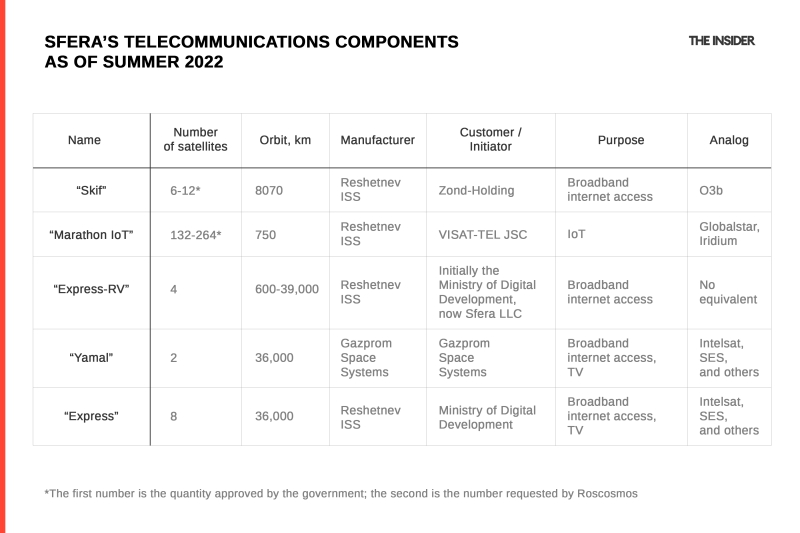
Usually, a constellation refers to satellites with the same function and design, controlled by a single operator. However, the Roscosmos Sfera project also included, for example, Yamal and Smotr spacecraft from the formally independent Gazprom Space Systems project. The Ministry of Digital Development-operated Express satellites were also part of the plan, even though that ministry is separate from Roscosmos. Some of the projects placed inside Sfera duplicate one another, while others compete with one another.
From the moment Sfera was announced, the proposed makeup of the system was constantly changing. First, the navigation system GLONASS was excluded from the project, apparently because of its military role. Given the success of Starlink and OneWeb on the one hand, and the sanctions imposed on Roscosmos after the 2014 annexation of Crimea on the other, it became clear that Efir had no commercial prospects on the world market. Russia’s domestic market, meanwhile, was too narrow for the system to ever pay for itself. Even such supposedly “extra-budgetary” investors as VEB and Gazprom refused to invest in Efir, and the project was effectively shut down in 2021.
Even such supposedly “extra-budgetary” investors as VEB and Gazprom refused to invest in Efir
Roscosmos hoped that Sfera would receive financing from new national programs tied to Russia’s digitalization and Arctic development. At the same time, when asked directly about whether the project could ever survive without government subsidies, Roscosmos representatives responded with vague talk about new jobs, an infrastructure project, and its multiplier and synergy effects. In other words, even at an early stage and in peacetime, Sfera was never intended to become a commercial rival to Starlink.
Although Efir failed to win support, the task of broadband internet access remained within Sfera, as did satellite imaging projects. By the start of Russia’s full-scale invasion of Ukraine in February 2022, Sfera consisted of 10 projects: five telecommunications systems and five for Earth observation.
Roscosmos did not disclose how the 40 billion rubles allocated to Sfera were spent, but the most likely explanation is that the money was put toward building and launching geostationary Express satellites for the Digital Development Ministry. Even so, the first launch was the small Skif-D prototype. When it finally went up in October 2022, Roscosmos rushed to report that Sfera was beginning to move from concept to reality.
The Skif satellite constellation project emerged on the initiative of Zond-Holding LLC as a Russian version of the international O3b system. The difference lay in orbit inclination: the O3b’s orbit is close to the equator, while the Russian version was projected to run “across it” in a near-polar orbit. Plans called for six to 12 satellites, depending on the geographic area of use. If Skif were used only within Russia and other northern countries, six satellites would be enough. If global coverage were the goal, 12 would be needed.
That seems like a very small number compared with Starlink’s thousands of satellites, but there is a major difference in orbital altitude — Starlink operates at 550 kilometers, while Skif satellites were set to orbit at 8,070 kilometers. That height difference also affects the size of ground stations. Skif requires antennas 1.8 and 2.4 meters in diameter, meaning its likely customers are not individual users, but mobile operators, remote settlements, and passenger ships. Such an antenna could not be mounted even on a large drone.
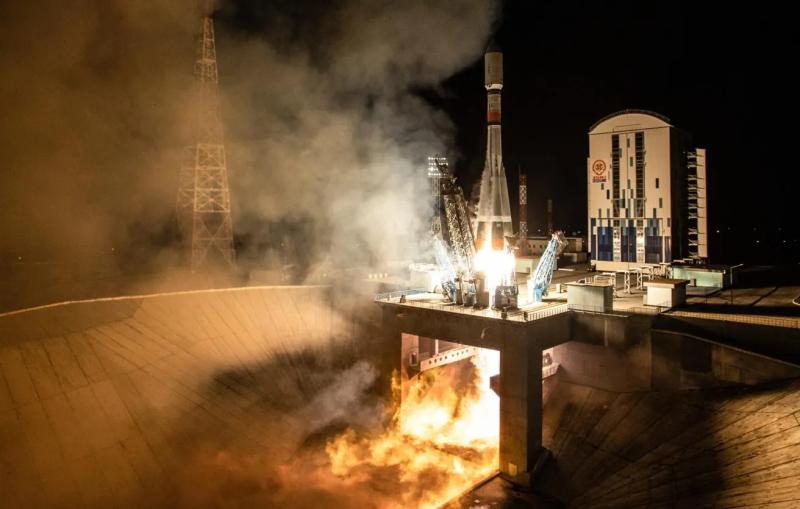
Launch of the Soyuz-2.1b carrier rocket carrying the first satellite of the federal Sfera program — Skif-D — and three Gonets-M satellites
Skif faced obvious obstacles even before the war in Ukraine. The first six Skif satellites could have provided stable communications only to the sparsely populated northern regions of the world, which represent too small a market. Launching the next six satellites would have made sense only if there had been confirmed international demand for the first generation. But the advance of global competitors and the tightening of sanctions in 2022 left Skif with virtually no chance of survival.
The Skif project was not included in the national “Space” project that began in 2025, and it has effectively been shut down.
The same fate awaited another ambitious project that Roscosmos once promoted with pride. Reshetnev Information Satellite Systems, a major Russian manufacturer, had been actively working on a Sfera-related project called Marathon IoT — a low-orbit, multi-satellite “internet of things” system intended to transmit small volumes of data, above all telemetry from instruments, aircraft, ships, cars, and the like. The satellites, weighing about 50 kilograms each, were supposed to be assembled in series like Starlink satellites, something no one in Russia had done before.
In 2022, Roscosmos released upbeat videos hailing the start of mass production. After the shutdown of Efir, Marathon IoT was supposed to become the largest constellation within Sfera. The plan called for launching 264 satellites, with the first useful operations in an experimental mode expected in 2025. Last year, however, the project was effectively shut down after being excluded from the national Space project.
After the shutdown of Efir, Marathon IoT was supposed to become the largest constellation within Sfera
What remained were only the high-orbit Express, Express-RV, and Yamal projects, which Roscosmos does not actually own or operate, serving only as a contractor for the Digital Development Ministry and Gazprom.
Express and Yamal are geostationary communications and television broadcasting systems. Their satellites are meant to operate in high circular orbit, about 36,000 kilometers above Earth. At that altitude, a satellite effectively hangs over the planet’s surface and acts as a stationary relay.
Express-RV is a more complex system, requiring movable antennas that track the satellite as it slowly moves relative to Earth along a highly elliptical orbit.
Geostationary communications systems work better in southern regions, while a highly elliptical system is better suited to northern regions and the Arctic. In all cases, using such systems on the ground requires bulky receiving stations that are unsuitable for combat use or for controlling medium-size or small drones. In short, despite having Starlink as a potential model to copy, Roscosmos went in a different direction.
In 2020, a company called Megafon 1440 effectively began developing its own version of Starlink. It started as a project office within Russian telecoms operator Megafon, where newly hired specialists worked to determine the most effective and competitive architecture for a satellite constellation. As the project advanced, the team developed a clearer understanding of the Russian industry’s technical capabilities, the space sector’s limits, and the needs of potential customers.
Megafon invested 6 billion rubles in the project over the first two years. That allowed the company to recruit a strong young team and offer salaries that were competitive even when compared with the compensation on offer at Russian IT giants such as Yandex and Mail.Ru. The company’s effective hiring policy led the head of Roscosmos to openly complain in a speech to the State Duma in 2024 that private companies were “taking the best people.”
In 2022, after the start of the full-scale war, Megafon was sanctioned by the U.S. government. As a result, its satellite-building division was turned into a separate legal entity, Bureau 1440, and transferred into the X Holding group. X Holding manufactures and supplies equipment for mobile operators, but it is also involved in internet monitoring and blocking systems in Russia and, according to some reports, is linked to the FSB.
In 2023, Bureau 1440 launched three satellites from the Rassvet-1 series into space as part of an effort to test the performance of its spacecraft, propulsion systems, and telecommunications payload. The tests were successful. The next generation, Rassvet-2, also consisting of three satellites, was launched and tested in 2024. This time, the company was carrying out a trial run for advanced inter-satellite laser communication technology, which is meant to improve the stability of the entire system by making it less dependent on ground stations. The tests were once again successful.
Under current plans, the Rassvet constellation is projected to include 250 satellites by 2027, 750 by 2030, and 900 by 2035. That is significantly fewer than the American Starlink system has now, meaning it would be more accurate to compare Rassvet to the international OneWeb project, which currently has about 650 satellites.
Starlink is aimed primarily at the mass consumer, and the provision of the services it offers requires high capacity from the constellation and the ability to work with large numbers of users on the ground. In order to meet the company’s constantly growing demand, new launches are a necessity. Starlink also offers a small, inexpensive ground terminal, which has proved especially valuable in wartime, including for operating large drones.
OneWeb, by contrast, is oriented toward larger customers: transport and telecommunications companies, along with banks and governments. Its terminals are therefore larger and more expensive, making them unsuitable for combat drones.
Bureau 1440 initially sought to emulate the OneWeb business model, providing services for state-owned airline Aeroflot and railway company Russian Railways. Today, however, the company’s main customer is clearly Russia’s Defense Ministry. It can be expected that plans for Rassvet will be revised in the direction of Starlink, both in terms of the number of satellites and the technology of ground terminals.
Plans for Rassvet will be revised in the direction of Starlink, both in terms of the number of satellites and the technology of ground terminals
After completing tests of the satellites’ key systems, Bureau 1440 scheduled the first launch of a large group of 16 Rassvet spacecraft from Plesetsk for the end of 2025. These were supposed to begin forming a full-fledged constellation. However, the launch was postponed to 2026, reportedly because the satellites were not ready. According to rumors, “captured” parts from OneWeb satellites that Roscosmos left at Baikonur in February 2022 after breaking a launch contract were used to build the first batch.
At the beginning of 2026, after Russian forces in Ukraine lost access to Starlink, the military’s need for domestic alternatives became acute. That means Bureau 1440 can be certain that orders will come.
Financing is also not a problem. Under the national Data Economy project, Bureau 1440 has been promised 102.8 billion rubles from the federal budget. In addition, the company has allocated 329 billion rubles of its own funds to the project through 2030.
Now the well-resourced Bureau 1440 team will have to overcome the next technological barrier: scaling up. Given the prevalence of U.S. and European sanctions on modern microelectronics, and amid a shortage of available electronic components (which are needed first and foremost by Russia’s military industry to make modern weapons), setting up serial production of satellites will be an extremely difficult task.
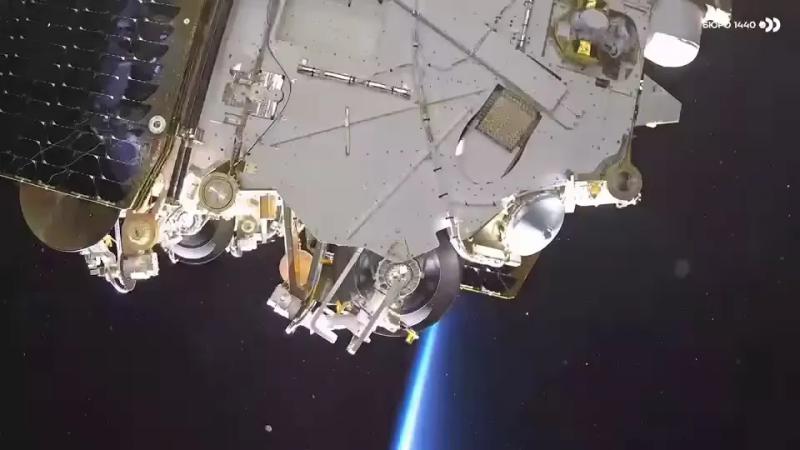
Launch of 16 spacecraft into low Earth orbit for the Rassvet constellation
Today, serial satellite production has been mastered by only a few American and Chinese companies: Starlink and OneWeb, Qianfan and Guowang. Roscosmos never managed to do it with Marathon IoT, even if some of its less-than-successful experiences may provide useful lessons for Bureau 1440.
Still, the pace of Rassvet’s deployment clearly falls short of what Russia’s Defense Ministry needs. At the same time, Elon Musk’s decision to help Ukraine cut off Russian troops’ access to Starlink has made the development of a domestic alternative an even higher priority for the Kremlin.
Meanwhile, the Roscosmos Sfera project, conceived in peacetime largely for civilian use, is receding into the shadows. Such initiatives are of little interest to a militarized state that looks set to remain at war for the foreseeable future.