
Iran’s economy is facing problems so severe that even a swift end to the ongoing war would not be enough to rescue it. The country regularly suffers from energy shortages, its infrastructure is in dire need of repair, and there is no money to solve either problem. The war has deepened the crisis. Damage from the U.S.-Israeli campaign is estimated at $270 billion, five times Iran’s state budget revenue for the 2024-25 fiscal year and roughly equal to its prewar GDP. The economy is expected to shrink by more than 10%. Reconstruction funds are limited, as oil revenue alone is not enough, and the government is spending more than it earns. State projects are financed through banks, while subsidies keep gasoline prices for ordinary Iranians low to prevent unrest. Inflation is running at 40% a year, and the currency has depreciated by 47%. Foreign investors are unlikely to put their money in Iran even if sanctions are lifted, as the deterrent effect of corruption and the risk of financing terrorism will remain. In fact, government incompetence is doing more damage to the country’s economic position than the war itself, writes economist Patrick Clawson, director of the Iran program at The Washington Institute for Near East Policy.
Доступно на русскомContents
Iranians have suffered such extensive economic blows in recent years that their situation would not qualify as good even if an agreement is reached soon to decisively end the current conflict. Consider where Iran was before the damages on key economic sites caused by the Israeli-American bombing of 13,000 targets in Iran.
Last November, President Masoud Pezeshkian warned that the entire capital might have to be evacuated due to acute water shortages. After years of excessive consumption and dam construction, the country was thrown into crisis when the most recent cycle of periodic droughts hit. In addition, for months before the war, electricity was cut off in major cities for hours at a time, sometimes with no warning. According to Ahmad Moradi, a member of the parliamentary energy committee, the national grid now has a shortfall of 20,000 megawatts due to “insufficient generation capacity, problems at power stations, and aging transmission lines.” Many apartment buildings in Iran have had to purchase generators to guard against the elevators suddenly not working.
Even before the war, Iranians faced shortages of water, electricity, and gas
That’s not the end of the problems. Natural gas shortages this past winter forced authorities to close industrial plants powered by gas and cut the wages of factory workers. The low rates charged for natural gas, oil, and electricity contributed to excessive consumption. When supplies were cut, firms stopped paying, which left energy producers unable to afford to upgrade their aging and inefficient facilities and transmission lines. According to the 2025 Statistical Review of World Energy, Iran depends on natural gas for 69% of its total energy, higher than any country other than Turkmenistan and Uzbekistan (Russia is also quite reliant on natural gas, using it for 54% of its total energy supply). Electrical generation, industrial use, and household heating are the main consumers, with minor exports to Turkey and Iraq. Providing adequate natural gas during the winter has long been a problem. Electrical generating facilities using gas are almost all dual-capable, meaning they can burn various types of fuel oil in winter when gas supplies run short. However, this feature makes these facilities less efficient and causes severe pollution. Cutting off industrial users during cold spells has also been a problem. Iran has long had inadequate facilities to stockpile gas during the summer (when demand is lower) for use during the winter.
All of these problems have gotten worse in recent years, and the continuing failure of the government to address these problems is a sign of how badly Iranian governments have done at managing the economy. When warning about a potential shut-off of gas for homes, Pezeshkian’s proposed remedy for the shortage bordered on satire: “I wear warm clothes at home. Other people can do that too.” (Notably, he grew up in Iran’s Azerbaijan region, where winter temperatures can reach 40 degrees below zero.) When power stations ran short of natural gas, they had to turn to burning heavy fuel oil in place of gas. As a result, urban pollution became so bad that this past winter many schools were forced to close for temporary periods that sometimes lasted upwards of 50 days.
Iran now spends $6 billion per year on gasoline imports due to smuggling and overconsumption. The Iranian Navy (regular and Revolutionary Guard) frequently intercept ships carrying smuggled gasoline. There are allegations that various officials are involved in the smuggling, but little clear evidence has emerged. Much of the smuggling appears to be done by entrepreneurs — the classical stereotype of Iranians being that many are active traders.
Fears of protests such as those in 2019 led the government to keep the price of gasoline in local currency steady for years even as inflation raged. At long last, President Pezeshkian proposed raising prices a few months ago, but only to levels that are still less than 5 percent of what is paid in neighboring countries. Clearly, that money could be better spent on improving the dire electricity and water situations instead.
Iran has long insisted that any deal with the United States must include extensive sanctions relief. However, even if we imagine that Washington unexpectedly agreed to lift all sanctions on Iran (something extremely unlikely), Iran’s regime-dominated business environment would still remain deeply corrupt and foreigners would remain subject to arbitrary arrest. In short, external measures alone will never convince outside investors to provide the funds needed for fixing the country’s electricity, water, and gas sectors.
U.S. pressure has led governments and banks in several countries to partly or fully restrict Iran’s access to assets that totaled $100 billion at one point, mostly from oil sales. Reports suggest Washington has offered to grant Tehran access to some of those funds as part of a potential deal covering the Strait of Hormuz and the Iranian nuclear program. However, Tehran had serious problems benefiting from similar U.S. offers in the past. Financial institutions were still leery of Iran, not least because of warnings from the multinational Financial Action Task Force (FATF), which reasonably concluded that the Islamic Republic is a high-risk jurisdiction rife with money laundering and terrorism financing.
Being a classical economist, I would argue that inflation in Iran is a monetary phenomenon — that is, the basic cause is that the Central Bank of Iran tolerates (or even encourages) a rapid increase in the money supply. The main reason for the rapid increase is that banks lend vast sums to the government for government-ordered projects.
Government projects in Iran are financed by bank loans, which leads to rising inflation
In other words, the Iranian government spends vastly more than it takes in, and it does so because of projects that it mandates, such as toll roads built with bank financing, or through spending by the IRGC. Some of that government spending is designed to forestall possible protests, which is precisely why the ridiculous amounts spent on subsidizing gasoline consumption continue to be allocated.
Iran also complains about the UN sanctions that were reimposed last year after the European powers invoked the “snapback” provision in the 2015 nuclear deal, which said those sanctions would be automatically reimposed whenever one of the signatories to the deal complained that Iran was not living up to its provisions. However, UN sanctions are not having much impact because Iran does not trade much with industrialized countries. Before the snapback, the EU reported $2 billion in annual imports from Iran (about half goods and half services) and $5 billion in exports (80% goods, 20% services). Even Tehran’s trade with its strategic partner in Moscow is relatively small: Russian imports were $700 million in 2023, while its exports were $1.5 billion.
On the economic front, many Iranians look to the free-market exchange rate as an indicator of how things are actually going. A decade ago, that rate was 32,000 rials per dollar; today, it is a whopping 1,530,000 (it was 930,000 in late February before the war). The average annual devaluation of 47% owes much to inflation, which has averaged about 40% per year and is exacerbated by the massive government deficit (itself a function of lower oil income and high off-budget spending).
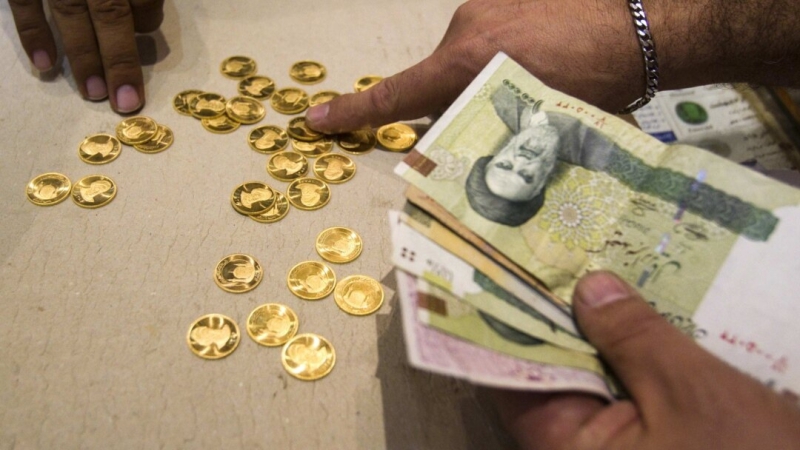
A customer buys Iranian gold coins at a currency exchange in Tehran
No wonder Iranians, who cannot find dollars to buy on the free market, are on track to purchase more than 500,000 gold coins this year (a traditional hedge against inflation, sold by the Central Bank at auction prices up to 30% higher than their intrinsic metal value). These and other examples of incompetence by self-styled technocrats have led many to question whether the men making policy decisions in Tehran know what they are talking about, including on foreign policy.
These economic problems come after several years when things were actually going pretty well. According to IMF data, in the five years from 2020 through 2024, Iran’s GDP grew at an average of 4.4% a year. By comparison, the United States grew at an average of 2.3% a year, with European numbers coming in even lower.
But more recently, the situation has become increasingly difficult. The IMF reports that Iran’s GDP shrank by 1.5% in 2025, and even pre-war the IMF forecast that it would fall another 6.1% in 2026. Due to the war, this figure could well exceed 10%. The war damage, estimated by the Iranian government at $270 billion (not including damage to military installations), will make the situation much worse. Some of Iran’s most important economic facilities, such as petrochemical complexes and steel mills, have been knocked out of action, and major road and rail bridges have been destroyed. Some war-torn countries, however, have recovered faster than many estimated at first. I think Iran can do the same, and therefore it could limit the GDP fall to low double-digits instead of some of the higher figures (e.g., 20%) being mooted. Certainly more than the 6.1% the IMF estimated pre-war.
The Iranian government estimates the war damage at $270 billion
The country, which had reduced unemployment from a peak of 14% in 2010 to 8% in 2025, has now lost at least 1 million jobs directly because of the war. Aware that mass layoffs have been occurring, the Iranian government is discussing grants to smaller businesses and bank loans to larger ones which limit how many workers they let go. However, those programs seem likely to cover costs for a few months at most, whereas many firms fear the drop-off in demand and the supply problems will last much longer. Unemployment had been headed down in recent years, mostly because of the sharp decline in birth rates in the 1990s meant many fewer people joining the labor force. Still, women’s participation in the labor force remains abysmally low at around 10-12%, or one-third the level in Saudi Arabia. Now, there will be much pressure to expel Afghans, at least 1.5 million have been forced out in the last year but probably 2.5 million remain, providing much of the lower-income labor. Iranian economist Hadi Kahalzadeh has warned that 10 million to 12 million jobs — about half of Iran’s workforce — are at risk.
To be sure, Iran looks set to continue exporting a full 1.5 million barrels of oil a day, including what it can sell from the floating storage it had off Asian coastlines when the war began. And the price of oil will be higher this year than last. That said, the few tens of billions of extra income Iran might earn from higher oil exports will not even begin to cover all the war damage.
Even if Iran succeeded in collecting a $2-per-barrel toll from a renewed 12 million barrels a day of oil exports through the Strait of Hormuz, that would still amount to less than $9 billion a year (given that Saudi Arabia and the U.A.E. will continue to use their pipelines, avoiding the Strait).
Of course, it is important to bear in mind that Iran is less dependent on oil than it used to be. In 1983-1984, the IMF reported that oil constituted 98% of the country’s total exports. In 2022-2023, however, Iran’s Customs Administration reported that non-oil exports had reached $53 billion, substantially more than oil sales. Admittedly, this figure is distorted because Iran, like the United States and the World Trade Organization, classifies its several billion dollars’ worth of condensate exports as non-oil exports, even though they are essentially a type of oil. Yet even if condensates are subtracted, Iran’s non-oil exports alone come close to equaling its $60 billion in total imports.
Oil production is 100% controlled by the state, mostly through the National Iranian Oil Company, while natural gas liquids and condensates come through companies producing natural gas. Exports are tightly controlled by the state, which hides the channels it uses in order to better evade sanctions. Iran uses a host of intermediary companies to assist in that evasion — some of which have been found to be siphoning off large sums, leading to several multibillion dollar scandals. Quite a lot of the exports are done, as permitted by the authorities, by entities owned by or controlled by the Revolutionary Guards and their allies, with the revenue accruing to the Guards directly rather than going through the state budget.
Oil exports are tightly controlled by the state, which hides the channels it uses in order to better evade sanctions
The government also makes small amounts from local sales of oil products, but low prices keep the revenue very low — typically, the sales revenue is not even enough to pay the cost of refining and distribution. The government claims that oil revenue is less than tax revenue (each being around 40-45% of the budget, with privatization proceeds also important), but that significantly understates the fiscal importance of oil revenue given that substantial sums are earned by the Guards from selling the oil they are allocated.
In short, Iran’s economic situation was poor before the war – bad enough that the regime resorted to using deadly force to put down the resulting protests(the authorities acknowledge killing 3,000 protestors on Jan. 8, while outside estimates put the death toll much higher). The war will only worsen the economic problems. How Iranians will react is the big question.