
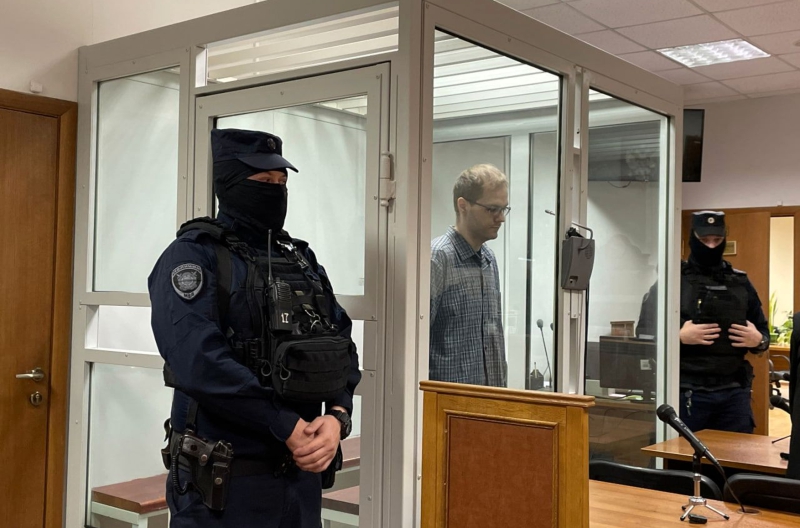
Physicist Artem Khoroshilov in the courtroom on Dec. 4, 2025
Russian authorities detained at least seven scientists in 2025, bringing the total number of those in prison to at least 31, according to a report by the independent science-focused publication T-invariant. The official grounds for arrests over the past year included charges of spreading “fake news about the army,” treason, “confidential cooperation” with a foreign state, and accusations of criminal financial activity.
Arrests in 2025
In April 2025, Russian authorities arrested physicist Grigory Severin yet again. A candidate of physical and mathematical sciences, Severin had previously been dismissed from Voronezh State University for participating in public protests. He was detained on Apr. 22 and charged with “discrediting” the Russian armed forces based on conversations he had with other inmates while serving a previous sentence. Severin had faced repeated criminal prosecution since 2021 and had been serving time in a penal settlement, meaning the new case against him is but one more episode in a long chain of repression.
Severin is not alone. In July 2025, Moscow’s Lefortovo District Court arrested geographer Vadim Saltykovsky — a professor at Plekhanov Russian University of Economics and a former employee of the Russian presidential property management department. Saltykovsky stands accused of treason, a crime that carries a maximum penalty of life imprisonment. After his arrest, information about Saltykovsky was removed from the websites of the universities that employed him. The basis on which the charges against him were made has not been disclosed.
No later than August 2025, Nikolai Zyuzev was deprived of his liberty. A doctor of philosophy, a sociologist, and a researcher of Pitirim Sorokin’s legacy, Zyuzev was detained in Syktyvkar and placed in pretrial detention on charges of “confidential cooperation with a foreign state.” Zyuzev holds Canadian citizenship and previously taught at Syktyvkar State University. After the start of the war, he left Russia but continued to visit the region.
On Aug. 30, 2025, the Kuibyshevsky District Court of St. Petersburg remanded Kirill Yakovlev into pretrial detention. Yakovlev, a sociologist and a graduate student at the Higher School of Economics, is also known by the literary pseudonym Glikery Ulunov. He was charged with “organizing activities aimed at inducing suicide.” As evidence, the prosecution used materials published on the website of the Flags cultural project, which investigators claim “contains a set of linguistic and psychological indicators of incitement to suicide and self-harming behavior.” Yakovlev faces five to 15 years in prison.
In October 2025, Moscow police arrested historian Pavel Syutkin — an independent researcher who has authored several books on the history of Russian cuisine. Russia's Investigative Committee charged Syutkin with spreading “fake news” about the army. On Oct. 9, a court remanded Syutkin into pretrial detention. On Oct. 17, he was added to Rosfinmonitoring’s list of “extremists and terrorists.” According to investigators, the grounds for the prosecution were his public statements about the use of Russia’s armed forces.
Also in October, it became known that Leonid Pshenichnov was detained in Kerch. Pshenichnov is a doctor of sciences, Ukraine’s leading specialist in Antarctic research, and a member of the Commission for the Conservation of Antarctic Marine Living Resources (CCAMLR), representing Ukraine. His detention was reported by the National Antarctic Scientific Center of Ukraine and by Ukrainian diplomats; Russian authorities did not publicly comment. According to the Ukrainian side, Pshenichnov is accused of treason and causing economic damage to Russia. In Kyiv, it is believed that the prosecution is linked to his involvement in developing an initiative to create a marine protected area near the Antarctic Peninsula, which Russia viewed as a threat to its industrial fishing interests.
On Oct. 30, 2025, Russian law enforcement took into custody Rustam Kaibyshev — a doctor of physical and mathematical sciences and the director of the Research Institute of Materials Science and Innovative Technologies at Belgorod State National Research University. The Belgorod Regional Court upheld a 2.5-year sentence in a general-security penal colony on charges of large-scale fraud. Kaibyshev was found guilty of providing the Ministry of Science and Higher Education with false information on a government-funded research project. Investigators assessed the damage at 14 million rubles ($174,000). The scientist pleaded not guilty and was taken into custody in the courtroom. T-invariant notes that Kaibyshev’s case resembles the prosecution of academician Oleg Kabov and is based on expert assessments of highly dubious validity.
T-invariant also highlights the arrest of Leonid Katz, an exceptionally talented young researcher who is just beginning his academic career. On Dec. 2, 2025, Moscow’s Meshchansky Court remanded the 22-year-old Higher School of Economics graduate into pretrial detention on charges of treason. Before this, Katz had spent more than two months under back-to-back administrative arrests — he was detained immediately after leaving a temporary detention facility and repeatedly placed under arrest for “disobedience to police” and “obscene language.” Katz graduated from the “Intellectual” school in Moscow and, after defending his bachelor's diploma, was accepted into several master’s programs in Russia and France, including at MIPT, Skoltech, École Normale, and Paris-Saclay University.
Scientists released in 2025
At the same time, T-invariant lists at least three members of the academic community who were released from detention in 2025.
- Alexei Soldatov, a doctor of physics and mathematics and a pioneer of the Russian Internet, had his prison sentence replaced with a fine of 500,000 rubles ($6,200) in August 2025 in a case concerning abuse of authority.
- Timofey Mokhnenko, an employee of the N. N. Blokhin Cancer Research Center, was released in November 2025 after serving one and a half years of his sentence.
- Vladimir Mironov, a post-graduate student at the Alferov University in St. Petersburg, was released on July 2, 2025, having fully served his sentence in a case concerning “hooliganism” and “discrediting” the army.
The most common charge is “treason”
According to T-invariant, at least 31 scientists and researchers are currently imprisoned in Russia. Most of them are there on treason charges, with some facing multiple charges. Below is a list of defendants in such cases (there are a total of 16).
Scientists who have been sentenced (10 people):
- Artem Khoroshilov, 21 years
- Alexei Vorobyov, 20 years
- Ruslan Shadiev, 18 years
- Alexander Shiplyuk, 15 years
- Anatoly Maslov, 14 years
- Dmitry Kizhmenev, 13 years
- Valery Golubkin, 12 years
- Anatoly Gubanov, 12 years
- Alexander Lukanin, 7.5 years
- Alexander Kuranov, 7 years
Researchers who have been sentenced:
- Andrei Veryanov, 24 years
- Valery Kachin, 14 years
Scientists being held in pretrial detention on treason charges:
- Valery Zvegintsev
- Vladislav Galkin
- Vadim Saltykovsky
Allegedly charged with treason, with no official confirmation from Russian authorities:
- Leonid Pshenichnov
This list covers only cases of treason and related charges and does not include scientists prosecuted for “fake news,” “discrediting the army,” “confidential cooperation,” or economic offenses. However, those facing such charges are included in the list of 31 scientists and researchers currently imprisoned.