
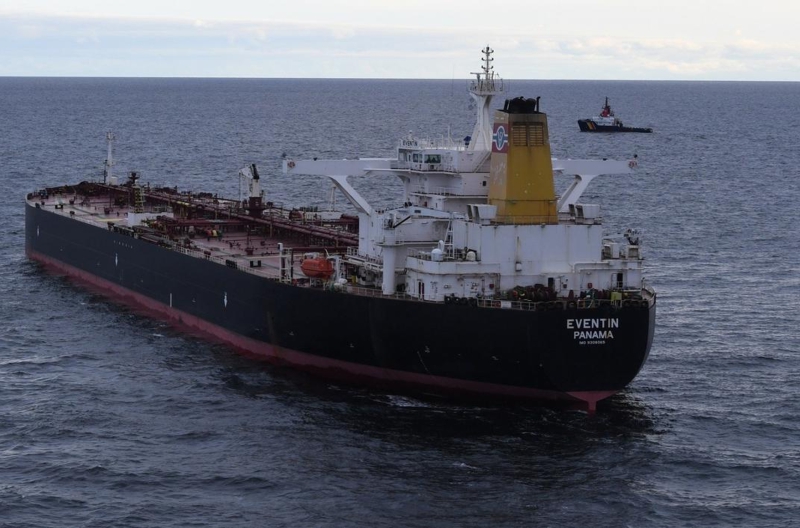
The Russian “shadow fleet” tanker Eventin was confiscated after drifting and being towed to anchorage off the German island of Rugen in March 2025. Photo: Central Command for Maritime Emergencies
Germany’s Federal Fiscal Court has ruled that customs authorities cannot seize the oil tanker Eventin, which has been anchored off the island of Rügen for nearly a year, Der Spiegel reports. The court said it had “reasonable doubts about the legality of the confiscation measures.”
The Main Customs Office ordered the seizure of the vessel and its cargo in March, but the shipowner challenged the decision. A financial court in Greifswald had earlier sided with the shipowner, and the federal court has now upheld that ruling, noted Süddeutsche Zeitung.
Before it experienced engine trouble this past January, the Panama-flagged Eventin left Russia’s Ust-Luga port in the Baltic Sea, reportedly bound for India with 100,000 tons of crude oil worth more than €40 million. However, on Jan. 10, the ship needed to be towed to the port area of Sassnitz on Rügen. Since then, it has been guarded around the clock by the German coast guard and federal police.
The vessel was added to the EU sanctions list in late February over its connection to Russia’s “shadow fleet.” Its registered owner, the Marshall Islands-based Laliya Shipping Corp., insists the tanker “was never intended to transport sanctioned petroleum products.”
German authorities have yet to decide their next steps, and further legal proceedings are likely, according to Spiegel.
Why Europe struggles to restrict sanctions-evading vessels
European governments face major obstacles not only when it comes to confiscating “shadow fleet” tankers, but even over efforts to detain them. As The Insider has previously reported, gaps in international maritime law make the seizure of vessels extremely difficult — even when a ship lacks valid registration or engages in clear violations.
Countries bordering the Baltic Sea, including Germany, regularly announce new measures aimed at curbing the shadow fleet. But while these steps are helpful for building a legal and informational base for future sanctions, in practice sanctioned Russian oil continues to be transported.
Since July, Sweden and Germany have introduced enhanced checks on insurance for foreign vessels. But Sweden’s maritime authority told The Insider that the purpose of the new rules is simply to “collect additional information for the monitoring system,” not to conduct port-state control or detain ships.
Sweden’s coast guard similarly described the new procedures as a way to “signal presence and strengthen the deterrent effect” against the shadow fleet, while the country’s Foreign Ministry noted that governments have “only limited options” for direct enforcement. German Transport Minister Patrick Schnieder said the measures are intended “to enable further action that could ultimately lead to adding ships to sanctions lists.”
Denmark faces similar constraints. It has repeatedly announced tighter insurance inspections for tankers passing through its waters — most recently in October — but analysts say actual confiscations remain unlikely.
In line with this reality, Mark Douglas, an analyst at the ship tracking firm Starboard Maritime Intelligence, told The Insider that any intensified monitoring is more likely to generate grounds for new sanctions than to stop vessels outright:
“From everything I've seen, Denmark is just going to be more closely monitoring these tankers…I don't think this announcement will see any tankers being stopped.
What seems more likely, and what I think other oversight measures have done, is provide more information to enable sanctioning on tankers and also the insurance companies that enable them.
No EU sanctioned tankers are allowed to stop at Danish ports, so the impact on those tankers is zero — they are managing to operate without Danish ports already. Maybe Denmark could ban tankers loaded in Russia from their ports, but some of those tankers (mostly Greek owned) are operating legitimately under the price cap, and I think in general it's unlikely that Denmark would ban vessels without EU sanctions to back them.
So I think these new measures are not significantly different from what's in place. If they result in more tankers being sanctioned, that should help to make the oil trade harder, but it seems unlikely that they will have an immediate difference on the trade.”
To date, only two instances of European authorities detaining shadow-fleet tankers have been documented — and both involved the same vessel. In April 2025, Estonia detained the tanker Kiwala, which sailed under Djibouti’s flag but was not listed in that country’s registry, a violation of maritime law. The ship was later released and subsequently changed its name and flag.
In early October, the same tanker, now called Boracay and flying the flag of Benin, was detained in the English Channel by French authorities. Police arrested the captain and first mate, accusing them of disobeying orders and failing to prove ownership. The crew members were soon released, with the captain ordered to appear in court in February. Meanwhile, the tanker continued its voyage.