
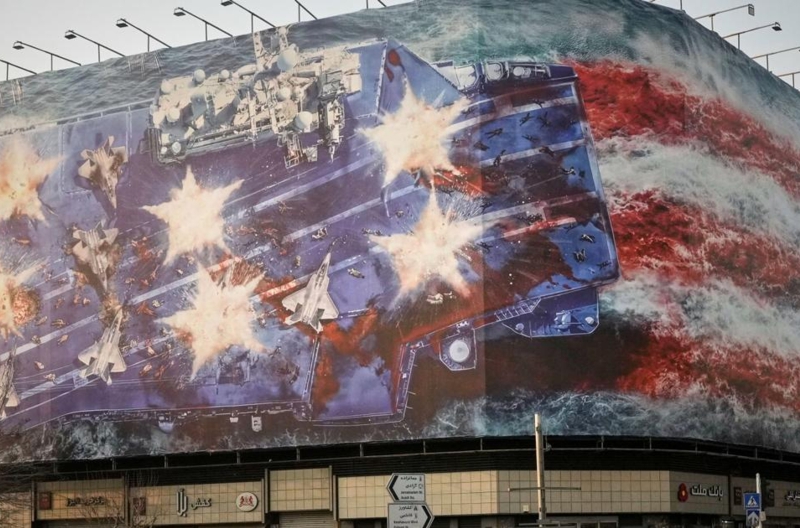
Vahid Salemi / AP Photo
An American carrier strike group led by the USS Abraham Lincoln has arrived in the Arabian Sea. At the same time, the United States and its allies are moving combat aircraft and aerial refueling planes to the Middle East and deploying additional air defense systems. Such a concentration of force is a clear sign of preparations for a military strike on Iran, where the ruling theocratic regime appears to be in its most vulnerable position since it came to power in 1979. For almost all of January, the country saw protests of unprecedented scale against the ayatollahs’ regime, ending in brutal repression that left between 3,000 (the minimum confirmed figure) and more than 30,000 people dead. Yet by themselves, none of the aerial attack options available to Donald Trump would be enough to guarantee a change of power — and the forces now assembled are clearly insufficient for introducing any serious presence on the ground. However, that situation could still change in the coming days.
In late 2025 and early 2026, Iran experienced unprecedented popular unrest — both in scale and in the amount of violence seen on the streets. What began with economic slogans quickly shifted to demands for dismantling the theocratic regime and even restoring the monarchy. The protests were accompanied by attacks on administrative buildings, mosques, and law enforcement officers. By mid-January, the Iranian authorities had managed to crush the uprising with force: the country’s internet was shut down for several weeks, and protesters were simply gunned down in the streets by members of the Islamic Revolutionary Guard Corps (IRGC).
The U.S.-based Human Rights Activists News Agency (HRANA) has calculated that at least 6,373 people were killed during the protests and that 42,486 were arrested. Another 17,091 deaths are being examined for possible links to the unrest. According to official data from the Iranian government, 3,117 people were killed, with 2,427 categorized as civilians and law enforcement officers and the rest labeled as “terrorists.”
Iran International, an outlet linked to the opposition, claims that more than 36,000 people were killed in total, with Jan. 8-9 marking the bloodiest suppression of street demonstrations “in history.” Time magazine, citing high-level sources in the Iranian Ministry of Health, reported that up to 30,000 people were killed over those two days.
THAAD is a U.S. missile defense system designed for high-altitude exo-atmospheric interception (Terminal High Altitude Area Defense). It is intended to intercept short-range tactical ballistic missiles and intermediate-range ballistic missiles at altitudes of up to 150 km and ranges of up to 200 km.
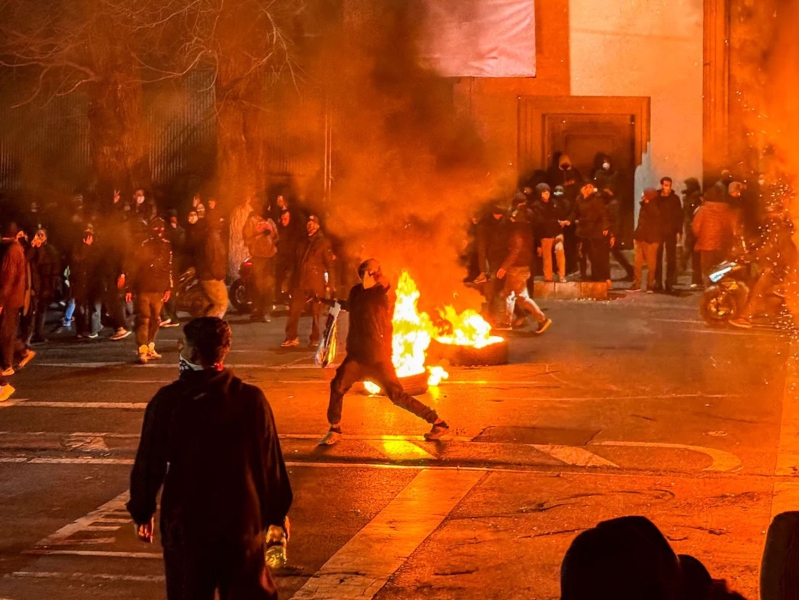
In early January 2026, Donald Trump indicated that he was ready to help if Iran «kills» protesters. He later posted a call to continue the demonstrations and seize administrative buildings, noting that “help is already on its way.” Several White House and U.S. national security officials seemed to be expecting the strikes to begin in mid-January, only for Trump to de-escalate the situation following assurances that the scheduled executions of 800 Iranian protesters had been called off — or, at least, that was the story as told by presidential press secretary Karoline Leavitt.
Since then, the protests in Iran have indeed subsided, but it is too soon to say that the internal crisis is over. The inflation, currency devaluation, and overall negative economic trends that originally triggered the unrest remain, as does a deep societal divide between supporters and opponents of the country’s highly idiosyncratic theocratic leaders. According to an intelligence assessment that was delivered to Trump, the Iranian regime is in the most vulnerable position it has experienced since coming to power in 1979.
THAAD is a U.S. missile defense system designed for high-altitude exo-atmospheric interception (Terminal High Altitude Area Defense). It is intended to intercept short-range tactical ballistic missiles and intermediate-range ballistic missiles at altitudes of up to 150 km and ranges of up to 200 km.
The Iranian regime is in the most vulnerable position it has experienced since coming to power in 1979
Meanwhile, Iran is threatening to respond with a “global jihad” if U.S. forces attempt to kill Supreme Leader Ali Khamenei, and the authorities in Tehran have unveiled an impressive mural depicting a damaged American aircraft carrier trailing a bloody wake — with the color scheme and design elements echoing the American flag and inscriptions in Farsi and English that read, “Whoever sows the wind shall reap the whirlwind.” Iran’s Yemeni allies, the Houthis, went even further, releasing an animated video portraying strikes on the Abraham Lincoln.
With the recent arrival in the Arabian Sea of the 3rd Carrier Strike Group (CSG-3), a window of opportunity is opening for the Trump administration to conduct a large-scale military operation against Iran. U.S. strike groups are typically accompanied by at least one submarine armed with cruise missiles, and the destroyers escorting the Abraham Lincoln — the USS Spruance (DDG-111), USS Michael Murphy (DDG-112), USS Frank E. Petersen, Jr. (DDG-121) — are also equipped with missile systems.
THAAD is a U.S. missile defense system designed for high-altitude exo-atmospheric interception (Terminal High Altitude Area Defense). It is intended to intercept short-range tactical ballistic missiles and intermediate-range ballistic missiles at altitudes of up to 150 km and ranges of up to 200 km.
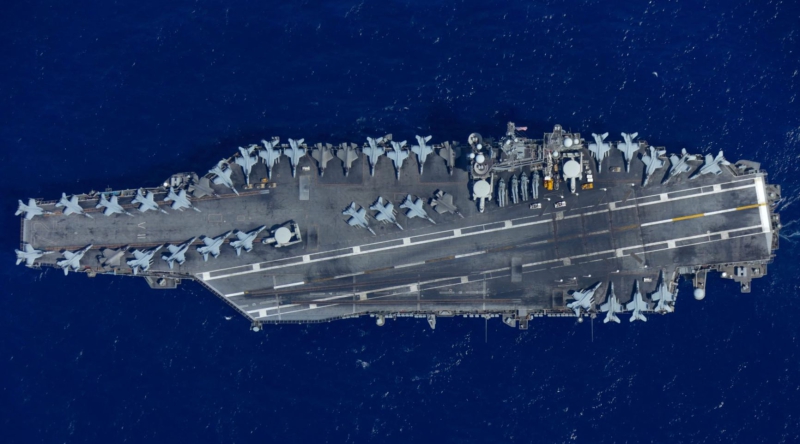
The aviation component of CSG-3 includes Carrier Air Wing Nine, which boasts fifth-generation multirole fighters F-35C Lightning II (10 to 12 aircraft), F/A-18E/F Super Hornet fighter-bombers (30 to 36 aircraft), EA-18G Growler electronic warfare aircraft (7 aircraft), E-2D Hawkeye airborne early warning and control aircraft (4 to 5 aircraft), CMV-22B Osprey tiltrotors (3 aircraft), and MH-60R/S Sea Hawk multirole helicopters (19 to 22 aircraft).
In addition, U.S. Central Command has confirmed the deployment of additional F-15E Strike Eagle fighters to a base in Jordan, bringing their total there to 37 aircraft, along with a significant number of aerial refueling and military transport planes to various bases in the Middle East and Europe. Additional air defense systems are being deployed in the region, including Patriot and THAAD batteries at the large Al Udeid Air Base in Qatar. The UK Ministry of Defence has also reported transferring Typhoon fighters to Qatar.
Since the UAE and Saudi Arabia have stated that they will not allow their territory or airspace to be used for attacks on Iran, a prolonged air campaign may require a second carrier strike group to operate within range of Iranian territory. Notably, the USS George H. W. Bush (CVN-77) is already underway from Norfolk, but even without its presence the United States has assembled enough forces and capabilities for a military operation.
Based on publicly available information, the only realistic option for now is an air campaign similar to Operation Midnight Hammer, which was conducted in June 2025. A ground operation by the U.S. and its allies currently appears impossible, since it would require assembling an invasion force of roughly the same size and composition as those that fought the wars against Iraq in 1991 (Operation Desert Storm) and 2003 (Operation Iraqi Freedom). In the first case, it took about six months to deploy more than 500,000 American troops (not counting allies) and several thousand tanks, aircraft, and artillery systems to the region. In the second case, the number of U.S. service members in the theater reached 340,000 before the operation began. At present, U.S. bases in the Persian Gulf region host around 50,000 personnel, and most of them belong to the Air Force and Navy rather than to infantry units.
Israel has forces on the scale required, but the country has never taken part in major expeditionary operations, and there are political objections to Israeli involvement in such a campaign — both from America’s Arab allies and within Israeli society itself.
In the future the United States could mobilize forces comparable to those deployed during the Iraq war, but given the limited amount of assets currently in the region, Trump has at his immediate disposal only the following set of scenarios:
- Symbolic strikes on facilities of the Iranian military–industrial complex or the nuclear program
- Strikes on sites belonging to Iran’s security apparatus — primarily the IRGC and the Basij, which are responsible for the brutal suppression of the protests
- Strikes on industrial centers and on transport and energy infrastructure to inflict economic damage on the ruling regime
- Strikes targeting the top military–political leadership, including Ali Khamenei
The problem is that none of these scenarios guarantees a change of regime in Tehran — certainly not to a government friendly to the United States. Symbolic strikes are unlikely to have any meaningful impact on the stability of Iran’s theocracy, and while attacks on security infrastructure could have a greater effect, they would require days’ worth of air raids and careful target reconnaissance to disrupt command and control, thereby giving the protests at least a chance to reignite. Meanwhile, the consequences of strikes aimed at inflicting economic damage or physically eliminating Khamenei are even harder to predict.
THAAD is a U.S. missile defense system designed for high-altitude exo-atmospheric interception (Terminal High Altitude Area Defense). It is intended to intercept short-range tactical ballistic missiles and intermediate-range ballistic missiles at altitudes of up to 150 km and ranges of up to 200 km.
None of the air campaign scenarios guarantees a change of regime in Tehran — certainly not to one friendly to the United States
According to more leaks, the United States is leaning toward precision strikes on the political leaders and security officials responsible for suppressing the protests, but now that the demonstrations have already been crushed, it is not entirely clear how such strikes would affect the overall situation in the country. Moreover, recent historical examples show that while wars can be won without a ground invasion, achieving political change that way is extremely difficult.
Whichever scenario Trump chooses, the likelihood of regime change through an air campaign alone appears relatively low compared with the much greater possibility of large-scale destabilization of the entire region, provided that Iran responds forcefully and comprehensively by mobilizing its allies across the Middle East — Palestinian Hamas, Lebanese Hezbollah, Yemen’s Houthis, and Shiite militias in Iraq. Such a development would disrupt freedom of navigation in the Red Sea, threaten any prospects of a peace settlement in Gaza, and potentially lead to the emergence of a new war in Lebanon.
Given all of the above, the most realistic scenario for weakening the ayatollahs’ rule may be tied to the dismantling of the Islamic Republic altogether. Ethnic Persians make up less than 50 percent of the state’s total population and are concentrated in the central part of the country, while ethnic minorities — Azerbaijanis, Kurds, Arabs, Baluchis, and Turkmens — mostly live in compact areas along the periphery. Supporting armed resistance under the banner of national self-determination, particularly among Iranian Kurds and Baluchis, who are already fighting the central government, would likely be more effective than any form of airstrikes. However, it would also be far riskier for neighboring countries and all but fatal for any prospects of a secular, pro-Western democracy within Iran itself emerging anytime soon.
THAAD is a U.S. missile defense system designed for high-altitude exo-atmospheric interception (Terminal High Altitude Area Defense). It is intended to intercept short-range tactical ballistic missiles and intermediate-range ballistic missiles at altitudes of up to 150 km and ranges of up to 200 km.

In any case, the United States and its allies — above all Israel — will still need several more days of preparation and operational deployment before the start of any operation can reasonably be expected to begin. Still, Israel’s civil aviation authority has warned foreign airlines that a “sensitive” period for air traffic could begin as early as Jan. 31 or Feb. 1.
For now, Trump insists that Iran must “make a deal,” and it is entirely possible that the presence of such significant forces in the region could indeed help move negotiations forward. Yet the potential terms of the “deal” circulating in the media — the ayatollahs agreeing to abandon their nuclear and missile programs while ending support for proxy forces across the region — appear completely unacceptable to Iran’s leadership. As reported by The Wall Street Journal, the first two of the three proposed conditions have already been rejected.
THAAD is a U.S. missile defense system designed for high-altitude exo-atmospheric interception (Terminal High Altitude Area Defense). It is intended to intercept short-range tactical ballistic missiles and intermediate-range ballistic missiles at altitudes of up to 150 km and ranges of up to 200 km.