
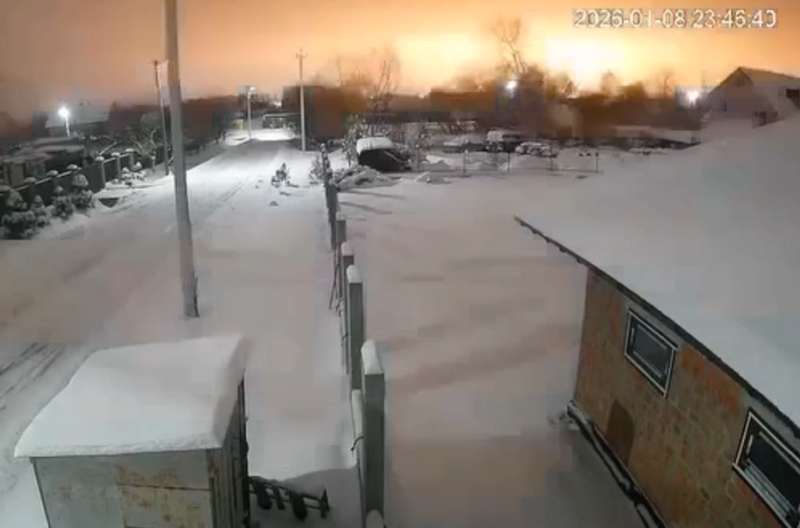
A still from a video of the strike on the Lviv Region in western Ukraine. Source: Ukraine Battle Map
Russia’s Ministry of Defense has confirmed that the Oreshnik missile system was used in the missile strike on Ukraine's Lviv Region on the night of Jan. 8-9. According to a statement published on the morning of Jan. 9, strike drones were also involved in the attack “on critically important facilities on the territory of Ukraine.”
The statement says the strike was carried out “in response to a terrorist attack by the Kyiv regime on the residence of the president of the Russian Federation in Novgorod Region, carried out on the night of Dec. 29, 2025.” It also claims that “facilities producing unmanned aerial vehicles used in the terrorist attack, as well as energy infrastructure supporting the operation of Ukraine’s military-industrial complex, were hit.”
On the night of Jan. 8-9, Russia launched a ballistic missile at Ukraine’s Lviv Region. Ukrainian monitoring channels suggested the munition may have been the Oreshnik missile system, which is designed to carry nuclear warheads but can also be used to deliver conventional explosives. Russia has previously used the Oreshnik without a nuclear payload, striking Dnipro on Nov. 21, 2024.
On the night of Jan. 8-9, a series of consecutive explosions was indeed recorded in the Lviv Region, and a critical infrastructure facility was targeted, Lviv mayor Andriy Sadovyi confirmed. According to the head of the regional military administration, Maksym Kozytskyi, the strike hit a critically important facility. Ukrainian Telegram channels reported that the Stryi gas field and an underground gas storage facility were likely targeted.
Russia’s purported justification for the strike, however, has raised questions. At the end of December, Putin accused Ukraine of attempting to attack his residence in Novgorod Region with drones. Moscow’s Defense Ministry later stated that 91 Ukrainian UAVs had been involved in the attack — but that none of them had reached the head-of-state’s Valdai residence.
On Dec. 30, Donald Trump said he was very angry after learning from Putin about the “attack by the Armed Forces of Ukraine” on his Russian counterpart’s residence. However, just a few days later, the U.S. president told journalists that he did not believe Ukraine had targeted Putin’s residence: “I don't believe that strike happened. There is something that happened fairly nearby, but had nothing to do with this.” Ukrainian President Volodymyr Zelensky called the reports of an attack on Valdai fake, saying that Russia’s accusations were aimed at sabotaging the peace process.