
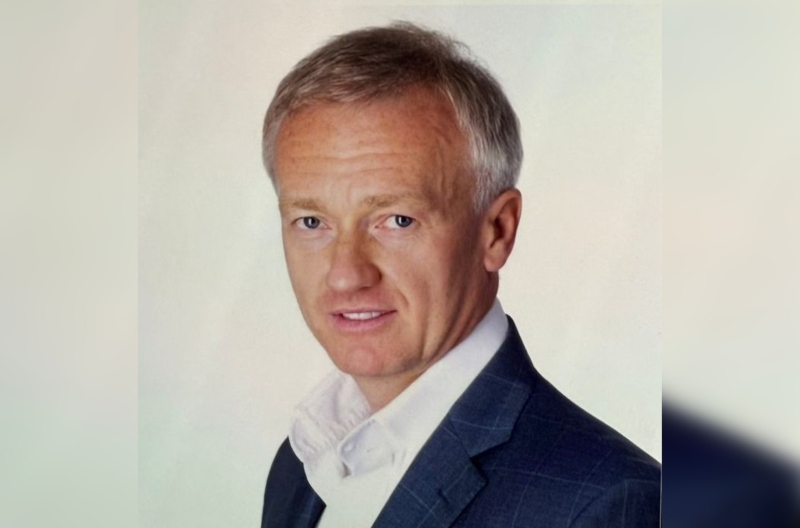
Vladislav Baumgertner, the former CEO of Russian potash producer Uralkali, went missing on Jan. 7 in Limassol, Cyprus. Photo: Cyprus Police
On Jan. 11, police in Cyprus reported the disappearance of Vladislav Baumgertner, the former head of Russian potash producer Uralkali. According to the police, the Russian citizen went missing on Jan. 7 in Limassol, where he was living.
“The 56-year-old is described as about 1.90 m tall, of slim build, with gray hair. At the time he left [his home], he was wearing black shorts and a black short-sleeved T-shirt,” the police said in a statement posted on their website.
Cypriot news outlet Philenews reported that the last signal from Baumgertner’s mobile phone was recorded in the Pissouri area near Limassol, along a hard-to-reach rocky coastline. The disappearance was reported by one of Baumgertner’s employees, who became concerned after he stopped answering calls.
A search operation involving police, Civil Defense, and personnel from the British Sovereign Base Areas, as well as a helicopter and drones, was launched on Saturday, Jan. 10. Search efforts were suspended Sunday because of severe winter storms and resumed from the early morning on Monday. Baumgertner lives alone in Cyprus, while his family remains abroad.
Baumgertner worked at Uralkali from 2003 to 2013, serving first as commercial director and later as chief executive. In 2013, Uralkali, which exported its products through the Belarusian Potash Company — a joint venture with state-owned Belaruskali — announced it would begin selling fertilizers independently. In response, Belarusian authorities invited Baumgertner to Minsk, where he was arrested and accused of participating in a criminal group that allegedly understated the true prices of potash.
Baumgertner spent time in custody in Belarus before being extradited to Russia, where a criminal case was also opened against him on charges of abuse of authority. After returning to Russia, the former Uralkali chief spent a month in a Moscow pretrial detention center. He was then placed under house arrest and later released under travel restrictions. The case against Baumgertner was not closed until February 2015.
However, Limassol Assistant Police Director Lefteris Kyriakou said Monday that there is no evidence so far linking that episode to Baumgartner’s current disappearance. “At this stage, it does not appear to be connected,” Kyriakou said, adding that the authorities have found no immediate indications of foul play.
The disappearance comes amid what the administration of Cypriot president Nikos Christodoulides has described as an “organized hybrid attack” by Russia. The government says the recent release of a so-called kompromat video targeting the administration was a response to Cyprus’ pro-Western shift. Officials have linked the timing to Cyprus taking over the rotating EU Council presidency and to a recent visit by Ukrainian President Volodymyr Zelensky, arguing that Russia is using “hybrid tools” to depict the republic as an unreliable European partner. The attack reportedly bore “all the hallmarks” of previous Russian campaigns against France, Germany, and the U.S.
Adding to the complexity are the activities of Cyprus-registered intermediaries linked to efforts to bypass EU sanctions. Previous investigations by the Belarusian Investigative Сenter and Politico found that Belaruskali, the state-owned producer that replaced Baumgertner’s former company in the European market, used Nicosia-based Dimicandum Invest Holding to reroute potash exports through St. Petersburg. The reports said documents showed the Cyprus firm was paid $20 a ton for logistics services that typically cost about $11, fueling allegations that the island has been used as a hub to siphon off sanctioned funds.
Since the start of the full-scale invasion of Ukraine, Cyprus has provided financial, security and humanitarian support to Kyiv, including through EU frameworks.
At the same time, Cyprus has faced criticism as a conduit for Russian money entering the EU and as a tax haven for Russian oligarchs.
Multiple Russians from the Forbes Billionaires List — including Oleg Deripaska, and Igor Kesaev, Mikhail Gutseriev — have seen their “golden” Cypriot passports revoked in recent years amid increased scrutiny of the Cyprus Investment Program (CIP). Nicosia also launched a dedicated sanctions implementation unit in mid-2025, spurred in part by the Cyprus Confidential investigation, which revealed the extent of Cyprus’ role as a gateway to Europe for Kremlin-connected elites.
Tensions intensified last Thursday — a day after Baumgertner’s disappearance — when a senior Russian diplomat was found dead inside his office at the Russian Embassy in Nicosia. The Cyprus Mail reported, citing sources familiar with the matter, that the man was found around midday, while police were not notified of the death until several hours later.
Embassy officials then prevented Cypriot police from entering the building to examine the scene, justifying the obstruction with reference to the extraterritorial status of the building. Later, Russian officials handed over the body in the embassy’s courtyard, saying the death was a suicide. They also claimed that a suicide note had been left, but it was not provided to Cypriot investigators. Sources close to the situation told the Cyprus Mail that a post-mortem examination conducted on Friday determined the cause of death to be unnatural.
Police spokesman Vyronas Vyronos said in a later statement that the death was not the result of a criminal act, with an autopsy ruling out foul play. He added that the body would be handed over to the embassy for repatriation to Russia.
The embassy later confirmed the death of one of its employees, identifying him as A.V. Panov. In a statement, the embassy said he died on Jan. 8 and described the loss as a “profound personal tragedy for his family and friends.”
The video posted on social media Thursday splices together clips of three political figures — the president’s brother-in-law, who also heads his office, a former energy minister and the chief executive of a major construction company — discussing their ties to the president, campaign financing and efforts to attract foreign investment, implying influence peddling.
The video also alleges that President Nikos Christodoulides exceeded the 1 million euro ($1.16 million) campaign finance limit by accepting unreported cash donations during his 2023 presidential campaign.
Its most serious claim is that the Cypriot government would seek to block EU sanctions against Russian oligarchs in exchange for corporate payments.