
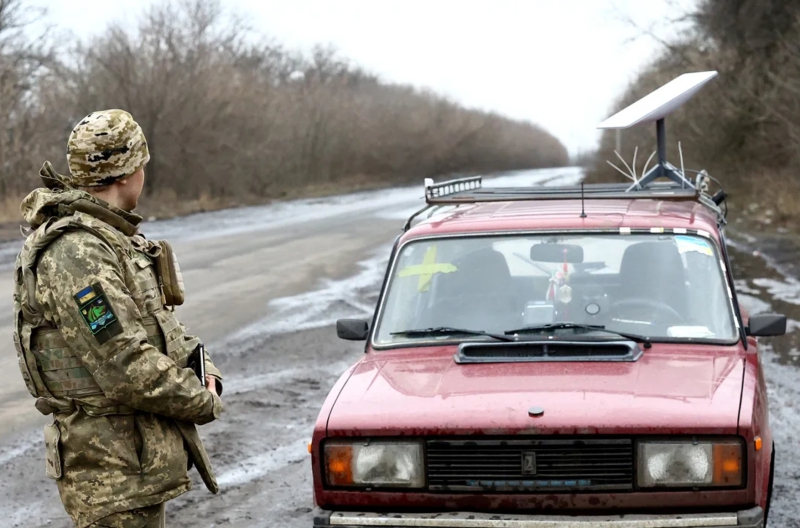
A Ukrainian serviceman stands next to a vehicle equipped with a Starlink satellite communications terminal. Photo: Reuters
The Ukrainian government has approved a resolution to create a “whitelist” for Starlink satellite communication terminals, according to a Feb. 2 statement from Defense Minister Mykhailo Fedorov, who linked the decision to the use of the terminals by Russian forces. Russian drones equipped with Starlink terminals are difficult to shoot down, Fedorov explained, as they fly at low altitude, are resistant to electronic warfare, and can be controlled by operators in real time even from long distances.
“The only technical solution to counter this is the introduction of a ‘whitelist’ and the authorization of all terminals. At the initiative of the Ukrainian government, we are implementing it in cooperation with SpaceX,” the minister wrote.
Under the new rules, all terminals used by individuals and companies in Ukraine must be registered. Unregistered users will be disconnected. Fedorov added that the registration process for both businesses and private individuals would be “as simple as possible.” The requirement does not apply to the military, which uses a separate communications channel.
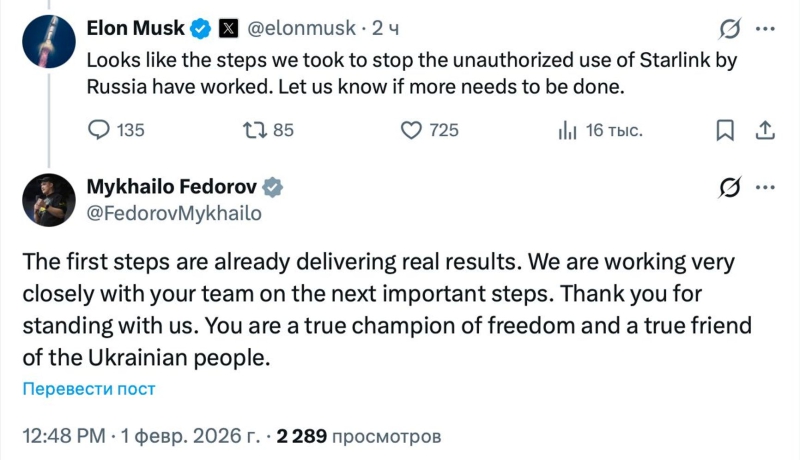
According to an exchange on X between Fedorov and Elon Musk, measures taken by SpaceX to prevent Russia from using Starlink to attack targets in Ukraine are yielding positive results.
“Looks like the steps we took to stop the unauthorized use of Starlink by Russia have worked. Let us know if more needs to be done,” Musk wrote on Feb. 1, responding to Fedorov’s tweets from Jan. 29 describing the problem. In reply, the defense minister wrote: “The first steps are already delivering real results. We are working very closely with your team on the next important steps. Thank you for standing with us. You are a true champion of freedom and a true friend of the Ukrainian people.”
Serhii “Flash” Beskrestnov, the author of a popular Telegram channel, is a Ukrainian military specialist in the fields of communications, electronic warfare, and unmanned systems. Since January 2026, he has served as an advisor to Ukraine’s defense minister, Mykhailo Fedorov.
“Shahed” is the name of a family of Iranian-made kamikaze drones, including the Shahed-131 and Shahed-136 models. Localized Russian versions are known as the Geran-1, Geran-2, and Geran-3 (the latter being a jet-powered modification) and are produced at the Alabuga Special Economic Zone in Russia’s Tatarstan Region. The Geran-type drone has a flight range of up to 2,500 kilometers (1,550 miles) and can carry a warhead weighing up to 90 kilograms (about 200 pounds), though some sources say an upgraded warhead can reach 300 kilograms (660 pounds).
Neither Fedorov nor Musk specified what precise results had been achieved. The previous evening, Ukrainian military advisor Serhii “Flash” Beskrestnov wrote that the measures taken had also affected Ukrainian Starlink users.
“I cannot publicly disclose everything that has already been done, is being done, and will be done, but all these actions are aimed at one goal: protecting the people of our country — both military and civilians — and our infrastructure from the threat posed by the enemy’s strike drones. I want to emphasize that the current solutions are TEMPORARY (or, put another way, EMERGENCY) and will be replaced by a comprehensive, well-thought-out solution that will take us time,” Beskrestnov wrote.
On Jan. 29, Fedorov said representatives of Ukraine’s defense ministry had informed SpaceX that the Russian army was using Starlink to control drones during attacks on Ukrainian cities and that Ukrainian officials had “proposed specific ways to address the problem.” According to Fedorov, the U.S. company immediately began working on a solution.
Beskrestnov said “hundreds” of cases of Russian drone attacks using Starlink modules had been recorded, adding that it was possible Shahed-type drones controlled via Starlink were behind a Jan. 27 attack on a passenger train in the Kharkiv Region in which five people were killed.
Serhii “Flash” Beskrestnov, the author of a popular Telegram channel, is a Ukrainian military specialist in the fields of communications, electronic warfare, and unmanned systems. Since January 2026, he has served as an advisor to Ukraine’s defense minister, Mykhailo Fedorov.
“Shahed” is the name of a family of Iranian-made kamikaze drones, including the Shahed-131 and Shahed-136 models. Localized Russian versions are known as the Geran-1, Geran-2, and Geran-3 (the latter being a jet-powered modification) and are produced at the Alabuga Special Economic Zone in Russia’s Tatarstan Region. The Geran-type drone has a flight range of up to 2,500 kilometers (1,550 miles) and can carry a warhead weighing up to 90 kilograms (about 200 pounds), though some sources say an upgraded warhead can reach 300 kilograms (660 pounds).