
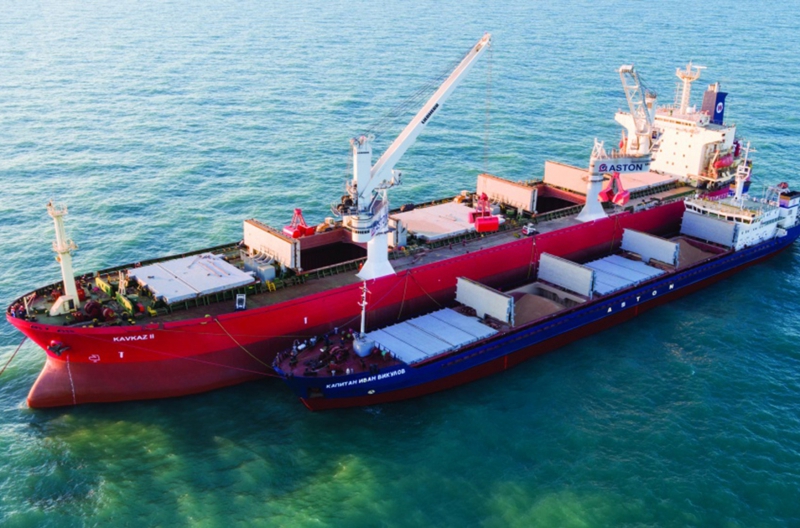
Offshore ship-to-ship cargo transfer from the bulk carrier Kavkaz II to another vessel. Photo: aston.ru
Western sanctions and severe winter weather have pushed Russia to increase its exports of petroleum products through ship-to-ship transfers, leading to a shortage of suitable tankers, traders told Reuters. Data from the London Stock Exchange Group (LSEG) supports that account.
The ship-to-ship transfer scheme allows ice-class tankers to make short voyages from Russian ports and transfer cargo to other vessels in the Mediterranean and Atlantic. Those ships then deliver the products to Asia. The arrangement helps shorten routes, allowing Russia to cope with a shortage of vessels. After the European Union embargo took effect in 2023, Asian countries became the main destination for Russian petroleum product exports.
The situation was worsened by severe cold in early 2026, when rules for sailing in the Baltic Sea were tightened: tankers without an ice class were barred from entering Russian ports, while Ice1-Ice2 vessels were required to use icebreaker escorts.
With those constraints in mind, traders have increasingly turned to ship-to-ship transfers. According to LSEG, in January two tankers carrying 240,000 tons of naphtha from the Russian port of Ust-Luga transferred cargo off Port Said and off the coast of Togo, after which it was delivered to Singapore. In February, ship-to-ship transfers also began off the coast of Morocco, with their volume exceeding 200,000 tons. In March, two more tankers headed for a transfer operation near the Italian port of Augusta.
Experts warn that the use of this practice is increasing risks.
Ship-to-ship transfers are not a new phenomenon, but the frequency with which they are now being used — in poor weather conditions and often to conceal the origin of sanctioned oil — significantly increases environmental risks, Isaac Levi, Europe-Russia team lead and “shadow fleet” expert at the Centre for Research on Energy and Clean Air (CREA) told The Insider:
“Ship-to-ship transfers aren’t new, but the way they’re now being used more frequently, in worse weather, and often to obscure the origin of sanctioned oil raises the environmental risk profile significantly. We are seeing a convergence of environmental, safety, and legal risks: higher chances of spills or collisions, weaker oversight, and greater exposure to sanctions breaches. What used to be a controlled logistical operation is increasingly becoming a workaround tactic, and that’s where the real danger lies.”
In 2020, Russia’s Natural Resources Ministry proposed banning ship-to-ship oil transfers. The ministry’s head at the time, Dmitry Kobylkin, sent a letter addressing the issue to Vladimir Putin, who marked it “agree.”
At the time, Kobylkin justified the proposal with data showing the occurrence of more than 600 emergency incidents in the Black Sea alone, including petroleum spills, the death of marine life, and the release of chemical substances into the water. The letter did not specify the period during which the incidents occurred.
The natural resources minister saw particular danger in offshore transfers involving large oil tankers. “In the event of an emergency involving a large oil tanker, the damage caused to the sea and the coastal zone would be irreparable,” he said.