
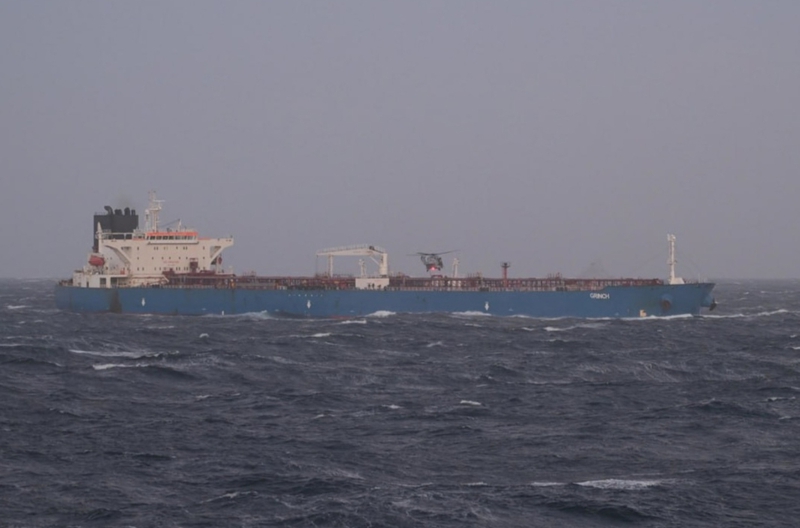
The tanker Grinch was intercepted by the French Navy in the Mediterranean Sea on Jan. 22. Photo: French Joint Staff (@FrenchForces / X)
France will be forced to release a detained tanker from Russia’s “shadow fleet” due to limitations in national legislation, President Emmanuel Macron told Ukrainian President Volodymyr Zelensky in a phone call on Jan. 29. Zelensky, in turn, announced the news at a meeting with journalists in Kyiv, according to a report by European Pravda. The Insider had earlier reported that the European Union has limited legal mechanisms to hold detained tankers.
During the call, Zelensky thanked the French leader for detaining the vessel. In response, Macron said current French and international law does not allow the authorities to hold civilian ships for extended periods, even if they are under sanctions. At the same time, the French president said he intends to initiate legislative changes so that similar tankers could remain under arrest in the future.
The case concerns the oil tanker Grinch (IMO: 9288851), which was detained by the French military in the Mediterranean Sea on Jan. 22. The vessel, which sails under the flag of the Comoros islands, departed from Russia’s northern port of Murmansk and is involved in the transportation of Russian oil to China and India. In July 2025, the tanker was added to sanctions lists by the European Union, the United States, and the UK. On Jan. 26, French authorities arrested the ship’s captain, a 58-year-old citizen of India.
As The Insider previously reported, Europe’s reluctance to confiscate “shadow fleet” tankers is largely the result of shortcomings in international maritime law. Under existing conventions, prolonged detention of a vessel in port is not allowed — after paying fines and passing technical inspections, a ship has to be released, otherwise the state risks lawsuits in international courts.
Experts also point to fears of escalation, as attempts to intercept such vessels have already led to retaliatory actions by Russia and rising international tensions. Countries also face practical challenges in detaining tankers, including questions about who pays for maintenance, how to handle the cargo and crew, and how long a vessel can remain in port.
In effect, the only known case of a “shadow” tanker being confiscated in Europe occurred in Germany in January 2025, when the vessel Eventin was towed away due to the environmental risk it posed. However, even in that case, the tanker’s legal status remains unresolved, as Germany’s Federal Fiscal Court blocked the confiscation last December.
Specialists interviewed by The Insider believe a real solution is reachable by way of a new international convention on ship registration under the auspices of the International Maritime Organization, a process they say would be lengthy. Real and tough measures, in their view, are likely to appear only after a major environmental incident, the probability of which is considered high due to the fact that “shadow fleet” tankers are generally quite old and often poorly maintained.