
Russian authorities have temporarily postponed the introduction of fees for VPN traffic, but the campaign to restrict the internet in the country continues. In response to ongoing shutdowns and the threat of a complete network collapse in the country, decentralized digital communication tools are becoming increasingly popular. For example, Meshtastic devices, which transmit messages over radio waves, are emerging as a possible alternative to conventional messaging apps in the event of a total internet blackout. Meanwhile, the specialized messenger DeltaChat is capable of functioning even under whitelist restrictions. Already, more than 10,000 people in Moscow alone are employing these technologies – though for now most users are amateur radio enthusiasts.
Доступно на русскомContents
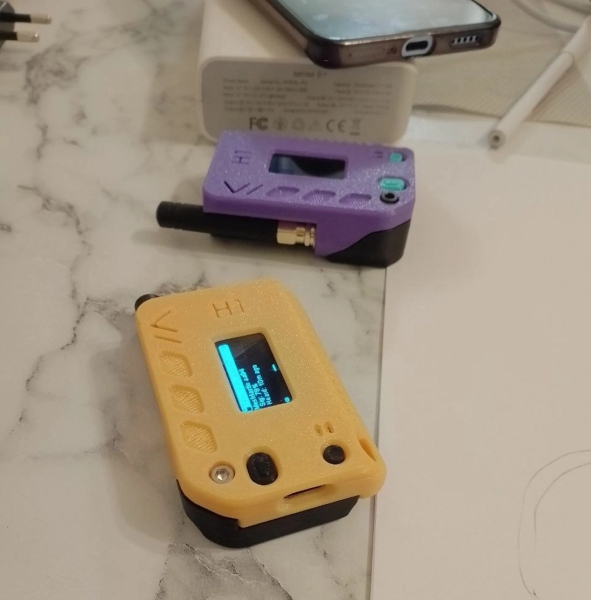
“This device here is called a ‘node,’” says radio enthusiast Sergey (name changed for security reasons), holding out a rectangular box with a thick antenna on the side.
Sergey lays two such boxes on the table in front of him — one purple and one orange. Using these devices, he can exchange short text messages with other node owners over radio waves without relying on the internet or cellular networks.
Two Meshtastic “nodes”
The radio communication standard that makes this possible is called LoRa (short for “Long Range”). It allows the transmission of small data packets over distances of up to 15 kilometers under ideal conditions and up to five kilometers in urban areas. LoRa transmitters are integrated on a single board with the ESP32 microcontroller, which can connect to Wi-Fi and Bluetooth, allowing them to be used for the Internet of Things.
Using a technology known as Meshtastic, nodes are linked together into a single decentralized network, thereby extending the signal range. The technology was developed in the early 2020s by American engineer Kevin Hester to help people stay connected far from cellular towers.
Today, Meshtastic is an open-source project whose development is supported by tens of thousands of people around the world, from ravers and “preppers” to volunteers helping victims of natural disasters.
Sergey is around 30 years old. He lives in northern Moscow and is passionate about the science behind communications. After watching videos by Dmitry Pobedinsky, who in September 2025 released a viral video titled “This Will Save You When They Block the ENTIRE INTERNET,” Sergey decided to assemble a device that would allow him to survive a “digital apocalypse.”
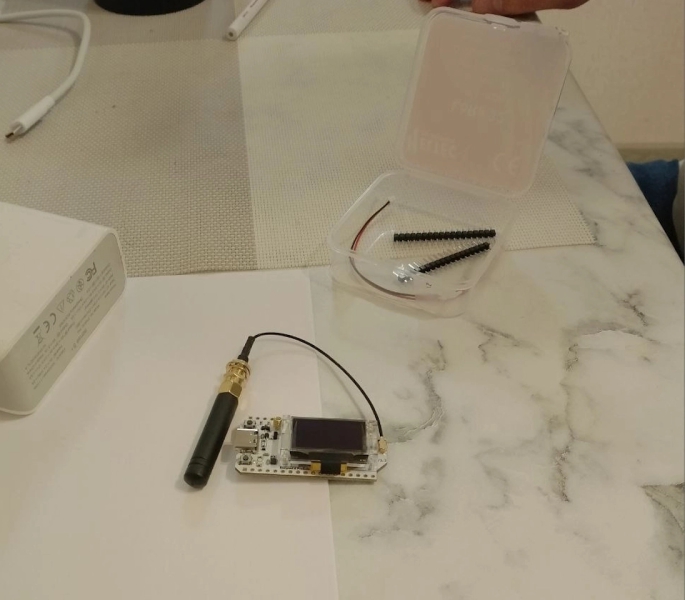
Hercules Heltec V3 board
ESP32 LoRa devices supporting Meshtastic technology are freely available on all major online marketplaces. For around 10,000 rubles ($140), it is possible to buy a fully assembled gadget with a built-in keyboard and a full display, while a bare digital board that can be used to assemble a radio device independently costs around 2,000 rubles ($28).
“This is the Hercules Heltec V3 model,” Sergey explains. “It’s the most common one and fairly cheap. There are more powerful models that consume less battery power, but they’re more expensive. These little antennas came bundled with the board, but people recommend replacing them because they’re too weak. I ordered the case separately and soldered in a battery as well — those are bought separately too. In principle, you don’t even have to do any of that: the board itself is already ready to use, and if you don’t have a battery, you can power it with a power bank.”
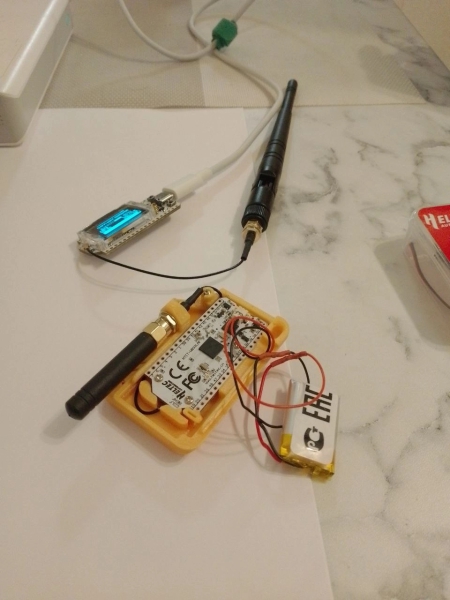
The Hercules Heltec V3 board powered by a power bank
Once the device is ready, the user needs to download the latest version of the software from the official Meshtastic website, along with the Android or Apple app in order to pair the radio module with a smartphone. The application also has a web version for Chrome-based browsers. However, from the perspective of many Meshtastic users, that somewhat undermines the “purity of the experiment,” since their primary interest is communication without the internet.
When the Meshtastic app is launched for the first time, users select their country and configure region-specific settings (which can easily be found in specialized Telegram chats). These settings determine the frequency range in which the device will operate.
Communication via Meshtastic is not regulated by the government as long as it takes place within the unlicensed 868 MHz frequency band. In addition, the transmitter itself must not exceed 25 mW in power — otherwise, it must be registered with Roskomnadzor and the user must obtain an official amateur radio license. Transmitters exceeding 100 mWare prohibited altogether.
Once all the setup steps are completed, the device turns into a fully functional node. Messages typed on a smartphone are transmitted to the node via Bluetooth or Wi-Fi and then relayed over radio waves across the network. At the same time, the messages are protected from outside access through end-to-end encryption, just like in modern messaging apps.
Messages arriving at your node undergo the reverse conversion from radio signal into digital data, allowing you to read them on your smartphone. And if the gadget has a keyboard and screen, messages can be written and sent directly from the device itself.
Using the Meshtastic app, users can correspond via private chat with acquaintances who have their own nodes, or else communicate in a public channel where messages are visible to everyone. The app’s map also shows which nodes are operating nearby, and it is possible to create a private channel for communication and by sharing an access key with selected invitees.
In order for a message to travel across a large city, the mesh-network principle comes into play. “Look,” Sergey says, sketching a diagram on a sheet of paper. “I want to send a message to you, but we’re out of each other’s range. So we need a third person — let’s call him Matvey — whose device can receive my message. Matvey himself can’t read it because it’s encrypted, but his node forwards the message onward and records that a relay took place. From Matvey, the message goes to Boris, whose device forwards it further, recording that it is now the third relay in the chain. And so on.”
The maximum number of “hops” a message can make between sender and recipient is set to three by default, though it can be manually increased to seven. The limit was introduced by the developers in order to prevent endlessly “hopping” messages from clogging up the communication channel.
“The connection works within a single city and the nearby Moscow suburbs,” Sergey explains, “but unfortunately, you can’t send a message from Moscow to Tver. I read about an enthusiast in Stavropol Krai who climbed a mountain and transmitted a message over 130 kilometers, but that was a record, and he was standing on a mountaintop with a very powerful antenna.”
In Stavropol Krai, an enthusiast climbed a mountain and transmitted a message over 130 kilometers – a record
With the node Sergey lent me, I return home and join the chatter in Moscow’s public Meshtastic chat. Most users here are interested in whether their signal is getting through and, if so, how many “hops” it has travelled. “Testing a stub antenna, can anyone hear me?” one user asks. “I can only break through onto the airwaves with a pole the size of a Jedi sword. In other (better-off) neighborhoods I can message from ground level,” another reports.
But conversations also drift into ordinary everyday topics. People chat about work, joke around, complain about their memory getting worse with age, wish other users “good night,” or write phrases like “Good morning to the cellblock” (a slang greeting associated with prison culture).
Some of the exchanges come through only in fragments, suggesting either that the quality of the connection is imperfect or that my own user settings still leave much to be desired.
According to the official map maintained by the OneMesh project, Meshtastic communities are currently active in dozens of Russian cities. At the time of writing, the number of active nodes that had connected to the network at least once within the previous 14 days exceeded 12,500. The largest concentration — more than 3,200 — was recorded in Moscow and the surrounding region. St. Petersburg ranked second with nearly 2,000 nodes, followed by Yekaterinburg (just under 600), Novosibirsk (around 480), and Ryazan (415).
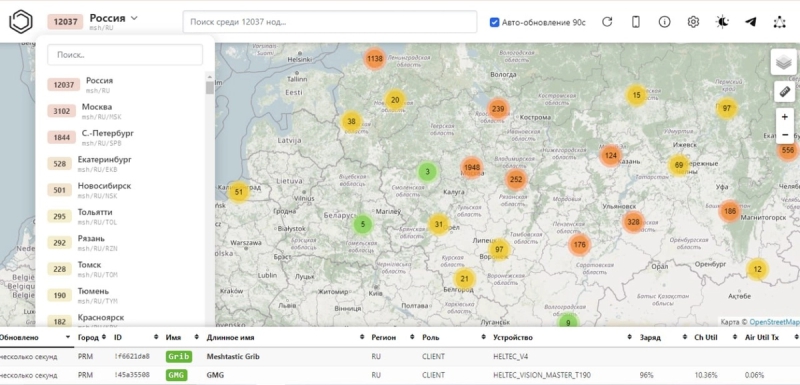
Screenshot of the map of Russian “nodes”
Journalists have already noted the predictable surge of interest in Meshtastic amid mobile internet shutdowns in various parts of Russia. For now, however, most Russian owners of LoRa devices do not appear to view their activity merely as a form of amateur radio hobbyism.
Still, the technology offers far broader possibilities than simple messaging. For example, a node can be used as a “bridge” between a mesh network and the regular internet, and it is easy to find online accounts from Meshtastic enthusiasts who have configured their nodes to send and read email. Some have even managed to receive fresh posts from their Telegram feeds on a node, as blogger Techno Minimalist did using a Raspberry Pi single-board computer roughly the size of a bank card (such devices are typically used for teaching programming).
Techno Minimalist wrote a script that allows a node connected to the internet at his home using a Raspberry Pi to automatically query Telegram for new posts from channels he follows. The node then forwards those posts to the portable node he carries around the city. As a result, the blogger no longer has to worry that a mobile internet shutdown might cause him to miss interesting updates.
“I can read channels, load the latest posts, and scroll through them — without videos or pictures, of course. I implemented transliteration so the screen can fit twice as many characters. It’s also possible to set it up to receive private messages and send back replies,” Techno Minimalist wrote in a post that went viral.
At the same time, IT expert and digital rights advocate Gennady (name changed for security reasons) cautions against excessive optimism about Meshtastic’s potential to substitute for internet access during shutdowns. He emphasizes that the very configuration of LoRa radio modules is designed for low-power operation so as not to interfere with gate remotes, alarm systems, and other devices functioning on the same frequencies. According to him, all claims about transmitting messages through Meshtastic over distances of dozens of kilometers remain theoretical calculations that cannot realistically be achieved in practice.
“When you send a message across seven ‘hops’ in Moscow, one of those intermediate hops will inevitably involve the internet,” Gennady argues. “Roughly speaking, I’m sitting at home, and two hops away from me there’s a relay node that pushes the message onto the internet, then it resurfaces somewhere else. But once the internet disappears entirely, your node will only be able to communicate with other nodes that are within direct line of sight, meaning even to communicate across neighboring streets in areas with high-rise buildings, we would have to violate Roskomnadzor regulations, because LoRa devices based on the ESP32 are supposed to operate at low power and with non-amplified antennas. That’s why they’re sold with those little ‘stubs,’ those tiny antennas.”
Together with his colleagues, Gennady calculated how many LoRa devices would theoretically be required to transmit a message into Moscow from abroad under ideal conditions. They arrived at a figure of around 200 “hops.”
Implementing such a setup in practice is physically impossible. Even within Moscow’s city limits the system faces difficulties: hundreds of nodes scattered across a metropolis not only expand the mesh network’s coverage but also interfere with one another, distorting communication. “Unfortunately, Meshtastic is basically a toy — a fun little novelty,” Gennady says. “Even dial-up internet as it existed, say, in 1991, vastly surpasses any network that could be built on Meshtastic in terms of speed and capacity.”
Gennady notes, however, that there are better alternatives: “Beyond Meshtastic, there are more advanced solutions worth mentioning that can run on the same radio devices. These are the MeshCore and Reticulum projects. People are experimenting, and perhaps at the next stage of technological development all this amateur radio activity will amount to something meaningful. In the beautiful Russia of the future, once sanctions are lifted, we may turn out to be more technologically prepared than the guys in California who are currently pouring money into startups and accelerators.”
“In the beautiful Russia of the future, once sanctions are lifted, we may turn out to be more technologically prepared than the guys in California”
MeshCore is a relatively new protocol for linking LoRa devices into a unified network. It was introduced to the public in early 2025 by Australian developer Scott Powell. The basic operating principles remain the same. However, MeshCore introduces a clear distinction between ordinary user nodes (called companions) and relay devices (known as repeaters).
Unlike in Meshtastic, companions do not send messages directly to one another; instead, communication passes through a repeater that is responsible for intelligent route selection, with users choosing during setup whether to configure a LoRa device as a companion or as a repeater. This network configuration has significantly expanded the system’s coverage, allowing MeshCore to support data transmission over as many as 64 “hops.”
Using around 300 repeaters placed at elevated points in mountainous terrain, MeshCore volunteers have managed to establish a communication line stretching roughly 640 kilometers between Vancouver, Canada and Eugene, Oregon. Cross-border transmission between the two cities can be accomplished in just 12 “hops,” without any intermediate connection to the internet.
Another major test that MeshCore passed was the large-scale blackout in Berlin earlier this year. After an arson attack against a cable bridge, tens of thousands of homes were left without electricity and heating for several days. The blackout was accompanied by a communications outage, leaving people unable to contact their relatives through conventional means. However, LoRa radio modules running the MeshCore protocol continued operating and withstood the sudden surge in demand.
The Telegram channel of MeshCore enthusiasts in Russia reported that the first repeaters began operating in Moscow and Kazan as early as late 2025. Just a couple of months of development proved sufficient to cover the entire Russian capital and the surrounding region with the network, and at present, the “Meshkartel” project shows around 1,800 active receivers on its map of Russia, with 679 of them located in Moscow.
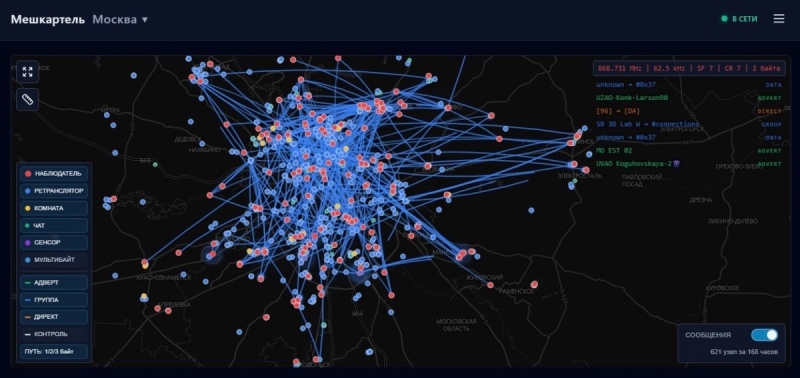
Screenshot of the map of MeshCore “nodes” in Moscow and the surrounding region
The Reticulum networking tool makes it possible to combine many different types of devices and data transmission methods — computers connected by cable, phones operating via Bluetooth, portable radio stations — into a single “web” capable of functioning at extremely low connection speeds. The ambitious goal of its creator, engineer Mark Qvist, is to build a fully decentralized alternative to the internet as we know it.
As Qvist himself explains, “we don’t need one big network layered on top of the internet, but many networks connected in countless ways. We need thousands of networks without kill switches and control mechanisms, and we need to tie them together both through and beyond the internet.”
“We don’t need one big network layered on top of the internet, but many networks connected in countless ways.”
It is difficult to reliably determine how widespread this technology is in Russia, but according to Gennady, there are rumors that Moscow alone already has more registered Reticulum nodes than all of the United Kingdom.
Interest among Russians in mesh networks, including the MeshCore project, is indeed growing noticeably, says Ksenia Yermoshina, a UX designer for the Delta.Chat messenger and an enthusiast of mesh-network development:
“If you look at maps of users of these tools, you can see that there are already many antennas and that the network density is high — and not only in large cities. People are sharing knowledge with one another, and there are many mesh-network guides circulating online. Moreover, bridges are being created between MeshCore and Delta.Chat and between Delta.Chat and Meshtastic. Hybrids are emerging that allow users of ordinary communication tools to interact with people in mesh networks and vice versa. I think the future belongs precisely to such projects. In principle, this bridge-building is the direction in which communication in Russia may develop under whitelist restrictions.”
Communication without an internet connection does not necessarily require intermediary specialized radio devices. It can also be organized via messengers that are capable of transmitting data via Bluetooth. The main problem with such applications is the extremely limited range of Bluetooth itself, which extends to several dozen meters at best. However, this limitation can be addressed through the previously described method of linking smartphones into a mesh network.
In the summer of 2025, Twitter co-founder Jack Dorsey introduced the BitChat messenger, which operates using precisely this technology. BitChat has no central servers and it requires neither registration nor SIM cards. The service assigns users a random nickname when first launched, which they can later change. Messages sent through BitChat exist nowhere except on the user’s own device, and the developers implemented a number of technical measures intended to make user identification as difficult as possible.
Earlier this year, BitChat served as the primary means of communication for participants in mass protests in Uganda. The demonstrations erupted after the country’s incumbent leader, 81-year-old Yoweri Museveni, declared himself the winner of his seventh consecutive presidential election.
The developers of BitChat expressed support for the protesters and called on “every Ugandan programmer” to join the project’s development. They also released an update allowing not only smartphones but also LoRa radio modules to function as communication nodes for the messenger.
Another way to preserve digital communication amid deliberate “jamming” from the authorities is to use the Delta.Chat messenger, which still requires an internet connection. However, because Delta.Chat operates using email protocols, it is extremely difficult for the state to block the messenger without disabling email delivery services altogether.
Delta.Chat can be configured to work through a regular email account, though the developers recommend using their dedicated chatmail relays instead. These employ encryption, collect no user information, and store messages only temporarily, while a user’s device is offline. The application automatically assigns a relay to the user on first launch, though it can also be changed manually if desired.
Delta.Chat performed successfully during internet shutdowns in Iran thanks to the fact that the local IT community had begun preparing for a “digital collapse” long before it occurred. “Iran has very strong programmers, developers, and advocates of free software,” Ksenia Yermoshina says. “From the information reaching us, several hundred chatmail relays had already been set up there in advance. And they weren’t just deploying relays — they were also experimenting with how the system functioned in general, including adding transport layers that we ourselves do not support.”
The messenger is now gaining an audience among Russian users as an application capable of “outsmarting” whitelist restrictions. By following instructions available online, it is relatively easy to configure a Mail.ru or Yandex Mail inbox for use as a Delta.Chat account. After that, users can continue communicating through the messenger, with Mail.ru or Yandex mail delivering the messages as ordinary emails. However, the providers themselves cannot read the correspondence because, as Yermoshina puts it, it appears to them as “a heap of encrypted gibberish.”
Delta.Chat is gaining an audience in Russia as an application capable of “outsmarting” whitelist restrictions
This method of communication is relatively safe, but it cannot be used if a person participates in large group chats using their Delta.Chat account. In that case, Mail.ru services will simply detect that messages are being sent and received too frequently and will automatically block the mailbox as if protecting it from spam activity. As Yermoshina explains:
“In normal times, when whitelist restrictions are not active, I always advise people to use our chatmail relays. There are many of them, and their number keeps growing. A great deal of work is being done to make them more resilient. They are maintained by an international community, audited for security, and designed for very high-threat scenarios — situations where police burst into a data center and physically seize the machine hosting everything. We put enormous effort into ensuring that in such a situation the police would find nothing unencrypted, no data from which they could reconstruct a social graph or detain anyone. So once again, use our chatmail relays, and keep a Mail.ru inbox in reserve for a ‘doomsday’ scenario.”
“If things go bad in Russia, then absolutely everything people have prepared locally will matter,” Yermoshina stresses. “As the example of Iran shows, people will use any working solution to contact one another and make sure their relatives are alive. They won’t be in some kind of ‘luxury’ situation where they can afford to be picky or selective about communication tools.”
In a relatively optimistic scenario, expert Gennady believes Russians will continue building local mesh networks during shutdowns. He emphasises that although such systems cannot transmit data over large distances, constructing a network within one’s own neighborhood is entirely realistic, and that developing technical literacy in the process is worthwhile all by itself.
The obvious problem is that the state may decide to intervene. Roskomnadzor’s structure includes the “Main Radio Frequency Center,” which is far more competent in the field of monitoring radio communication than Roskomnadzor itself is when it comes to internet censorship.
“If you’ve watched Soviet films about the Nazis, you may remember scenes where some intelligence operative is tapping out a message in Morse code while vehicles with rotating rooftop antennas drive through the streets trying to triangulate his position. Well, if you go to Roskomnadzor’s office in Butovo, you’ll see exactly that kind of vehicle parked nearby, with an antenna on the roof. All these blocks of media outlets, ‘undesirable organization’ labels, and fines for data leaks came later. Their core expertise is radio direction-finding, and there’s no reason to believe they’ve lost that capability,” Gennady explains.
“Roskomnadzor’s core expertise is radio direction-finding, and there is no reason to believe they’ve lost that capability”
To understand what truly harsh state control over radio communications might look like, Gennady points to the high-profile case involving “radio amateurs” currently unfolding in Belarus. The country’s security services announced that they had uncovered a large network of “radio spies” who allegedly connected to official frequencies on behalf of foreign intelligence services and extracted data critical to national security — including conversations at military airfields, information about air defense positions, and details of Alexander Lukashenko’s travel routes.
As a result, the Belarusian KGB confiscated more than 500 pieces of radio equipment and “held accountable” over 50 amateur radio operators. Seven people were charged with “treason” and “espionage,” offenses that can carry penalties up to and including death.
Journalists were able to establish that the detained were registered amateur radio operators who had passed a difficult state examination and obtained licenses. According to a theory advanced by Belarusian scientist and longtime radio enthusiast Sergey Besarab, if the detainees really did gain access to the security services’ closed communications, it was not out of malicious intent but because the officials themselves had failed to encrypt them properly: “Lukashenko’s guards were poorly educated savages who simply bought cheap junk and communicated through it, so these people are guilty only of having heard those conversations on their receivers.”
Speaking of the situation in Russia, Gennady says: “The radio frequency spectrum is a very limited resource that is not difficult for the state to control. Lukashenko has obviously moved far ahead of the Russian Federation in this respect, but we could slide in the same direction too. I’m old enough, for example, to remember when 5 GHz Wi-Fi routers were prohibited for civilian use [the State Commission for Radio Frequencies granted permission for their use at the end of 2011]. This whole story of restricting access to radio frequencies was gradually relaxed over time, but now the process has reversed direction, and I fear we are heading back toward Soviet-style communications legislation.”
When asked about where things might go from here, Gennady adds: “In conditions of a total internet shutdown, nothing will work — no VPN Generator, no Delta.Chat, no CENO browser will save you from a shutdown. If, under such conditions, someone offers you internet access, then they’re scammers. It’s as impossible as accessing the internet from a phone switched to airplane mode. But as long as at least some ‘holes’ remain, some traffic will still get through.”
Specialists currently prefer not to discuss the possible technical solutions openly, even though “beta versions” of them already exist. But they say these tools will not resemble ordinary VPNs with suspicious foreign IP addresses but will instead evolve toward fully disguising traffic to fit within whitelist restrictions.
“And the best thing you can do right now to preserve internet access,” Gennady advises, “is ask a friend in the West to buy hosting for you and provide a home computer so that you can build your own small VPN using a nonstandard protocol and prepare to tunnel traffic through the MAX messenger or via email.”